
The Ayyubid dynasty was the founding dynasty of the medieval Sultanate of Egypt established by Saladin in 1171, following his abolition of the Fatimid Caliphate of Egypt. A Sunni Muslim of Kurdish origin, Saladin had originally served Nur ad-Din of Syria, leading Nur ad-Din's army in battle against the Crusaders in Fatimid Egypt, where he was made Vizier. Following Nur ad-Din's death, Saladin was proclaimed as the first Sultan of Egypt, and rapidly expanded the new sultanate beyond the frontiers of Egypt to encompass most of the Levant, in addition to Hijaz, Yemen, northern Nubia, Tarabulus, Cyrenaica, southern Anatolia, and northern Iraq, the homeland of his Kurdish family. By virtue of his sultanate including Hijaz, the location of the Islamic holy cities of Mecca and Medina, he was the first ruler to be hailed as the Custodian of the Two Holy Mosques, a title that would be held by all subsequent Sultans of Egypt until the Ottoman conquest of 1517. Saladin's military campaigns in the first decade of his rule, aimed at uniting the various Arab and Muslim states in the region against the Crusaders, set the general borders and sphere of influence of the Sultanate of Egypt for the almost three and a half centuries of its existence. Most of the Crusader states, including the Kingdom of Jerusalem, fell to Saladin after his victory at the Battle of Hattin in 1187. However, the Crusaders reconquered the coast of Palestine in the 1190s.
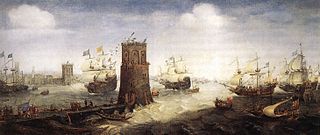
The Fifth Crusade (1217–1221) was a campaign in a series of Crusades by Western Europeans to reacquire Jerusalem and the rest of the Holy Land by first conquering Egypt, ruled by the powerful Ayyubid sultanate, led by al-Adil, brother of Saladin.

The Seventh Crusade (1248–1254) was the first of the two Crusades led by Louis IX of France. Also known as the Crusade of Louis IX to the Holy Land, it aimed to reclaim the Holy Land by attacking Egypt, the main seat of Muslim power in the Near East. The Crusade initially met with success but ended in defeat, with most of the army – including the king – captured by the Muslims.

Robert I, called the Good, was the first Count of Artois. He was the fifth son of King Louis VIII of France and Blanche of Castile.
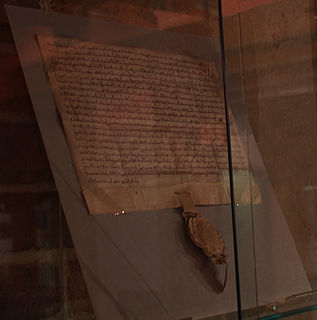
Sir William Longespée was an English knight and crusader, the son of William Longespée and Ela, Countess of Salisbury. His death became of significant importance to the English psyche, having died at the Battle of Mansurah, near Al-Mansurah in Egypt.

Guillaume de Sonnac was Grand Master of the Knights Templar from 1247 to 1250.

Shajar al-Durr, also Shajarat al-Durr, whose royal name was al-Malika ʿAṣmat ad-Dīn ʾUmm-Khalīl Shajar ad-Durr, was a ruler of Egypt. She was the wife of As-Salih Ayyub, and later of Izz al-Din Aybak, the first sultan of the Mamluk Bahri dynasty. Prior to becoming Ayyub's wife, she was a child slave and Ayyub's concubine.
The Battle of Fariskur was the last major battle of the Seventh Crusade. The battle was fought on 8 April 1250, between the Crusaders led by King Louis IX of France and Egyptian forces led by Turanshah of the Ayyubid dynasty.
The Crusades were a series of religious wars initiated, supported, and sometimes directed by the Latin Church in the medieval period. The best known of these Crusades are those to the Holy Land in the period between 1095 and 1291 that were intended to recover Jerusalem and its surrounding area from Islamic rule. Beginning with the First Crusade, which resulted in the recovery of Jerusalem in 1099, dozens of Crusades were fought, providing a focal point of European history for centuries.

The Battle of Mansurah was fought from 8 to 11 February 1250, between Crusaders led by Louis IX, King of France, and Ayyubid forces led by Sultana Shajar al-Durr, vizier Fakhr ad-Din ibn as-Shaikh, Faris ad-Din Aktai and Baibars al-Bunduqdari. It was fought in present-day Mansoura, Egypt.
Raoul II, Lord of Coucy was a son of Enguerrand III and his wife Maria of Oisy. In 1246 he succeeded his father as lord of Coucy. Raoul died at the Battle of Mansurah in Egypt during the Seventh Crusade.

John II, also known as Je(h)an de Nesle and by the sobriquet le Bon et le Bègue, was the tenth Count of Soissons, succeeding his father Ralph the Good, in 1235. He was the son of his father's second wife, Yolande. By marriage he also became Count of Chartres and Lord of Amboise. He was well-connected with the trouvères: his younger brother Raoul was one and he received the dedication of a song by Pierrekin de la Coupele. He was also a cousin by marriage of the historian Jean de Joinville. He is not to be confused with John II of Nesle, the burggrave of Bruges.
Battle of Dorylaeum can refer to:
Amicie de Courtenay (1253–1275) was a French noblewoman and a member of the Capetian House of Courtenay, a cadet line of the House of Capet.

Peter of Courtenay (French: Pierre de Courtenay was a French knight and a member of the Capetian House of Courtenay, a cadet line of the royal House of Capet. From 1239 until his death, he was the ruling Lord of Conches and Mehun-sur-Yèvre.

Matthew II or Mathieu II, called the Great or the Great Constable, was lord of Montmorency from 1189 and Constable of France from 1218 to 1230.
Fakhr al-Din ibn al-Shaykh was an Egyptian emir of the Ayyubid dynasty. He served as a diplomat for sultan al-Kamil from 1226 to 1228 in his negotiations with the Holy Roman Emperor Frederick II leading to the end of the Sixth Crusade. He later commanded forces during the Seventh Crusade, dying at the Battle of al-Mansura in 1250.
The battle of Mansurah took place from 26–28 August 1221 near the Egyptian city of Mansurah and was the final battle in the Fifth Crusade (1217–1221). It pitted the Crusader forces under papal legate Pelagius Galvani and John of Brienne, king of Jerusalem, against the Ayyubid forces of the sultan al-Kamil. The result was a decisive victory for the Egyptians and forced the surrender of the Crusaders and their departure from Egypt.
Jean de Ronay was knight of the Order of Saint John of Jerusalem who was appointed Grand Commander of the Knights Hospitaller by the Grand Master Guillaume de Chateauneuf in 1243 or 1244. He served as interim Grand Master of the Knights Hospitaller from 1244 to 1250 during the captivity of de Chateauneuf. He died in battle during the Seventh Crusade.
Battle of Fariskur may refer to:
