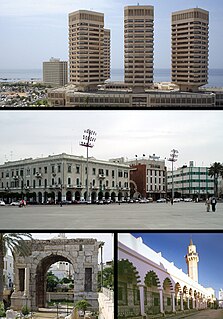
Tripoli (; Arabic: طرابلس, Ṭarābulus. Tripoli is the capital city and the largest city of Libya, with a population of about 1.158 million people in 2018. It is located in the northwest of Libya on the edge of the desert, on a point of rocky land projecting into the Mediterranean Sea and forming a bay. It includes the port of Tripoli and the country's largest commercial and manufacturing centre. It is also the site of the University of Tripoli. The vast Bab al-Azizia barracks, which includes the former family estate of Muammar Gaddafi, is also located in the city. Colonel Gaddafi largely ruled the country from his residence in this barracks.

Richard Somers was an officer of the United States Navy, killed during a daring assault on Tripoli.

The First Barbary War (1801–1805), also known as the Tripolitanian War and the Barbary Coast War, was the first of two Barbary Wars, in which the United States and Sweden fought against the four North African states known collectively as the "Barbary States". Three of these were nominal provinces of the Ottoman Empire, but in practice autonomous: Tripoli, Algiers, and Tunis. The fourth was the independent Sultanate of Morocco.

USS Tripoli (CVE-64) was a Casablanca-class escort carrier of the United States Navy. Tripoli is the first US Navy ship named for the Battle of Derne in 1805. It was the decisive victory of a mercenary army led by a detachment of United States Marines and soldiers against the forces of Tripoli during the First Barbary War. It was the first recorded land battle of the United States fought overseas.
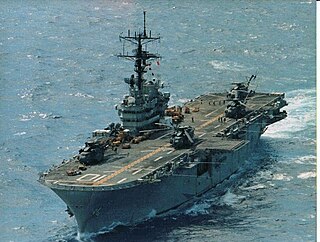
USS Tripoli (LPH-10), an Iwo Jima-class amphibious assault ship, was laid down on 15 June 1964 at Pascagoula, Mississippi, by the Ingalls Shipbuilding Corporation; launched on 31 July 1965; sponsored by Mrs. Jane Cates, the wife of General Clifton B. Cates, former Commandant of the Marine Corps; and commissioned on 6 August 1966 at the Philadelphia Naval Shipyard, Capt. Henry Suerstedt, Jr., in command. Tripoli was the second U.S. Navy ship named for the Battle of Derna in 1805. It was the decisive victory of a mercenary army led by a detachment of United States Marines and soldiers against the forces of Tripoli during the First Barbary War. It was the first recorded land battle of the United States fought overseas.
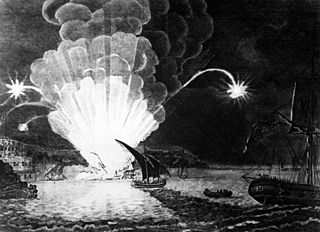
The first USS Intrepid was a captured ketch in the United States Navy during the First Barbary War.

The Battle of Derna at Derna, Cyrenaica, was the decisive victory in April–May 1805 of a mercenary army recruited and led by United States Marines under the command of U.S. Army Lieutenant William Eaton, diplomatic Consul to Tripoli, and U.S. Marine Corps First Lieutenant Presley Neville O'Bannon. The battle involved a forced 521-mile (839-km) march through the North African desert from Alexandria, Egypt, to the eastern port city of Derna, Libya, which was defended by a much larger force.
The Mediterranean Squadron, also known as the Mediterranean Station, was part of the United States Navy in the 19th century that operated in the Mediterranean Sea. It was formed in response to the First Barbary War and Second Barbary Wars. Between 1801 and 1818, the squadron was composed of a series of rotating squadrons. Later, squadrons were sent in the 1820s to the 1860s to suppress piracy, primarily in Greece and to engage in gunboat diplomacy. In 1865 the force was renamed the European Squadron.
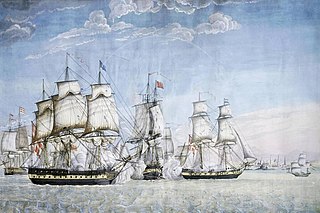
The action of 16 May 1797 was a naval battle that took place near Tripoli in Ottoman Tripolitania. The Danish squadron was victorious over a Tripolitan squadron that outnumbered them in terms of the number of vessels. The result was a peace treaty between the Bey of Tripoli and Denmark.

Tripoli International Airport was an international airport built to serve Tripoli, the capital city of Libya. The airport is located in the area of Qasr bin Ghashir, 24 kilometres (15 mi) from central Tripoli. It used to be the hub for Libyan Airlines, Afriqiyah Airways, and Buraq Air.
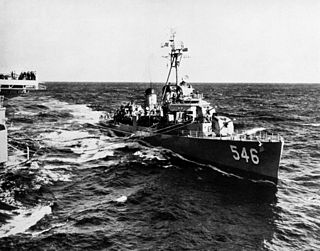
USS Brown (DD-546) was a Fletcher-class destroyer of the United States Navy, named for George Brown, a seaman on the crew of USS Intrepid during the raid that destroyed the captured USS Philadelphia in Tripoli harbor during the First Barbary War. Entering service in 1943 during World War II, the ship saw active service until 1962 when she was decommissioned and sold to Greece. Renamed Navarinon, the destroyer was active until 1981 when she was sold for scrap.

The Second Battle of Tripoli Harbor was a naval action during a naval blockade which took place in Tripoli Harbor in 1804. The battle is part of the First Barbary War between forces of the United States and the forces of the Eyalet of Tripolitania.
Yusuf Karamanli, Caramanli or Qaramanli or al-Qaramanli, was the best-known Pasha of the Karamanli dynasty (1711–1835) of Tripolitania.

To the Shores of Tripoli is a 1942 American Technicolor film directed by H. Bruce Humberstone and starring John Payne, Maureen O'Hara and Randolph Scott. The film was produced by Darryl F. Zanuck.

The First Battle of Tripoli Harbor was a naval battle fought on May 16, 1802 in Tripoli Harbor between a combined force consisting of the American frigate USS Boston and two Swedish Navy frigates against several Tripolitan Barbary corsairs. The Swedish-American force was enforcing the blockade when an engagement broke out between it and Tripolitan forces. The Allied fleet damaged the Tripolitan squadron as well as the harbor fortifications before withdrawing and resuming the blockade.
The Siege of Tripoli (1102–1109) took place in the aftermath of the First Crusade and led to the establishment of the fourth crusader state, the County of Tripoli, in Lebanon.

The Port of Tripoli is the principal sea port in Tripoli, the capital of Libya, and one of the oldest ports in the Mediterranean. The port serves general cargo, bulk cargo & passengers.

The Gulf of Bomba is a body of water in the Mediterranean Sea on the northern coast of Libya. It lies about 40 miles (64 km) east of Derna at 32 degrees 38 minutes North Latitude, 23 degrees 07 minutes East Longitude. It is named after the Libyan village of Bomba.
The Battle of Tripoli was a battle between the navies of the Kingdom of Sardinia and Vilayet of Tripoli on 26 September 1825 during the Sardinian-Tripolitanian war of the same year. In order to resist Tripolitanian demands for increased tribute, the Sardinian king sent a squadron to force Tripoli to a favorable peace treaty. The Tripolitanians refused to change their demands and as a result the Sardinian squadron assaulted the city of Tripoli, sinking several vessels and landing a force to attack the city. Suffering heavy naval losses the Tripolitanian government quickly agreed to a favorable peace treaty with Sardinia, thus ending the war on favorable terms for the Sardinians.
The following is a timeline of the history of the city of Tripoli, Libya.
