
Stanisław Poniatowski was a Polish military commander, diplomat, and noble. Throughout his career, Poniatowski served in various military offices, and was a general in both the Swedish and Polish–Lithuanian militaries. He also held numerous civil positions, including those of podstoli of Lithuania and Grand Treasurer of the Lithuanian army in 1722, voivode of the Masovian Voivodeship in 1731, regimentarz of the Crown Army in 1728, and castellan of Kraków in 1752. Throughout his lifetime, he served in many starost positions.

Prince Michał Serwacy Wiśniowiecki was a Lithuanian nobleman, magnate, politician, diplomat, general, a successful military commander and the last male representative of the Wiśniowiecki family.

Varėna District Municipality is a municipality in Alytus County in southern Lithuania.

Pirčiupiai is a village in Valkininkų (Valkininkai) eldership, Varėna district municipality, Alytus County, Dzūkija region, Lithuania. According to the 2001 census, the village had a population of 103 people. At the 2011 census, the population was 75.
Lithuanian Civil war refers to the conflict from 1697 to 1702 between the powerful Sapieha family, which dominated the internal affairs of the Grand Duchy of Lithuania, and an anti-Sapieha coalition, so-called Republicans or Confederates, composed of the opposing noble families that disliked Sapieha family's hegemony in the country. The szlachta was mostly on the side of the Republicans as they were angry at Sapieha's abuse and the taxes imposed on them to finance the Lithuanian army, which was mostly loyal to the Sapiehas.
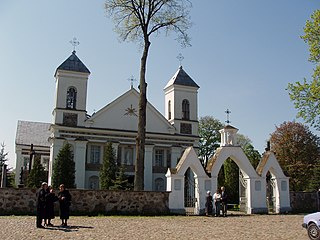
Valkininkai is a historic town in Valkininkų (Valkininkai) eldership, Varėna District Municipality, Alytus County, Lithuania, located about 22 km (14 mi) northeast from Varėna and about 55 km (34 mi) southwest from Vilnius. At the 2001 census its population was 238 and at the 2011 census it was 229.
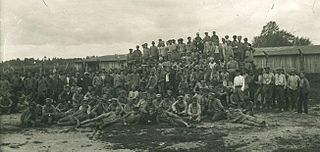
The Lithuanian–Soviet War or Lithuanian–Bolshevik War was fought between newly independent Lithuania and the Russian Soviet Federative Socialist Republic in the aftermath of World War I. It was part of the larger Soviet westward offensive of 1918–1919. The offensive followed retreating German troops seeking to establish Soviet republics in Ukraine, Belarus, Lithuania, Latvia, Estonia, Poland and link up with the German Revolution. By the end of December 1918 Soviet forces reached Lithuanian borders. Largely unopposed, they occupied one town after another and by the end of January 1919 controlled about 2⁄3 of the Lithuanian territory. In February, the Soviet advance was stopped by Lithuanian and German volunteers, who prevented the Soviets from capturing Kaunas, the temporary capital of Lithuania. From April 1919, the Lithuanian war went parallel with the Polish–Soviet War. Poland had territorial claims over Lithuania, especially the Vilnius Region, and these tensions spilt over into the Polish–Lithuanian War. Welsh-Polish historian Norman Davies summarized the situation: "the German army was supporting the Lithuanian nationalists, the Soviets were supporting the Lithuanian communists and the Polish Army was fighting them all." In mid-May, the Lithuanian army, now commanded by General Silvestras Žukauskas, began an offensive against the Soviets in northeastern Lithuania. By mid-June, the Lithuanians reached the Latvian border and cornered the Soviets among lakes and hills near Zarasai, where the Soviets held out until the end of August 1919. The Soviets and Lithuanians, separated by the Daugava River, maintained their fronts until the Battle of Daugavpils in January 1920. As early as September 1919, the Soviets offered to negotiate a peace treaty, but talks began only in May 1920. The Soviet–Lithuanian Peace Treaty was signed on July 12, 1920. Soviet Russia fully recognized independent Lithuania.

Dargužiai is a village in Valkininkų (Valkininkai) eldership, Varėna district municipality, Alytus County, southeastern Lithuania. According to the 2001 census, the village had a population of 307 people. At the 2011 census, the population was 252.
Daržininkai is a village in Valkininkų (Valkininkai) eldership, Varėna district municipality, Alytus County, southeastern Lithuania. According to the 2001 census, the village had a population of 78 people. At the 2011 census, the population was 40.
Degsnės is a village in Valkininkų (Valkininkai) eldership, Varėna district municipality, Alytus County, southeastern Lithuania. It is located 3 kilometres (2 mi) northwest of Valkininkai. According to the 2001 census, the village had a population of 68 people. At the 2011 census, the population was 66.
Kuršiai is a village in Valkininkų (Valkininkai) eldership, Varėna district municipality, Alytus County, southeastern Lithuania. According to the 2001 census, the village had a population of 93 people. At the 2011 census, the population was 54.
Paklėštarė is a village in Valkininkų (Valkininkai) eldership, Varėna district municipality, Alytus County, southeastern Lithuania. According to the 2001 census, the village had a population of 191 people. At the 2011 census, the population was 150.
Pūčkornės is a village in Valkininkų (Valkininkai) eldership, Varėna district municipality, Alytus County, southeastern Lithuania. According to the 2001 census, the village has a population of 128 people. At the 2011 census, the population was 20.
Užuperkasis is a village in Valkininkai eldership, Varėna District Municipality, Alytus County, southeastern Lithuania. According to the 2001 census, the village has a population of 359 people. At the 2011 census, the population was 343.
Čižiūnai is a village in Valkininkų (Valkininkai) eldership, Varėna district municipality, Alytus County, southeastern Lithuania. According to the 2001 census, the village had a population of 199 people. At the 2011 census, the population was 129.

Michał Franciszek Sapieha was a Polish-Lithuanian magnate of the Sapieha family, Koniuszy of Lithuania, and a general of Lithuanian and Russian armies.

Grzegorz Antoni Ogiński was a Polish-Lithuanian Hetman and governor-general of the Duchy of Samogitia from 1698. He was the fourth and youngest son of Jan Jacek Ogiński, also a hetman.
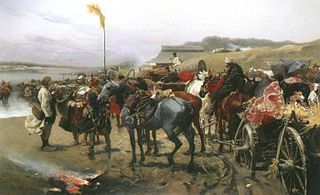
The Battle of Valkininkai took place on November 18, 1700, during the Lithuanian Civil War, between forces of the Sapieha family, led by Michał Franciszek Sapieha, and an anti-Sapieha coalition of Wiśniowiecki, Ogiński, Radziwiłł and Pac families and their supporters, led by Michał Serwacy Wiśniowiecki.
The Battle of Valkininkai took place at 6 March 1706 close to the town of Valkininkai in the Grand Duchy of Lithuania during the Great Northern War.
Žilinėliai is a village in Jakėnai Eldership, Varėna District Municipality, Alytus County, in southeastern Lithuania. As of the 2011 census, the population was 20.
