
The Gulf of Finland is the easternmost arm of the Baltic Sea. It extends between Finland to the north and Estonia to the south, to Saint Petersburg in Russia to the east, where the river Neva drains into it. Other major cities around the gulf include Helsinki and Tallinn. The eastern parts of the Gulf of Finland belong to Russia, and some of Russia's most important oil harbors are located farthest in, near Saint Petersburg. As the seaway to Saint Petersburg, the Gulf of Finland has been and continues to be of considerable strategic importance to Russia. Some of the environmental problems affecting the Baltic Sea are at their most pronounced in the shallow gulf. Proposals for a tunnel through the gulf have been made.

The Treaty of Nystad was the last peace treaty of the Great Northern War of 1700–1721. It was concluded between the Tsardom of Russia and the Swedish Empire on 10 September [O.S. 30 August] 1721 in the then Swedish town of Nystad. Sweden had settled with the other parties in Stockholm and in Frederiksborg (1720).
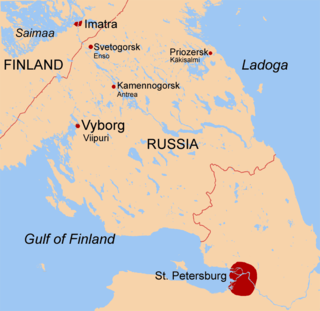
The Karelian Isthmus is the approximately 45–110-kilometre-wide (30–70 mi) stretch of land, situated between the Gulf of Finland and Lake Ladoga in northwestern Russia, to the north of the River Neva. Its northwestern boundary is a line from the Bay of Vyborg to the westernmost point of Lake Ladoga, Pekonlahti. If the Karelian Isthmus is defined as the entire territory of present-day Saint Petersburg and Leningrad Oblast to the north of the Neva and also a tiny part of the Republic of Karelia, the area of the isthmus is about 15,000 km2 (5,800 sq mi).
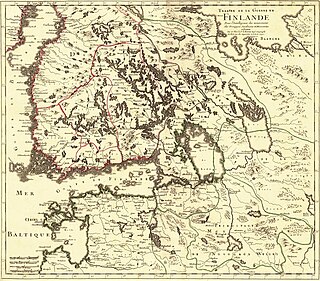
The Russo-Swedish War of 1741–1743 was instigated by the Hats, a Swedish political party that aspired to regain the territories lost to Russia during the Great Northern War, and by French diplomacy, which sought to divert Russia's attention from supporting its long-standing ally the Habsburg monarchy in the War of the Austrian Succession. The war was a disaster for Sweden, which lost more territory to Russia.
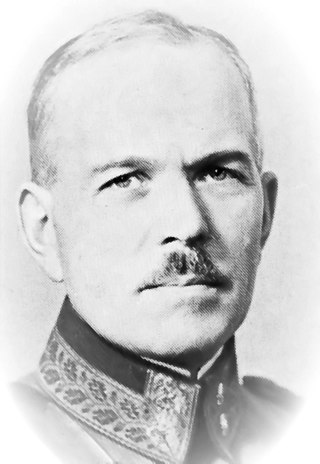
Karl Lennart Oesch was one of Finland's leading generals during World War II. He held a string of high staff assignments and front commands, and at the end of the Continuation War commanded three Finnish army corps on the Karelian Isthmus. He received numerous awards, including the Finnish Mannerheim Cross during his service. Following the end of the Continuation War, he was tried and convicted for war crimes relating to the treatment of Soviet prisoners-of-war.

The Russo-Swedish War of 1788–1790 was fought between Sweden and Russia from June 1788 to August 1790. The war was ended by the Treaty of Värälä on 14 August 1790 and took place concomitantly with both the Austro-Turkish War (1788–1791), Russo-Turkish War (1787–1792) and Theatre War. The war was, overall, mostly insignificant for the parties involved.

Vyborg Bay is a deep inlet running northeastward near the eastern end of Gulf of Finland in the Baltic Sea. The city of Vyborg is located near the head of the gulf.
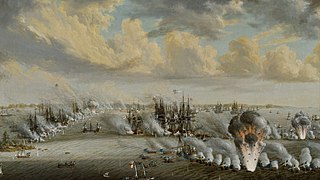
The Second Battle of Svensksund was a naval battle fought in the Gulf of Finland outside the present day city of Kotka on 9 and 10 July 1790. The Swedish naval forces dealt the Russian fleet a devastating defeat that brought an end to the Russo-Swedish War (1788–1790). The battle is the biggest Swedish naval victory and the largest naval battle ever in the Baltic Sea. It qualifies among the largest naval battles in history in terms of the number of vessels involved.

Vasily Yakovlevich Chichagov was an admiral in the Russian Navy who distinguished himself in the Russian–Swedish war, and an explorer.

Vyborg Castle is a fortress in Vyborg, Russia. It was built by the Swedes during the Middle Ages around which the town of Vyborg evolved. The castle became the stronghold of the Swedish realm in the Karelian region. Throughout the centuries, it was the first defence of the kingdom against the Russians. Its military and strategic status in the late Middle Ages was second only to the fortified capital Stockholm. Currently it serves as the site of Vyborg Regional Museum.

The Battle of Vyborg Bay was a naval battle fought between Russia and Sweden on July 3, 1790 in Vyborg Bay off the coast of Vyborg during the Russo-Swedish War (1788–1790). The Swedish Navy suffered heavy losses, losing six ships of the line and four frigates, but Gustav III of Sweden eventually ensured a Swedish naval escape through a Russian naval blockade composed of units of the Baltic Fleet, commanded by Admiral Vasily Chichagov. The battle ranks among the world's largest historical naval battles and also among the most influential, as it introduced the naval battle concept of "firepower over mobility".

The Battle of Vyborg Bay was fought in the Finnish-Soviet Continuation War (1941–1944).

Vyborg is a town and the administrative center of Vyborgsky District in Leningrad Oblast, Russia. It lies on the Karelian Isthmus near the head of Vyborg Bay, 130 km northwest of St. Petersburg, 245 km east of the Finnish capital Helsinki, and 38 km south of Russia's border with Finland, where the Saimaa Canal enters the Gulf of Finland. The most recent census population of Vyborg is as follows: 72,530 (2021 Census).

The Battle of Tali–Ihantala was part of the Finnish-Soviet Continuation War (1941–1944), which occurred during World War II. The battle was fought between Finnish forces—using war materiel provided by Germany—and Soviet forces. To date, it is the largest battle in the history of the Nordic countries.

The siege of Viborg took place in the spring of 1710 during the Great Northern War (1700–1721), as a second attempt by the Russians to capture the fortress port of Viborg, near the modern border between Russia and Finland, after a failed attempt in 1706. After the outbreak of the war, Swedish forces had fortified themselves in the port of Viborg. In order to assure safety for the newly founded city of Saint Petersburg, Peter the Great ordered the Swedish fort to be secured. A first unsuccessful attempt was made in 1706. Later plans were put on hold because of other ongoing conflicts but, after the Russian success at the Battle of Poltava in June 1709, the men and resources were available to capture the town.
In Swedish and Finnish history, Finland under Swedish rule is the historical period when the bulk of the area that later came to constitute Finland was an integral part of Sweden. The starting point of Swedish rule is uncertain and controversial. Historical evidence of the establishment of Swedish rule in Finland exists from the late 13th century onwards.
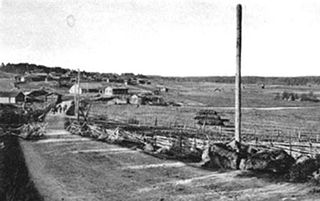
Battle of Antrea was a Finnish Civil War battle, fought in Antrea and Jääski, Finland in 11 February – 25 April 1918 between the Finnish Whites against the Finnish Reds.
Battle of Vyborg may refer to:
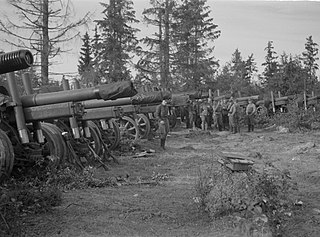
The Battle of Porlampi, also known as the Battle of Porlammi, was a military engagement fought between the Finnish Army and Red Army from 30 August to 1 September 1941 on the Karelian Isthmus. The battle was fought near the town of Porlampi during the second month of the Continuation War. The battle was a Finnish victory and effectively ended the reconquest of Karelia.
