
Year 1506 (MDVI) was a common year starting on Thursday of the Julian calendar.

The Timurid Empire was a late medieval, culturally Persianate Turco-Mongol empire that dominated Greater Iran in the early 15th century, comprising modern-day Iran, Iraq, Afghanistan, much of Central Asia, the South Caucasus, and parts of contemporary Pakistan, North India and Turkey. The empire was culturally hybrid, combining Turko-Mongolian and Persianate influences, with the last members of the dynasty being "regarded as ideal Perso-Islamic rulers".

Sultan Husayn Bayqara Mirza was the Timurid ruler of Herat from 1469 until May 4, 1506, with a brief interruption in 1470.

Muhammad ibn Khvandshah ibn Mahmud, more commonly known as Mirkhvand, was a Persian historian active during the reign of the Timurid ruler Sultan Husayn Bayqara. He is principally known for his universal history, the Rawżat aṣ-ṣafāʾ, which he wrote under the patronage of the high-ranking functionary Ali-Shir Nava'i. According to the German orientalist Bertold Spuler, the Rawżat aṣ-ṣafāʾ is the greatest universal history in Persian regarding the Islamic world.

Badr al-Din Hilali was a Persian poet of Turkic origin. In Herat, he was a member of the literary circle of Sultan Husayn-e Bayqara and a close associate Alisher Navai.

Iskandar Mirza was a member of the Timurid dynasty and the grandson of its founder, the Central Asian conqueror Timur. Iskandar was among the princes who attempted to claim the throne in the aftermath of Timur's death. He became a prominent ruler and was notable for his strong interest in culture and learning. He was defeated by his uncle Shah Rukh and later executed during a rebellion attempt.

The Mausoleum of Ali or Blue Mosque, located in Mazar-i-Sharif, Afghanistan, is a shrine purportedly housing the tomb of Caliph Ali, the first Imam of Shia Muslims.
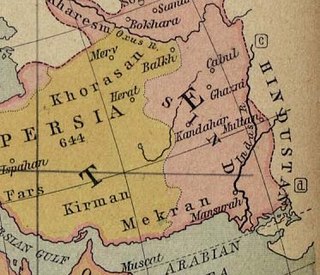
In 1504, Babur besieged Kabul and took the city from the Arghuns under Mukim Beg Arghun, to become the new king of Kabul and Ghazni regions. The territory gave him respite from his Uzbek troubles in Central Asia. It allowed him to build his nascent kingdom into a strong and formidable power in later years, enough to conquer northern India.

Abu Sa'id Mirza was the ruler of the Timurid Empire during the mid-fifteenth century.

Ahmed Khan bin Küchük was Khan of the Great Horde from 1465 to 1481.

The Musalla complex, also known as the Musallah Complex or the Musalla of Gawhar Shah, is a former Islamic religious complex located in Herat, Afghanistan, containing examples of Timurid architecture. Much of the 15th-century complex is in ruins today, and the buildings that still stand are in need of restoration. The complex ruins consist of the five Musallah Minarets of Herat, the Mir Ali Sher Navai mausoleum, the Gawhar Shad Mausoleum, and the ruins of a large mosque and a madrasa complex.

Sultan Ahmed Mirza was the eldest son of Abu Sa'id Mirza on whose death he became the Timurid ruler of Samarkand and Bukhara from 1469 until 1494. During his rule, he successfully repelled at least one invasion attempt by the Kara Koyunlu, and failed in an attempt to conquer Khurasan from its ruler Sultan Husayn Mirza Bayqara. He was embroiled in the Timurid Civil Wars with his brothers Umar Shaikh Mirza II and Sultan Mahmud Mirza. He died while returning from his Ferghana expedition against Babur, the twelve-year-old son and successor of Umar Shaikh Mirza II. As he had no male heir, he was succeeded by his brother, Sultan Mahmud Mirza.
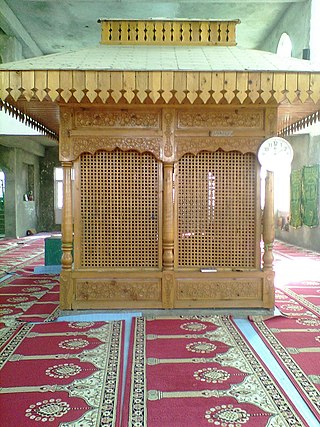
Mir Syed Shams-ud-Din Muhammad Arāqi, was an Iranian Sufi saint. Araqi was part of the order of Twelver Shia Sufis in Jammu and Kashmir who greatly influenced the social fabric of the Kashmir Valley and its surrounding regions.
Bayqara Kuh is a village in Qaranqu Rural District, in the Central District of Hashtrud County, East Azerbaijan Province, Iran. At the 2006 census, its population was 177, in 40 families.
Bayqara Rud is a village in Soluk Rural District, in the Central District of Hashtrud County, East Azerbaijan Province, Iran. At the 2006 census, its population was 505, in 106 families.

Sultan Mahmud Mirza was a Timurid prince from the branch of Transoxiana. He was the son of Abu Sa'id Mirza, the ruler of the Timurid Empire.

Mir Ali Heravi, also known as Mir Ali Hossein Heravi and Mir Jan, titled as Kateb-e Soltani, was a prominent Persian calligrapher and calligraphy teacher of Nastaʿlīq script in the 16th century. He was the second significant Persian calligrapher after Mir Emad. He had artistic influence on the later calligraphers.
Bayqara Mirza I was a Timurid prince and a grandson of the Central Asian conqueror Timur by his eldest son Umar Shaikh Mirza I.

Majd al-Din Muhammad Khvafi was a Persian bureaucrat, who was one of the leading figures of the Timurid Empire in the late 15th-century. Belonging to a family of bureaucrats from Khvaf, Majd al-Din dominated the government of Sultan Husayn Bayqara in 1472–1478 and 1487–1490. He was ultimately dismissed in 1490, and later murdered by the hands of his rivals en route to Mecca.
Sultan Masud Mirza was a Prince from the Timurid dynasty and a grandson of Abu Sa'id Mirza.
