
Miso is a traditional Japanese seasoning. It is a thick paste produced by fermenting soybeans with salt and kōji and sometimes rice, barley, seaweed, or other ingredients. It is used for sauces and spreads, pickling vegetables, fish, or meats, and mixing with dashi soup stock to serve as miso soup, a Japanese culinary staple. Miso is high in protein and rich in vitamins and minerals, and it played an important nutritional role in feudal Japan. Miso is still widely used in both traditional and modern cooking in Japan and has been gaining worldwide interest.
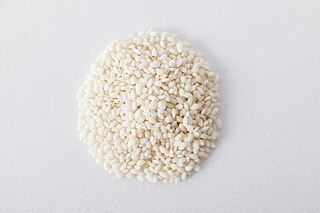
Glutinous rice is a type of rice grown mainly in Southeast and East Asia, and the northeastern regions of South Asia, which has opaque grains, very low amylose content, and is especially sticky when cooked. It is widely consumed across Asia.

Prahok is a salted and fermented fish paste used in Cambodian cuisine as a seasoning or a condiment. It originated as a way of preserving fish during the months when fresh fish was not available in abundant supply. Because of its saltiness and strong flavor, it was used as an addition to many meals in Cambodian cuisine, such as soups and sauces. A Cambodian saying goes, "No prahok, no salt", referring to a dish that is of poor flavor or bland thus highlighting its essentiality in Cambodian cuisine.

Gochujang or red chili paste is a savory, sweet, and spicy fermented condiment popular in Korean cooking. It is made from gochu-garu, glutinous rice, meju powder, yeotgireum, and salt. The sweetness comes from the starch of cooked glutinous rice, cultured with saccharifying enzymes during the fermentation process. Traditionally, it would be naturally fermented over years in jangdok (earthenware) on an elevated stone platform called jangdokdae in the backyard.

Douchi or tochi is a type of fermented and salted black soybean most popular in the cuisine of China, where they are most widely used for making black bean sauce dishes.

Tempoyak, asam durian or pekasam is a Malay condiment made from fermented durian. It is usually consumed by the ethnic Malays in Maritime Southeast Asia, notably in Indonesia and Malaysia. Tempoyak is made by taking the flesh of durian and mixing it with some salt and kept in room temperature for three or five days for fermentation. Tempoyaks are usually made during the durian season, when the abundance of durian and excess production are made into fermented tempoyak.
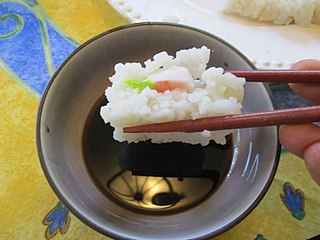
A dip or dip sauce is a common condiment for many types of food. Dips are used to add flavor or texture to a food, such as pita bread, dumplings, crackers, chopped raw vegetables, fruits, seafood, cubed pieces of meat and cheese, potato chips, tortilla chips, falafel, and sometimes even whole sandwiches in the case of jus. Unlike other sauces, instead of applying the sauce to the food, the food is typically placed or dipped into the sauce.

Fermented tofu is a Chinese condiment consisting of a form of processed, preserved tofu used in East Asian cuisine. The ingredients typically are soybeans, salt, rice wine and sesame oil or vinegar. In mainland China the product is often freshly distributed. In overseas Chinese communities living in Southeast Asia, commercially packaged versions are often sold in jars containing blocks 2- to 4-cm square by 1 to 2 cm thick soaked in brine with select flavorings.

Shrimp paste or prawn sauce is a fermented condiment commonly used in Southeast Asian and Southern Chinese cuisines. It is primarily made from finely crushed shrimp or krill mixed with salt, and then fermented for several weeks. They are either sold in their wet form or are sun-dried and either cut into rectangular blocks or sold in bulk. It is an essential ingredient in many curries, sauces and sambal. Shrimp paste can be found in many meals in Cambodia, Indonesia, Laos, Malaysia, Myanmar, the Philippines, Singapore, Thailand, and Vietnam. It is often an ingredient in dip for fish or vegetables.
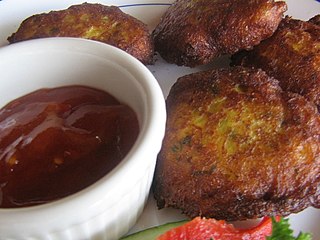
Chili sauce and chili paste are condiments prepared with chili peppers.
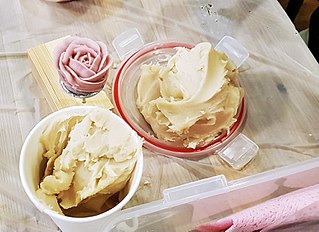
Sweet bean paste is a food ingredient used throughout East Asian cuisine, primarily as a filling for sweet desserts and pastries.

Fermented bean paste is a category of fermented foods typically made from ground soybeans, which are indigenous to the cuisines of East, South and Southeast Asia. In some cases, such as the production of miso, other varieties of beans, such as broad beans, may also be used.

Mont di is a collective term for Burmese dishes made with thin rice noodles. The vermicelli is used fresh, as it ferments quickly in Myanmar's tropical climate. There are a number of mont di dishes, and the Rakhine mont di of the Arakanese from western Myanmar is the most popular. Mandalay mont di is another well-known dish. A handful of regional rice vermicelli dishes, such as Mawlamyaing mohinga and Kengtung khao sen, are also interchangeably called "mont di."

A food paste is a semi-liquid colloidal suspension, emulsion, or aggregation used in food preparation or eaten directly as a spread. Pastes are often highly spicy or aromatic, are often prepared well in advance of actual usage, and are often made into a preserve for future use. Common pastes are some fruit preserves, curry pastes, and nut pastes. Purées are food pastes made from already cooked ingredients.
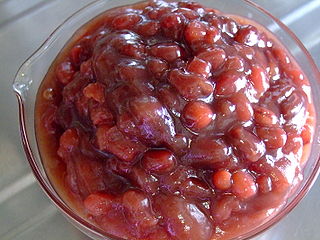
Red bean paste or red bean jam, also called adzuki bean paste or anko, is a paste made of red beans, used in East Asian cuisine. The paste is prepared by boiling the beans, then mashing or grinding them. At this stage, the paste can be sweetened or left as it is. The color of the paste is usually dark red, which comes from the husk of the beans. In Korean cuisine, the adzuki beans can also be husked prior to cooking, resulting in a white paste. It is also possible to remove the husk by sieving after cooking, but before sweetening, resulting in a red paste that is smoother and more homogeneous.
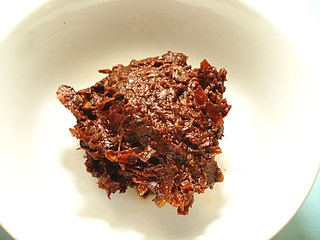
Doubanjiang, also known as douban, toban-djan, broad bean chili sauce, or fermented chili bean paste, is a hot and savoury Chinese bean paste made from fermented broad beans, chili peppers, soybeans, salt and flour. Characteristically used in Sichuan cuisine, it has been called "the soul of Sichuan cuisine." Sichuan dishes such as mapo tofu, huoguo, the Yuxiang flavour profile, and Shuizhu all use doubanjiang as a key ingredient. Other regions have their own versions: in Guangdong and Taiwan, for instance, the Sichuan doubanjiang is called la-doubanjiang to distinguish it from local non-spicy versions.
