
Pyotr Mironovich Masherov was a Soviet partisan, statesman, and one of the leaders of the Belarusian resistance during World War II who governed the Byelorussian Soviet Socialist Republic as First Secretary of the Communist Party of Byelorussia from 1965 until his death in 1980. Under Masherov's rule, Belarus was transformed from an agrarian, undeveloped nation which had not yet recovered from the Second World War into an industrial powerhouse; Minsk, the capital and largest city of Belarus, became one of the fastest-growing cities on the planet. Masherov ruled until his sudden death in 1980, after his vehicle was hit by a potato truck.

Michal Apanasavič Vituška was a Belarusian leader of the Black Cats, a unit of the SS-Jagdverbände, during World War II.

The Belarusian resistance during World War II opposed Nazi Germany from 1941 until 1944. Belarus was one of the Soviet republics occupied during Operation Barbarossa. The term Belarusian partisans may refer to Soviet-formed irregular military groups fighting Germany, but has also been used to refer to the disparate independent groups who also fought as guerrillas at the time, including Jewish groups, Polish groups, and nationalist Belarusian forces opposed to Germany.
When the Second World War in Europe began, the territory which now forms the country of Belarus was divided between the Soviet Union and the Second Polish Republic. The borders of Soviet Belarus were greatly expanded in the Soviet invasion of Poland of 1939. In 1941, the country was occupied by Nazi Germany. Following the German military disasters at Stalingrad and Kursk, the collaborationist Belarusian Central Council (BCC) was formed by the Germans in order to raise local support for their anti-Soviet operations. The BCC in turn formed the twenty-thousand strong Belarusian Home Defence (BKA), active from 23 February 1944 to 28 April 1945. Assistance was offered by the local Soviet administrative governments, and prewar public organizations including the former Soviet Belarusian Youth. The country was soon retaken by the Red Army in 1944. Devastated by the war, Belarus lost significant populations and economic resources. Many battles occurred in Belarusian and neighbouring territory. Belarusians also participated in regional conflicts.
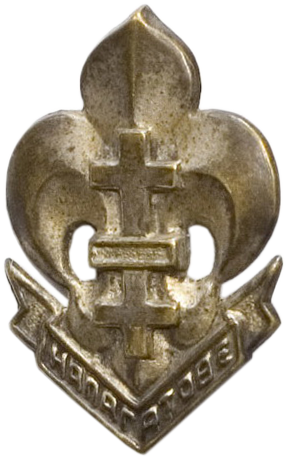
The Scout movement in Belarus consisted of 1200 members when it joined the World Organization of the Scout Movement (WOSM) in 2010. There are at least five nationwide associations as well as some regional associations. In addition, there were at one time Scouts-in-Exile in metropolitan areas of the United States, and there are presently international Scout units in Belarus.

Luninyets District or Luniniec District is a district (raion) of Brest Region in Belarus. Its administrative center is Luninyets.
Belarusian resistance movement are the resistance movements on the territory of contemporary Belarus. Wars in the area - Great Northern War and the War of the Polish Succession - damaged its economy further. In addition, Russian armies raided the Polish–Lithuanian Commonwealth under the pretext of the returning of fugitive peasants. By mid-18th century their presence in the lands of modern Belarus became almost permanent.

Vileyka District or Viliejka District is a district (raion) of Minsk Region in Belarus. The administrative center of the district is the town of Vileyka.
Filipowicz is a Polish surname derived from the given name Filip. Notable people with the surname include:
Anti-communist insurgencies continued in Central and Eastern Europe after the end of World War II. They were suppressed by the Soviet Union and its satellite states. Prominent movements include:
Braslaw District or Braslaŭ District is a district (raion) of Vitebsk Region in Belarus. Its administrative centre is Braslaw.

Syanno District is a district (raion) of Vitebsk Region in Belarus. Its administrative center is Syanno.
Halina is a given name. Notable people with the name include:

Belarusian nationalism refers to the belief that Belarusians should constitute an independent nation. Belarusian nationalism began emerging in the mid-19th century, during the January Uprising against the Russian Empire. Belarus first declared independence in 1917 as the Belarusian Democratic Republic, but was subsequently invaded and annexed by the Russian Soviet Federative Socialist Republic in 1918, becoming part of the Soviet Union. Belarusian nationalists both collaborated with and fought against Nazi Germany during World War II, and protested for the independence of Belarus during the late 1980s and early 1990s.
Anarchism in Belarus refers to anarchist movements in the Republic of Belarus and its historically associated territories within the Russian Empire. Anarchists in Belarus began in the 18th century when multiple anarchist organizations organizing separately against the Tsarist Russia. During the Russian Civil War anarchists organized into multiple anarchist federations and fought against the Red Army and seized control over sections of Belarus. Anarchists and other leftists across the former Russian Empire began an uprising against the Bolshevik government called by anarchists as the "Third Russian Revolution" most prominently in the uprising Russian and Belarusians staged a revolt during the Kronstadt rebellion. Belarusian and Russian anarchists would seize control over the Soviet Navy and nearly overthrow the Bolshevik government. However, Bolshevik repression and inability for the movement to organize effectively would lead to the uprisings' failing.

Pro-democratic and pro-Ukrainian partisan movements have emerged in Belarus and Russia following the Russian invasion of Ukraine, a major escalation of the Russo-Ukrainian War. These resistance movements act against the authoritarian governments of Alexander Lukashenko in Belarus and Vladimir Putin in Russia, as well as against civilian supporters of these authorities and the armed forces of both countries, with the aim of stopping the war.
Popular Resistance of Ukraine is a Ukrainian underground partisan organization operating in the territories of Ukraine occupied by Russian troops during the 2022 invasion of the country. The partisans operate in the rear and transmit the coordinates of important military facilities and the deployment of Russian troops to the Armed Forces of Ukraine.
This page is based on this
Wikipedia article Text is available under the
CC BY-SA 4.0 license; additional terms may apply.
Images, videos and audio are available under their respective licenses.
