
HMS Cromer was a Sandown-class minehunter commissioned by the Royal Navy in 1992. She was named after the North Norfolk seaside town of the same name.

A minehunter is a naval vessel that seeks, detects, and destroys individual naval mines. Minesweepers, on the other hand, clear mined areas as a whole, without prior detection of mines. A vessel that combines both of these roles is known as a mine countermeasures vessel (MCMV).

Chasmosaurus is a genus of ceratopsid dinosaur from the Upper Cretaceous Period of North America. Its name means 'opening lizard', referring to the large openings (fenestrae) in its frill. With a length of 4.3–4.8 metres (14.1–15.7 ft) and a weight of 1.5–2 tonnes, Chasmosaurus was a ceratopsian of average size. Like all ceratopsians, it was purely herbivorous. It was initially to be called Protorosaurus, but this name had been previously published for another animal. All specimens of Chasmosaurus were collected from the Dinosaur Park Formation of the Dinosaur Provincial Park of Alberta, Canada. C. russelli comes from the lower beds of the formation while C. belli comes from middle and upper beds.
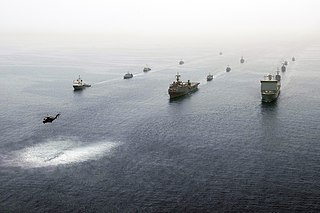
Standing NATO Mine Countermeasures Group 1 (SNMCMG1) is a North Atlantic Treaty Organisation (NATO) standing mine countermeasures immediate reaction force.

The Belgian Navy, officially the Belgian Maritime Component of the Belgian Armed Forces, formerly the Belgian Naval Force, is the naval service of Belgium.

The Ukrainian Cultural Heritage Village is an open-air museum that uses costumed historical interpreters to recreate pioneer settlements in east central Alberta, Canada, northeast and east of Edmonton. In particular it shows the lives of Ukrainian Canadian settlers from the years 1899 to 1930. Buildings from surrounding communities have been moved to the historic site and restored to various years within the first part of the twentieth century.
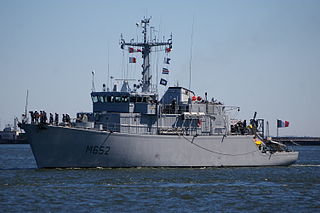
The Tripartite class is a class of mine warfare vessel used by the navies of Belgium, France and the Netherlands, as well as Pakistan, Indonesia, Latvia, and Bulgaria.

HMS Pembroke is a Sandown-class minehunter of the Royal Navy. She was the second ship launched of the second batch of the class, which had several improvements over the first five ships built. The ship was posted for three years to the Persian Gulf between 2009 and 2012. Pembroke has since been deployed in international exercises and in historic ordnance detection in home waters.

Aster (M915) is a Tripartite-class minehunter of the Belgian Naval Component, launched on 16 December 1985 at the Mercantile-Belyard shipyard in Rupelmonde and christened by Queen Paola of Belgium. The patronage of Aster was accepted by the city of Blankenberge. Aster was the first of the Belgian Tripartite-class minehunters.

Crocus (M917) is a Tripartite-class minehunter of the Belgian Naval Component, launched on 3 September 1986 at the Mercantile-Belyard shipyard in Rupelmonde and completed on 5 February 1987. The patronage of Crocus was accepted by the city of Genk. It was the third of the Belgian Tripartite-class minehunters.
Lobelia (M921) is a Tripartite-class minehunter of the Belgian Naval Component, launched on 3 February 1988 at the Mercantile-Belyard shipyard in Rupelmonde and christened by Anne Van De Kerckhof, the wife of the then Mayor of Diest, on 25 February 1989. The patronage of Lobelia was accepted by the city of Diest. It was the seventh of the Belgian Tripartite-class minehunters. The Belgian Naval Component announced on its website on 5 November 2007 that Mrs. Van De Kerckhof, the godmother of Lobelia, had died on 27 October. A delegation of the crew of Lobelia attended her funeral.

Narcis (M923) is a Tripartite-class minehunter of the Belgian Naval Component, launched in 1990, at the Mercantile-Belyard shipyard in Rupelmonde and christened by Mrs. Lafosse-De Backer, the wife of the then Mayor of Mons, on 14 March 1991. The patronage of Narcis was accepted by the city of Mons. It was the ninth of the Belgian Tripartite-class minehunters. The Belgian government chose to deploy the ship as part of its involvement with enforcing the Libyan no-fly zone.
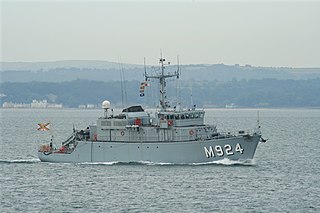
The Belgian minehunter Primula (M924) is a Tripartite-class minehunter of the Belgian Naval Component, launched on 20 December 1990 at the Mercantile-Belyard shipyard in Rupelmonde and christened by Mrs. Adriaensens, the wife of the then Mayor of Willebroek, on 12 June 1991. The patronage of Primula was accepted by the city of Willebroek. It was the tenth and last of the Belgian Tripartite-class minehunters.
EML Sulev (M312) is a Lindau-class minehunter of the Estonian Navy Mineships Division. The commanding officer of the vessel is Lieutenant Janek Naur.

EML Wambola (M311) is a Lindau-class minehunter of the Estonian Navy Mineships Division, formerly the German warship Cuxhaven. The commanding officer of the vessel is Captain Jaanus Antson.
The minehunter Wambola is the first vessel of the Estonian Navy Mineships Division and also the first modernized Lindau-class minehunter. A black keel on a silver background with a golden battle-axe is on the coat of arms of the vessel. The battle-axe is a weapon used by the ancient Estonians which also symbolizes their fighting spirit and strength. The ships motto is the Latin "Ad unquem" which is in English "Onto the nail head". The coat of arms was designed by Priit Herodes. In 2000 a cooperation contract was signed between the Pärnu city council and the minehunter Wambola which gave the vessel a right to wear the Pärnu town coat of arms and to introduce the city in all foreign harbors across the world.

Spedden is a hamlet in central Alberta, Canada within Smoky Lake County. It is located 0.3 kilometres (0.19 mi) north of Highway 36, approximately 106 kilometres (66 mi) southwest of Cold Lake. It was named after one of the original surveyors who died in the area in 1919. Previously it was Cache Lake.
PNS Munsif (M166) is the lead ship of the Munsif-class minehunter currently in service with the Pakistan Navy.

Imanta (M-04) is the lead ship of the Tripartite class of minehunters for the Latvian Naval Forces. The vessel was formerly HNLMS Harlingen (M854), an Tripartite-class minehunter of the Royal Netherlands Navy built in 1984. Alkmaar and Imanta are, respectively, the Dutch and Latvian navies' names of the Tripartite class of minehunters, developed jointly by France, Belgium, and the Netherlands.


