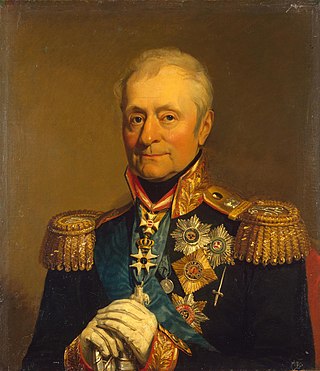
Levin August Gottlieb Theophil, Grafvon Bennigsen was a German general in the service of the Russian Empire. Bennigsen is immortalized in Russian history as the man who fought Napoleon Bonaparte with distinction at the Battle of Preussisch Eylau and played a pivotal role in decisively defeating Napoleon in the War of the Sixth Coalition.

The Biographical Dictionary of the Extreme Right Since 1890 is a reference book by Philip Rees, on leading people in the various far right movements since 1890. It contains entries for what the author regards as "the 500 major figures on the radical right, extreme right, and revolutionary right from 1890 to the present" . It was published, as a 418-page hardcover, in New York by Simon & Schuster in 1990 (ISBN 0-13-089301-3).

The Battle of Heilsberg took place on 10 June 1807, during the Napoleonic Wars.
Karl-August may refer to:

The Corps Hannovera Göttingen is one of the oldest German Student Corps, a Studentenverbindung or student corporation founded on January 18, 1809 at the Georg August University of Göttingen by students like Georg Kloss. The name was chosen because the founders had their home residences in the Kingdom of Hanover. As a corps it is a founder member (1848) of the Kösener Senioren-Convents-Verband (KSCV), the oldest governing body of such student associations in both Germany and Austria.

Karl Wilhelm Rudolf von Bennigsen was a German politician descended from an old Hanoverian family.

Count Nikita Petrovich Panin was an Imperial Russian diplomat, vice-chancellor, and (acting) State Chancellor and Foreign Minister of Russia. He was a nephew of Count Nikita Ivanovich Panin, son of Petr Ivanovich Panin, son-in-law of Count Vladimir Orlov. Nikita P. Panin plotted the assassination of Paul I of Russia together with Count Peter Ludwig von der Pahlen and the Russo-Neapolitan Admiral José de Ribas. Ribas died before the assassination, which was actually carried out on 23 March [O.S. 11 March] 1801 by a band of dismissed officers headed by General Bennigsen, a Hanoverian in the Russian service, and General Yashvil, a Georgian. The assassination brought Alexander I of Russia to the throne.

The Military Gallery is a gallery of the Winter Palace in Saint Petersburg, Russia. The gallery is a setting for 332 portraits of generals who took part in the Patriotic War of 1812. The portraits were painted by George Dawe and his Russian assistants Alexander Polyakov (1801–1835), a serf, and Wilhelm August Golicke.

Plötzensee Prison is a juvenile prison in the Charlottenburg-Nord locality of Berlin with a capacity for 577 prisoners, operated by the State of Berlin judicial administration. The detention centre established in 1868 has a long history; it became notorious during the Nazi era as one of the main sites of capital punishment, where about 3,000 inmates were executed. Famous inmates include East Germany's last communist leader Egon Krenz.

Rudolph or Rudolf or Rodolphe is a male first name, and, less commonly, a surname. It is an ancient Germanic name deriving from two stems: Hrōþi, Hruod, Hróðr or Hrōð, meaning "fame", "glory" "honour", "renown", and olf meaning "wolf"(Hrōþiwulfaz).
The Stade Region emerged in 1823 by an administrative reorganisation of the dominions of the Kingdom of Hanover, a sovereign state, whose then territory is almost completely part of today's German federal state of Lower Saxony. Until 1837 the Kingdom of Hanover was ruled in personal union by the Kings of the United Kingdom of Great Britain and Ireland.
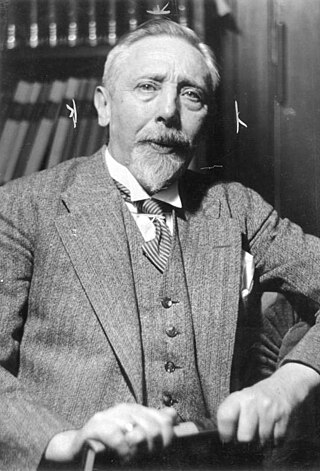
Hermann Gerhardt Karl Oncken was a German historian and political writer. He was one of the most notable historians of pre-Nazi Germany.
Events in the year 1944 in Germany.
Fuchs is a surname; it has as variants Fux, Fuhs and Fuchß. Notable persons bearing it include the following:

The House of Alvensleben is an ancient, Low German (niederdeutsch) noble family from the Altmark region, whose earliest known member, Wichard de Alvensleve, is first mentioned in 1163 as a ministerialis of the Bishopric of Halberstadt. The family name derives from Alvensleben Castle. They are one of the oldest extant German aristocratic families.

The Reichstag of the North German Confederation was the federal state's lower house of parliament. The popularly elected Reichstag was responsible for federal legislation together with the Bundesrat, the upper house whose members were appointed by the governments of the individual states to represent their interests. Executive power lay with the Bundesrat and the king of Prussia acting as Bundespräsidium, or head of state. The Reichstag debated and approved or rejected taxes and expenditures and could propose laws in its own right. To become effective, all laws required the approval of both the Bundesrat and the Reichstag. Voting rights in Reichstag elections were advanced for the time, granting universal, equal, and secret suffrage to men above the age of 25.
Heinz is a German given name, a diminutive of Heinrich and cognate of the given name Henry. People with this given name include:
Levin is a masculine given name. It is a modern German version of the Old English name Leofwine or the Old German Leobwin or Liebwin, meaning "dear friend." Dutch variants include Lieven and Lievin. A rare modern English variant is Lewin. It can also be a variant of Levi and is a surname with different origins.
Bennigsen is a village near Springe in the district of Hanover in Lower Saxony, Germany. Since 1974 it has been administered by the municipality of Springe.
Knut Gerschau is a German politician for the FDP and since 2021 member of the Bundestag, the federal diet. He is a past chairman of the board of the German Foundation for World Population (DSW) and state chairman of the Liberaler Mittelstand Lower Saxony.
