Blue Mosque may refer to:
Saray or Seray is a word of Persian origin which means "palace". It may refer to:

Begum is a royal and aristocratic title from Central and South Asia. It is the feminine equivalent of the title baig or bey, which in Turkic languages means "higher official". It usually refers to the wife or daughter of a beg. The related form begzada also occurs.
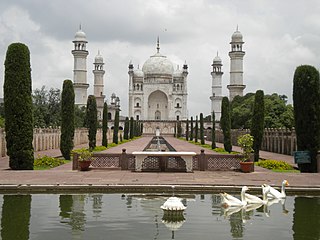
The Bibi Ka Maqbara is a tomb located in Aurangabad, Maharashtra, India. It was commissioned in 1660 by the Mughal emperor Aurangzeb in the memory of his wife Dilras Banu Begum and is considered to be a symbol of Aurangzeb's 'conjugal fidelity'. It bears a striking resemblance to the Taj Mahal, the mausoleum of Aurangzeb's mother, Mumtaz Mahal. Aurangzeb was not much interested in architecture though he had commissioned the small, but elegant, Pearl Mosque at Delhi. Bibi Ka Maqbara is the second largest structure that Aurangzeb has built, the largest being the Badshahi Mosque.

The Bibi-Khanym Mosque is one of the most important monuments of Samarkand, Uzbekistan. In the 15th century, it was one of the largest and most magnificent mosques in the Islamic world. It is considered a masterpiece of the Timurid Renaissance. By the mid-20th century, only a grandiose ruin of it still survived, but major parts of the mosque were restored during the Soviet period.

Po-i-Kalan, or Poi Kalan, is an Islamic religious complex located in Bukhara, Uzbekistan. The complex consists of three parts, the Kalan Mosque, the Kalan Minaret to which the name refers to, and the Mir-i-Arab Madrasah. The positioning of the three structures creates a square courtyard in its center, with the Mir-i-Arab and the Kalan Mosque standing on opposite ends. In addition, the square is enclosed by a bazaar and a set of baths connected to the Minaret on the northern and southern ends respectively.
Bibi Khānoom Astarābādi was a notable Iranian writer, satirist, and one of the pioneering figures in the women's movement of Iran.

Bibiheybət is a municipality in Baku, Azerbaijan. It has a population of 1,451.

Sayyid Ahmad Ali Khan, popularly known as Walla Jah or Ahmad Ali Khan of Murshidabad, was the Nawab of Bengal, Bihar and Orissa. He succeeded his half-brother, Zain-ud-Din Ali Khan, after he died on 6 August 1821, without a male issue. Walla Jah was the Nawab of Bengal from 1821 to 1824.

Mīr Sayyid Jalāl ad-Dīn an-Naqwī al-Bukhārī, better known as Jahāniyān Jahāngasht, was a Sufi saint from South Asia.

The Bibi-Heybat Mosque is a historical mosque in Baku, Azerbaijan. The existing structure, built in the 1990s, is a recreation of the mosque with the same name built in the 13th century by Shirvanshah Farrukhzad II Ibn Ahsitan II, which was completely destroyed by the Bolsheviks in 1936.
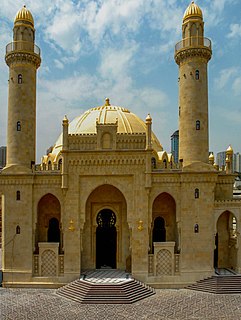
Taza Pir Mosque is a mosque in Baku, Azerbaijan. Its construction began in 1905 and was finished by 1914. The idea for the mosque as well as its financing was provided by an Azeri philanthropist, a female, Nabat Khanum Ashurbeyov (Ashurbeyli)

Lal Darwaza Mosque of Jaunpur, was built in 1447 by Queen Rajye Bibi and dedicated to Sayyid Ali Dawood Kutubbudin a saint.
Sayyid Ahmad Musavi Hindi was a Twelver Shia cleric. He was the paternal grandfather of the supreme leader of the Islamic republic of Iran, Ruhollah Khomeini.

Saray Mulk Khanum was the Empress consort of the Timurid Empire as the chief consort of Timur, also known as Tamerlane the Great, the founder of the Timurid Empire as well as the Timurid dynasty.
Shahar Banu Begum was Empress consort of the Mughal Empire from 14 March 1707 to 8 June 1707 as the third wife of Emperor Muhammad Azam Shah. She is popularly known by the titles Padishah Bibi and Padshah Begum.

Achut Bibi's Mosque and Tomb, also known as Shahi Masjid locally, is a medieval mosque and tomb complex on the bank of Sabarmati river in Dudheshwar, Ahmedabad, India.

Asrafia Jame Masjid, previously known as the Mosque of Ahladi Bibi, is a mosque located in the urban neighbourhood of Amlapara, in the city of Narayanganj, Bangladesh. It was built during the British Raj colonial period, dating back to the 1890s.
Tajlu Khanum or Tajli Begum, also known by her title of Shah-Begi Khanum, was a Turkoman princess from the Mawsillu tribe and principal consort of Ismail I.
