
Zadar County is a county in Croatia, it encompasses northern Dalmatia and southeastern Lika. Its center is the city of Zadar.

The Kingdom of Croatia entered a personal union with the Kingdom of Hungary in 1102, after a period of rule of kings from the Trpimirović and Svetoslavić dynasties and a succession crisis following the death of king Demetrius Zvonimir. With the coronation of King Coloman of Hungary as "King of Croatia and Dalmatia" in 1102 in Biograd, the realm passed to the Árpád dynasty until 1301, when the (male) line of the dynasty died out. Then, kings from the Capetian House of Anjou, who were also cognatic descendants of the Árpád kings, ruled the kingdoms. Later centuries were characterized by conflicts with the Mongols, who sacked Zagreb in 1242, competition with Venice for control over Dalmatian coastal cities, and internal warfare among Croatian nobility. Various individuals emerged during the period, such as Paul I Šubić of Bribir, who was representing the most powerful Croatian dynasty at the time, the Šubić noble family. These powerful individuals were on occasion able to de facto secure great deal of independence for their fiefdoms. The Ottoman incursion into Europe in the 16th century significantly reduced Croatian territories and left the country weak and divided. After the death of Louis II in 1526 during the Battle of Mohács and a brief period of dynastic dispute, both crowns passed to the Austrian House of Habsburg, and the realms became part of the Habsburg monarchy.
Sukošan is a village and a municipality in Zadar County, Croatia. It is located along the Adriatic tourism road between Zadar and Biograd na Moru.
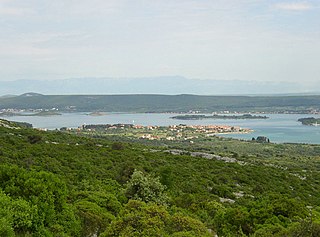
Pašman is an Adriatic island off the coast of northern Dalmatia in Croatia with an area of 60.11 km2, located to the south of Zadar, surrounded by the islands of Ugljan to the northwest, Iž to the west, and Dugi Otok and Žut to the southwest. The island is inhabited by 2,845 people, according to the 2011 census.

Biograd na Moru, shortened to simply Biograd, is a town in northern Dalmatia, Croatia and is significant for being another capital of the medieval Kingdom of Croatia. Biograd is administratively part of the Zadar County. It is located on the Adriatic Sea coast, overlooking the island of Pašman, on the road from Zadar and Sukošan towards Vodice and Šibenik.

Peter Krešimir IV, called the Great was King of Croatia and Dalmatia from 1059 until his death in 1074 or 1075. He was the last great ruler of the Krešimirović branch of the Trpimirović dynasty.

The Kingdom of Croatia, or Croatian Kingdom, was a medieval kingdom in Southern Europe comprising most of what is today Croatia, as well as most of the modern-day Bosnia and Herzegovina. The Croatian Kingdom was ruled for part of its existence by ethnic dynasties, and the Kingdom existed as a sovereign state for nearly two centuries. Its existence was characterized by various conflicts and periods of peace or alliance with the Bulgarians, Byzantines, Hungarians, and competition with Venice for control over the eastern Adriatic coast. The goal of promoting the Croatian language in the religious service was initially introduced by the 10th century bishop Gregory of Nin, which resulted in a conflict with the Pope, later to be put down by him. In the second half of the 11th century Croatia managed to secure most coastal cities of Dalmatia with the collapse of Byzantine control over them. During this time the kingdom reached its peak under the rule of kings Peter Krešimir IV (1058–1074) and Demetrius Zvonimir (1075–1089).
Svetoslav Suronja, was King of Croatia from 997 to 1000. A member of the Trpimirović dynasty, he reigned with the help of his ban, Varda. John the Deacon called him "Surinja", adopted in Croatian historiography as "Suronja", meaning "dark man" or "cold man", probably due to his temper. He was the oldest son of king Stephen Držislav, from whom he received the title of duke, and was designated as his successor.
Stephen I was King of Croatia from c. 1030 until his death in 1058 and a member of the Trpimirović dynasty. Stephen I was the first Croatian king whose given name was "Stephen" ("Stjepan"), as Držislav added the name Stephen at his coronation. His ban was Stephen Praska.

The siege of Zara or siege of Zadar was the first major action of the Fourth Crusade and the first attack against a Catholic city by Catholic crusaders. The crusaders had an agreement with Venice for transport across the sea, but the price far exceeded what they were able to pay. Venice set the condition that the crusaders help them capture Zadar, a constant battleground between Venice on one side and Croatia and Hungary on the other, whose king, Emeric, pledged himself to join the Crusade. Although some of the crusaders refused to take part in the siege, the attack on Zadar began in November 1202 despite letters from Pope Innocent III forbidding such an action and threatening excommunication. Zadar fell on 24 November and the Venetians and the crusaders sacked the city. After wintering in Zadar, the Fourth Crusade continued its campaign, which led to the siege of Constantinople.

Glamoč is a town and municipality located in Canton 10 of the Federation of Bosnia and Herzegovina, an entity of Bosnia and Herzegovina. It is situated in southwestern Bosnia and Herzegovina, at the foothills of Staretina and Velika Golija mountains, and on the edge of the central part of the Glamoč Field. The municipality encompasses the town of Glamoč as a seat of the municipality and more than 50 villages and hamlets situated along the Field. It mainly covers an area of the historical and geographical region of Tropolje.
The Hungarian placename Fehérvár may refer to:
Elvis Brajković is a Croatian former professional footballer who played as a defender.
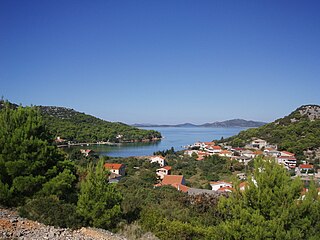
Vrgada is an island off the coast of Croatia in the Adriatic Sea. It is located halfway between Zadar and Šibenik, in the archipelago northwest of Murter and south of Biograd na moru, 2.5 nautical miles (4.6 km) from the mainland. It has area of 3.7 square kilometres. and population of 249. The only settlement on the island is also named Vrgada and is surrounded with pine forest. Main industries are agriculture and fishing. On northeast coast, there are several small coves.

D33 connects Šibenik to Drniš and Knin. Furthermore, the road has junctions to major state roads, namely D8 in Šibenik, connecting to Biograd na Moru and Trogir, and D1 in Knin, which in turn connects to Sinj to the south and to Gračac to the north. The southern terminus of the road is found in Vidici interchange near Šibenik. The road is also connected to A1 motorway in Šibenik interchange. The road is 73.3 km (45.5 mi) long. The northern terminus of the road is at Strmica border crossing to Bosnia and Herzegovina, where the road proceeds to Drvar.

D503 is a state road in the northern Dalmatia region of Croatia that provides access from the A1 motorway's Benkovac interchange to the D8 state road, facilitating access from A1 motorway to Biograd na Moru and surrounding seaside resorts. The road is 16.2 km (10.1 mi) long.

D110 is the main state road on the islands of Pašman and Ugljan in Croatia, connecting the towns of Preko and Tkon. From these two towns Jadrolinija ferries cross to the mainland, docking in Zadar and joining the D407 state road and Biograd na Moru and the D503 state road. The road is 41.6 km (25.8 mi) long. The two islands are connected via the Ždrelac Bridge, spanning Mali Ždrelac strait.

HNK Primorac is a Croatian football club based in town of Biograd na Moru.
Ivica Šangulin was a Croatian football player and manager.
Primorac is a common family name found in Croatia, Bosnia and Herzegovina and Serbia.
