
Pottery is the process and the products of forming vessels and other objects with clay and other ceramic materials, which are fired at high temperatures to give them a hard, durable form. Major types include earthenware, stoneware and porcelain. The place where such wares are made by a potter is also called a pottery. The definition of pottery used by the American Society for Testing and Materials (ASTM), is "all fired ceramic wares that contain clay when formed, except technical, structural, and refractory products." In archaeology, especially of ancient and prehistoric periods, "pottery" often means vessels only, and figures etc. of the same material are called "terracottas". Clay as a part of the materials used is required by some definitions of pottery, but this is dubious.

A doll is a model of a character, often used as a toy for children, and an artistic hobby for adults. Dolls have also been used in traditional religious rituals throughout the world. Traditional dolls made of materials such as clay and wood are found in the Americas, Asia, Africa and Europe. The earliest documented dolls go back to the ancient civilizations of Egypt, Greece, and Rome. They have been made as crude, rudimentary playthings as well as elaborate art. Modern doll manufacturing has its roots in Germany, from the 15th century. With industrialization and new materials such as porcelain and plastic, dolls were increasingly mass-produced. During the 20th century, dolls became increasingly popular as collectibles.

Longquan celadon (龍泉青瓷) is a type of green-glazed Chinese ceramic, known in the West as celadon or greenware, produced from about 950 to 1550. The kilns were mostly located in Lishui prefecture in southwestern Zhejiang Province in the south of China, and the north of Fujian Province. Overall a total of some 500 kilns have been discovered, making the Longquan celadon production area one of the largest historical ceramic producing areas in China. "Longquan-type" is increasingly preferred as a term, in recognition of this diversity, or simply "southern celadon", as there was also a large number of kilns in north China producing Yaozhou ware or other Northern Celadon wares. These are similar in many respects, but with significant differences to Longquan-type celadon, and their production rose and declined somewhat earlier.

Earthenware is glazed or unglazed nonvitreous pottery that has normally been fired below 1,200 °C (2,190 °F). Basic earthenware, often called terracotta, absorbs liquids such as water. However, earthenware can be made impervious to liquids by coating it with a ceramic glaze, which the great majority of modern domestic earthenware has. The main other important types of pottery are porcelain, bone china, and stoneware, all fired at high enough temperatures to vitrify.

Stoneware is a rather broad term for pottery or other ceramics fired at a relatively high temperature. A modern technical definition is a vitreous or semi-vitreous ceramic made primarily from stoneware clay or non-refractory fire clay. Whether vitrified or not, it is nonporous ; it may or may not be glazed. Historically, across the world, it has been developed after earthenware and before porcelain, and has often been used for high-quality as well as utilitarian wares.

Hard-paste porcelain, sometimes "true porcelain", is a ceramic material that was originally made from a compound of the feldspathic rock petuntse and kaolin fired at very high temperature, usually around 1400 °C. It was first made in China around the 7th or 8th century, and has remained the most common type of Chinese porcelain.
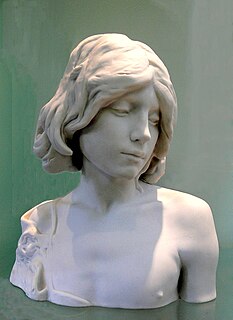
Biscuit porcelain, bisque porcelain or bisque is unglazed, white porcelain treated as a final product, with a matte appearance and texture to the touch. It has been widely used in European pottery, mainly for sculptural and decorative objects that are not tableware and so do not need a glaze for protection.
Biscuit is a small baked product; the exact meaning varies markedly in different parts of the world.

Ceramic glaze is an impervious layer or coating of a vitreous substance which has been fused to a ceramic body through firing. Glaze can serve to color, decorate or waterproof an item. Glazing renders earthenware vessels suitable for holding liquids, sealing the inherent porosity of unglazed biscuit earthenware. It also gives a tougher surface. Glaze is also used on stoneware and porcelain. In addition to their functionality, glazes can form a variety of surface finishes, including degrees of glossy or matte finish and color. Glazes may also enhance the underlying design or texture either unmodified or inscribed, carved or painted.

A Snow Baby is a small figurine, usually of a child, that depicts some aspect of the Christmas holidays or of winter sports. The traditional snow baby is made of unglazed biscuit porcelain and shows a child dressed in a snowsuit; the suit itself is covered in small pieces of crushed bisque, giving the appearance of fallen snowflakes. Figurines of other characters were also made, including Santa Claus, elves and animals such as penguins and polar bears.

A china doll is a doll made partially or wholly out of glazed porcelain. The name comes from china being used to refer to the material porcelain. Colloquially the term china doll is used to refer only to glazed porcelain dolls.
This is a list of pottery and ceramic terms.
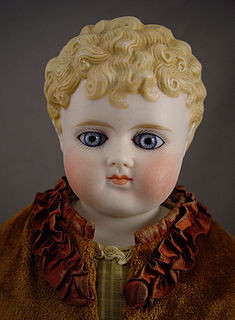
A parian doll, sometimes mistakenly referred to as a Dresden doll, was a type of doll manufactured primarily in Germany, from around 1860 to 1880. A parian doll, like a china doll, has a body made from fabrics and a head created from untinted white porcelain. Unlike the china doll however, the parian doll's head is not dipped in glaze before firing and as such has a matte finish, similar to bisque dolls, giving it a markedly different appearance. The term parian refers to the appearance of the fine white parian marble of Paros, Greece. The UFDC accepted definition of these dolls is as follows: "Parian doll: doll made of fine white bisque without tinting. The features, hair and cheeks may be painted." Many collectors now are discarding the term parian in favor of untinted bisque versus tinted bisque.

A bisque doll or porcelain doll is a doll made partially or wholly out of bisque or biscuit porcelain. Bisque dolls are characterized by their realistic, skin-like matte finish. They had their peak of popularity between 1860 and 1900 with French and German dolls. Bisque dolls are collectible, and antique dolls can be worth thousands of dollars. Antique German and French bisque dolls from the 19th century were often made as children's playthings, but contemporary bisque dolls are predominantly made directly for the collectors market.

Redware as a single word is a term for at least two types of pottery of the last few centuries, in Europe and North America. Red ware as two words is a term used for pottery, mostly by archaeologists, found in a very wide range of places. However, these distinct usages are not always adhered to, especially when referring to the many different types of pre-colonial red wares in the Americas, which may be called "redware".

Simon & Halbig was a doll manufacturer known for bisque doll heads with subtle colouring. They were based in Thuringia, the centre of the German doll industry. They supplied doll heads to many other well known doll makers. These are now collectables.

Biscuit refers to pottery that has been fired but not yet glazed. Biscuit is any pottery that has been fired in a kiln without a ceramic glaze. This can be a final product such as biscuit porcelain, or unglazed earthenware, often called terracotta, or, most commonly, an intermediary stage in a glazed final product.
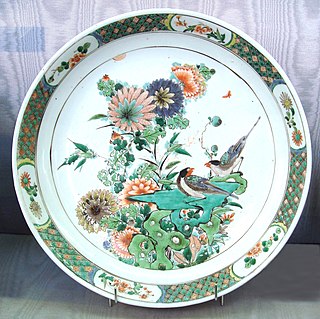
China painting, or porcelain painting, is the decoration of glazed porcelain objects such as plates, bowls, vases or statues. The body of the object may be hard-paste porcelain, developed in China in the 7th or 8th century, or soft-paste porcelain, developed in 18th-century Europe. The broader term ceramic painting includes painted decoration on lead-glazed earthenware such as creamware or tin-glazed pottery such as maiolica or faience.

Ceramic art is art made from ceramic materials, including clay. It may take forms including artistic pottery, including tableware, tiles, figurines and other sculpture. As one of the plastic arts, ceramic art is one of the visual arts. While some ceramics are considered fine art, as pottery or sculpture, most are considered to be decorative, industrial or applied art objects. Ceramics may also be considered artefacts in archaeology. Ceramic art can be made by one person or by a group of people. In a pottery or ceramic factory, a group of people design, manufacture and decorate the art ware. Products from a pottery are sometimes referred to as "art pottery". In a one-person pottery studio, ceramists or potters produce studio pottery.
Eutrope Bouret was a 19th-century French sculptor.

