
The Great Famine, also known as the Great Hunger, the Famine and the Irish Potato Famine, was a period of starvation and disease in Ireland lasting from 1845 to 1852 that constituted a historical social crisis and subsequently had a major impact on Irish society and history as a whole. The most severely affected areas were in the western and southern parts of Ireland—where the Irish language was dominant—and hence the period was contemporaneously known in Irish as an Drochshaol, which literally translates to "the bad life" and loosely translates to "the hard times". The worst year of the famine was 1847, which became known as "Black '47". The population of Ireland on the eve of the famine was about 8.5 million, by 1901 it was just 4.4 million. During the Great Hunger, roughly 1 million people died and more than 1 million more fled the country, causing the country's population to fall by 20–25% between 1841 and 1871. Between 1845 and 1855, at least 2.1 million people left Ireland, primarily on packet ships but also on steamboats and barques—one of the greatest exoduses from a single island in history.

The Irish Famine of 1740–1741 in the Kingdom of Ireland, is estimated to have killed between 13% and 20% of the 1740 population of 2.4 million people, which was a proportionately greater loss than during the Great Famine of 1845–1852.

The legacy of the Great Famine in Ireland followed a catastrophic period of Irish history between 1845 and 1852 during which time the population of Ireland was reduced by 50 percent.
"The Fields of Athenry" is a song written in 1979 by Pete St. John in the style of an Irish folk ballad. Set during the Great Famine of the 1840s, the lyrics feature a fictional man from near Athenry in County Galway, who stole food for his starving family and has been sentenced to transportation to the Australian penal colony at Botany Bay. It has become a widely known, popular anthem for Irish sports supporters.
Potato famine may refer to:
Black 47 was an American Celtic rock band from New York City, formed in 1989 by Larry Kirwan and Chris Byrne, and derives its name from a traditional term for the summer of 1847, the worst year of the Great Famine in Ireland.

A coffin ship is a popular idiom used to describe the ships that carried Irish migrants escaping the Great Irish Famine and Highlanders displaced by the Highland Clearances.
Great Famine may refer to:

Sir Charles Edward Trevelyan, 1st Baronet, was a British civil servant and colonial administrator. As a young man, he worked with the colonial government in Calcutta, India. He returned to Britain and took up the post of Assistant Secretary to the Treasury. During this time he was responsible for facilitating the government's response to the Great Famine in Ireland. In the late 1850s and 1860s he served there in senior-level appointments. Trevelyan was instrumental in the process of reforming the British Civil Service in the 1850s.
The Irish famine of 1879 was the last main Irish famine. Unlike the earlier Great Famines of 1740–1741 and 1845–1852, the 1879 famine caused hunger rather than mass deaths and was largely focused in the west of Ireland.
Celtic fusion is an umbrella term for any modern music which incorporates influences considered "Celtic", or Celtic music which incorporates modern music. It is a syncretic musical tradition which borrows freely from the perceived "Celtic" musical traditions of all the Celtic nations, as well as from all styles of popular music, it is thus sometimes associated with the Pan-Celtic movement. Celtic fusion may or may not include authentic traditional music from any one tradition under the Celtic umbrella, but its common characteristic is the inspiration by Celtic identity.

Souperism was a phenomenon of the Irish Great Famine. Protestant Bible societies set up schools in which starving children were fed, on the condition of receiving Protestant religious instruction at the same time. Its practitioners were reviled by the Catholic families who had to choose between Protestantism and starvation. People who converted for food were known as "soupers", "jumpers" and "cat breacs". In the words of their peers, they "took the soup". Although souperism did not occur frequently, the perception of it had a lasting effect on the popular memory of the Famine. It blemished the relief work by Protestants who gave aid without proselytising, and the rumour of souperism may have discouraged starving Catholics from attending soup kitchens for fear of betraying their faith.
A famine is a widespread shortage of food that may apply to any faunal species.

Death or Canada is a two-part Canadian–Irish docudrama which was broadcast in Ireland on RTÉ One in November/December 2008. In the UK on The History Channel UK in January and February 2009 as Fleeing The Famine. The film was also featured as part of the celebrations for Toronto's 175th anniversary.
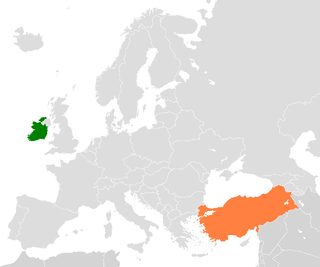
Ireland–Turkey relations are the bilateral relations between Ireland and Turkey. Formal relations were established in 1972. Ireland's embassy in Ankara was opened in 1998. Turkey has had an embassy in Dublin since 1973. Both countries are full members of the Council of Europe, the Organisation for Economic Co-operation and Development (OECD), the Organization for Security and Co-operation in Europe (OSCE), the Union for the Mediterranean and the World Trade Organization (WTO). Furthermore, Ireland is a member of the European Union while Turkey is a candidate.
Cormac Ó Gráda is an Irish economic historian and professor emeritus of economics at University College Dublin. His research has focused on the economic history of Ireland, Irish demographic changes, the Great Irish Famine, and the history of the Jews in Ireland.

James Aitken Frecheville is an Australian actor known for his lead role in the Australian film Animal Kingdom as Joshua "J" Cody, a confused teenager and youngest member of a criminal family in Melbourne's underworld.
The National Famine Commemoration Day is an annual observance in Ireland commemorating the Great Famine. A week-long programme of events leads up to the day, usually a Sunday in May. It has been organised officially by the government of Ireland since May 6th 2008. The main event is held in a different place each year, rotating among the four provinces of Ireland. There is also an international event, held in a place important for the Irish diaspora.
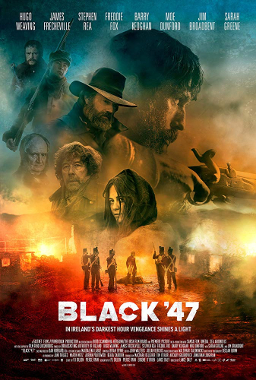
Black '47 is a 2018 Irish period drama film directed by Lance Daly. The screenplay is by PJ Dillon, Pierce Ryan, Eugene O'Brien and Lance Daly, based on the Irish-language short film An Ranger, written and directed by Dillon and Ryan. The film stars Hugo Weaving, James Frecheville, Jim Broadbent, Stephen Rea, Freddie Fox, Barry Keoghan, Moe Dunford, and Sarah Greene. Set in Connemara during the Great Irish Famine, the film follows an Irish Catholic soldier who has been fighting for the British Army abroad, as he deserts his regiment to reunite with his family. The title is taken from the most devastating year of the famine, 1847, which is referred to as "Black '47".

Lance Daly is an Irish film director, screenwriter and producer.
