This page is based on this
Wikipedia article Text is available under the
CC BY-SA 4.0 license; additional terms may apply.
Images, videos and audio are available under their respective licenses.
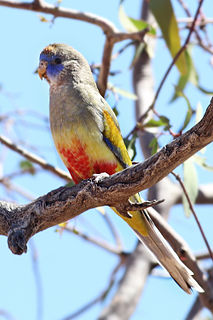
Platycercinae is a subfamily of birds belonging to the Psittaculidae family that inhabit Oceania. Consists of two tribes, the ground parrots and allies (Pezoporini) and the many species of broad-tailed parrot (Platycercini).
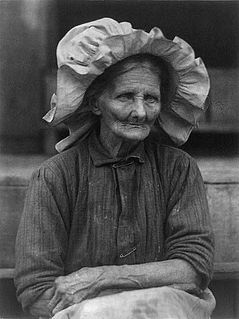
Bonnet has been used as the name for a wide variety of headgear for both sexes—more often female—from the Middle Ages to the present. As with "hat" and "cap", it is impossible to generalize as to the styles for which the word has been used, but there is for both sexes a tendency to use the word for styles in soft material and lacking a brim, or at least one all the way round, rather than just at the front. Yet the term has also been used, for example, for steel helmets. This was from Scotland, where the term has long been especially popular.

A flat cap is a rounded cap with a small stiff brim in front. The hat is also known in Scotland as a bunnet in the Scots language, in Wales as a Dai cap, in New Zealand as a cheese-cutter, and in the United States as a driving cap. Cloths used to make the cap include wool, tweed, and cotton. Less common materials may include leather, linen, or corduroy. The inside of the cap is commonly lined for comfort and warmth.
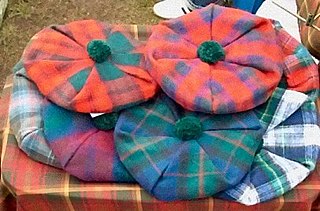
A tam o' shanter is a name given to the traditional Scottish bonnet worn by men. The name derives from Tam o' Shanter, the eponymous hero of the 1790 Robert Burns poem.
The eastern bluebonnet, also known as the greater bluebonnet, is an Australian parrot, one of two species in the genus Northiella. It was originally included in the genus Psephotus but due to distinctive physical and behavioural differences was reclassified into its own genus in 1994 by ornithologists and taxonomists Christidis and Boles. The bluebonnet is a medium-sized inland parrot commonly found in the interior of southeastern and central-southern Australia. It is adapted to life in semi-arid regions but can also flourish in regions of medium rainfall towards the eastern and southern extremities of its range.

(Robert) Julian Onderdonk was a Texan Impressionist painter, often called "the father of Texas painting."

Lupinus texensis, the Texas bluebonnet or Texas lupine is a species of lupine endemic to Texas. With other related species of lupines also called bluebonnets, it is the state flower of Texas.

The Balmoral is a traditional Scottish hat that can be worn as part of formal or informal Highland dress. Developed from the earlier blue bonnet, dating to at least the 16th century, it takes the form of a knitted, soft wool cap with a flat crown. It is named after Balmoral Castle, a royal residence in Scotland. It is an alternative to the similar and related (informal) Tam o' Shanter cap and the Glengarry bonnet.

Eumops is a genus of bats in the family Molossidae. A total of 17 species of this genus have been described. The name "Eumops" comes from the Greek prefix "Eu-", meaning "good" or "true," and the Malayan word "mops," which means bat.

The Blue Bonnet Court, originally called the Bluebonnet Tourist Camp, is a historic motor court-style motel in north-central Austin, Texas. Built in 1928-1929 by Joe and Elizabeth Lucas, the motel is situated on the northwestern corner of the Hyde Park subdivision along what was then the main road out of town. In the 1930s it featured Austin's first neon sign, which still hangs from the front.
Bluebonnet is a name given to any number of blue-flowered species of the genus Lupinus predominantly found in southwestern United States and is collectively the state flower of Texas. The shape of the petals on the flower resembles the bonnet worn by pioneer women to shield them from the sun.
Species often called bluebonnets include:

A doll hat is a women's millinery design scaled down to suggest a hat that could be worn by a doll. It can be of any design and is generally worn at the front of the head. The hat is usually held in place with a band of fabric or elastic secured at the back of the head.

The Salvation Army bonnet was a millinery design worn by female members of the Salvation Army. It was introduced in 1880 in the UK and was worn as headgear by most female officers in western countries. It began to be phased out from the late 1970s.
Naretha bluebonnet, species Northiella narethae, is an Australian parrot, one of two species in the genus Northiella. It is closely related to, and was considered a subspecies of, the eastern bluebonnet.
The 1975 Astro-Bluebonnet Bowl was a college football postseason bowl game that featured the Texas Longhorns and the Colorado Buffaloes.
The 1977 Astro-Bluebonnet Bowl was an American college football bowl game played on December 31, 1977 at the Astrodome in Houston, Texas. The game pitted the Texas A&M Aggies and the USC Trojans.
Bluebonnet Ordnance Plant was a munitions plant near McGregor, Texas, which manufactured TNT, bombs, ammonium nitrate and similar products for the American troops during World War II. BlueBonnet Ordnance Plant was one of four ordnance plants in the United States during World War II.


