
The House of Orsini is an Italian noble family that was one of the most influential princely families in medieval Italy and Renaissance Rome. Members of the Orsini family include five popes: Stephen II (752–757), Paul I (757–767), Celestine III (1191–1198), Nicholas III (1277–1280), and Benedict XIII (1724–1730). The family also included 34 cardinals, numerous condottieri, and other significant political and religious figures.

Giovanni Battista Moroni was an Italian painter of the Mannerism. He also is called Giambattista Moroni. Best known for his elegantly realistic portraits of the local nobility and clergy, he is considered one of the great portrait painters of the Cinquecento.
Niardo is a town and comune in the province of Brescia, in Lombardy.

Ludovico de' Medici, also known as Giovanni delle Bande Nere was an Italian condottiero. He is known for leading the Black Bands and serving valiantly in military combat under his third cousins, Pope Leo X and Pope Clement VII, in the War of Urbino and the War of the League of Cognac, respectively.
De Rossi is an Italian surname, and may refer to:

Francesco Maria Richini was an Italian Baroque architect.

Giovan Battista Aleotti was an Italian architect.

Fra’ Galgario, born Giuseppe Vittore Ghislandi, and also called Fra’ Vittore del Galgario, was an Italian painter, mainly active in Bergamo as a portraitist during the Rococo or late-Baroque period.
Orsini is a surname of Italian origin, originally derived from Latin ursinus ("bearlike") and originating as an epithet or sobriquet describing the name-bearer's purported strength. Notable people with the surname include the following:

Santa Maria dei Miracoli presso San Celso is a church and a sanctuary in Milan, Lombardy, northern Italy.
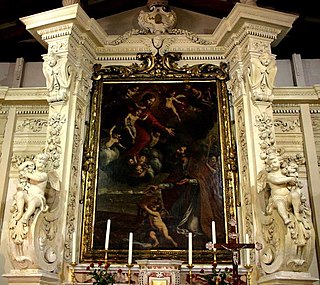
Giovanni Quagliata (1603–1673) was an Italian painter of the Baroque period. He is more properly known in Italy as Giovan Battista Quagliata, one of the leading artists of the Messinesi painters of the 17th century, as described by Francesco Susinno in his book "The Lives of the Messinesi Painters" published in 1724. Giovanni was born in Messina, Italy. He was a pupil of Pietro da Cortona and enjoyed the patronage and friendship of the Spanish Viceroy of Sicily, Don Juan José of Austria. Giovanni's brother, Andrea Quagliata, was also an historical painter, but of lesser significance. Giovanni's works – paintings, frescoes and large canvases – were famously displayed in the galleries and churches of Messina, but due to earthquakes from Mount Etna and wartime bombings, few have survived to the present day.

Giovanni Antonio Serbelloni was an Italian Cardinal.
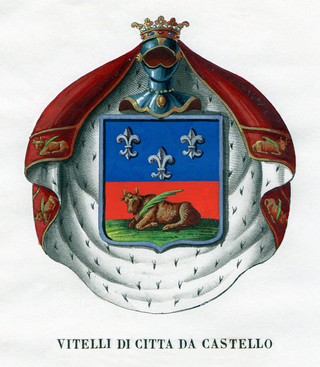
The House of Vitelli, among other families so named, were a prominent noble family of Umbria, rulers of Città di Castello and lesser rocche.
Giovanni Rossi may refer to:

Giovanni Pietro da Cemmo was an Italian painter.

The Teatro Goldoni of Florence was first opened in 1817 at the site of the former Annalena monastery in Oltrarno, region of Tuscany, Italy. The theater, dedicated to the playwright Carlo Goldoni, has a main facade on the narrow Via Santa Maria #15, it is near the corner with Via de Caldaie.
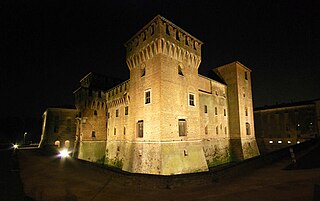
The Castello di San Giorgio is part of the Ducal palace of Mantua. It is a moated rectangular castle, each of which's four corners has a large tower and the moat is crossed by three drawbridges.

Danaë was a 1600-1605 oil on canvas painting by Annibale Carraci, destroyed during World War II. An autograph preparatory study survives in the Royal Collection at Windsor Castle.

Giovanni Corsi was a noble Italian Marquis, Knight, Patron, Ambassador and Senator of Florence in 1637. He was the second Marquis of Caiazzo, title he inherited after Bardo Corsi death in 1624.

The Barbiano di Belgioioso have been a noble family of northern Italy since the late Middle Ages.
This page is based on this
Wikipedia article Text is available under the
CC BY-SA 4.0 license; additional terms may apply.
Images, videos and audio are available under their respective licenses.

