 | Look up Bosphorus in Wiktionary, the free dictionary. |
The Bosphorus is a major waterway in Istanbul, Turkey, that forms part of the Turkish Straits.
Contents
Bosphorus or Bosporus may also refer to:
| Look up Bosphorus in Wiktionary, the free dictionary. |
The Bosphorus is a major waterway in Istanbul, Turkey, that forms part of the Turkish Straits.
Bosphorus or Bosporus may also refer to:

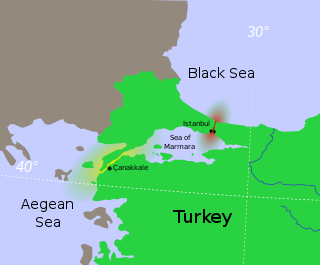
The Bosphorus Strait or Bosporus Strait is a natural strait and an internationally significant waterway located in northwestern Turkey. It forms part of the continental boundary between Asia and Europe, and divides Turkey by separating Anatolia from Thrace. It is the world's narrowest strait used for international navigation.

The Dardanelles, also known as the Strait of Gallipoli from the Gallipoli peninsula or from Classical Antiquity as the Hellespont, is a narrow, natural strait and internationally significant waterway in northwestern Turkey that forms part of the continental boundary between Asia and Europe and separates Asian Turkey from European Turkey. Together with the Bosphorus, the Dardanelles forms the Turkish Straits.
The Sea of Marmara, also known as the Marmara Sea, is an inland sea located entirely within the borders of Turkey. It connects the Black Sea to the Aegean Sea, separating the country's European and Asian part. The Bosphorus strait connects it to the Black Sea and the Dardanelles strait to the Aegean Sea. The former also separates Istanbul's European and Asian side. The Sea of Marmara is a small sea with an area of 11,350 km2 (4,380 sq mi), and dimensions 280 km × 80 km. Its greatest depth is 1,370 m (4,490 ft).

Anadoluhisarı, known historically as Güzelce Hisar is a medieval Ottoman fortress located in Istanbul, Turkey on the Anatolian (Asian) side of the Bosporus. The complex is the oldest surviving Turkish architectural structure built in Istanbul, and further gives its name to the neighborhood around it in the city's Beykoz district.

Rumelihisarı or Boğazkesen Castle is a medieval fortress located in Istanbul, Turkey, on a series of hills on the European banks of the Bosphorus. The fortress also lends its name to the immediate neighborhood around it in the city's Sarıyer district.

Marmaray is a 76.6 km-long (47.6 mi) intercontinental commuter rail line in Istanbul, Turkey. It comprises a rail tunnel under the Bosphorus strait and the modernization of existing suburban railway lines along the Sea of Marmara from Halkalı on the European side to Gebze on the Asian side. The procurement of new rolling stock for suburban passenger traffic is also part of the project. Construction started in 2004, with an initial target opening date of April 2009. After multiple delays caused by the discovery of historical and archaeological sites, the first phase of the project opened on October 29, 2013. It is the first standard gauge rail connection between Europe and Asia. The second phase of the project was scheduled to open in 2015, but work was stopped in 2014. Work was restarted in February 2017 and the full line opened on March 12, 2019.
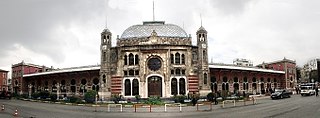
Sirkeci railway station, listed on maps as Istanbul railway station, is a railway terminal in Istanbul, Turkey. The terminal is located in Sirkeci, on the tip of Istanbul's historic peninsula, right next to the Golden Horn and just northwest of Gülhane Park and the Topkapı Palace. Sirkeci Terminal on the European side of the Bosporus strait, along with Haydarpaşa Terminal on the Asian side, are Istanbul's two intercity and commuter railway terminals. Built in 1890 by the Oriental Railway as the eastern terminus of the world-famous Orient Express that once operated between Paris and Istanbul in the period between 1883 and 2009, Sirkeci Terminal has become a symbol of the city. As of 19 March 2013, service to the station was indefinitely suspended due to the rehabilitation of the existing line between Kazlıçeşme and Halkalı for the new Marmaray commuter rail line. On 29 October 2013, a new underground station was opened to the public and is serviced by Marmaray trains travelling across the Bosphorus. Sirkeci Terminal has a total of 4 platforms with 7 tracks. Formerly, commuter trains to Halkalı would depart from tracks 2, 3 and 4; while regional trains to Kapıkule, Edirne and Uzunköprü, along with international trains to Bucharest, Sofia and Belgrade would depart from tracks 1 and 5.

Harem is a quarter in the Asian part of Istanbul, Turkey. Belonging to the Üsküdar district, it lies on the coast of the Sea of Marmara between the centres of Üsküdar and Kadıköy districts, next to Haydarpaşa Terminal.
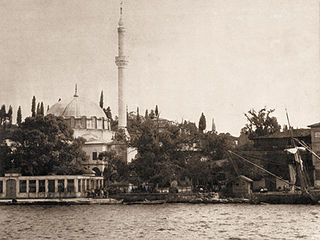
Beylerbeyi is a neighborhood in the Üsküdar municipality of Istanbul, Turkey. It is located on the Asian shore of the Bosporus, to the north of the Bosphorus Bridge. It is bordered on the northeast by the neighborhood of Çengelköy, on the east by Kirazlıtepe, on the southeast by Küplüce, on the south by Burhaniye, on the southwest by Kuzguncuk, and on the northwest by the Bosporus. Directly across the Bosporus is the Ortaköy neighborhood of Istanbul's Beşiktaş municipality.

Istanbul, formerly known as Constantinople, is the largest city in Turkey, serving as the country's economic, cultural and historic hub. The city straddles the Bosporus strait, lying in both Europe and Asia, and has a population of over 15 million residents, comprising 19% of the population of Turkey. Istanbul is the most populous European city, and the world's 15th-largest city.
The Bosphorus Bridge, known officially as the 15 July Martyrs Bridge and unofficially as the First Bridge, is one of the three suspension bridges spanning the Bosphorus strait in Istanbul, Turkey, thus connecting Europe and Asia. The bridge extends between Ortaköy and Beylerbeyi.
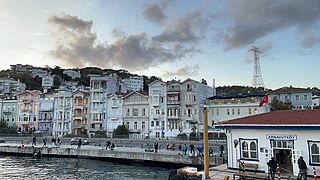
Arnavutköy is a historic neighbourhood in Istanbul, Turkey renowned for its wooden Ottoman mansions and seafood restaurants, as well as the campus of the prestigious Robert College with its historic buildings. It is part of the Beşiktaş district of Istanbul, and is located between Ortaköy and Bebek on the European shoreline of the Bosphorus strait.

A yalı is a house or mansion built right on the waterside and usually built with an architectural concept that takes into account the characteristics of the coastal location. A family who owned a waterside residence would spend some time in this usually secondary residence located at the sea shore, as opposed to the konak or the köşk. Thus, going to the "yalı" acquired the sense of both going to the seaside and to the house situated there. In its contemporary sense, the term "yalı" is used primarily to denote those 620 waterside residences constructed during the 18th, 19th, and 20th centuries and sprinkled along the Bosphorus in Istanbul. As such, they are one of the area's landmarks.
The Turkish Straits are two internationally significant waterways in northwestern Turkey. The straits create a series of international passages that connect the Aegean and Mediterranean seas to the Black Sea. They consist of the Dardanelles and the Bosphorus. The straits are on opposite ends of the Sea of Marmara. The straits and the Sea of Marmara are part of the sovereign sea territory of Turkey and subject to the regime of internal waters.
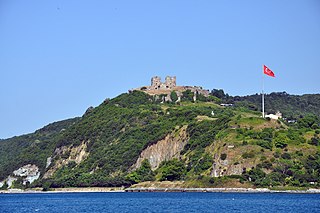
Yoros Castle is a ruined castle dating back to Byzantine times that stands above the confluence of the Bosphorus and the Black Sea, to the north of Joshua's Hill, in Beykoz district, Istanbul, Turkey. It is commonly referred to as the Genoese Castle, due to Genoa’s possession of it in the mid-15th century.

Rumeli Feneri, also Türkeli Feneri, a historical lighthouse still in use, is located on the European side of the Bosporus Strait's Black Sea entrance in Istanbul.

Anadolu Feneri is a historical lighthouse still in use, which is located on the Asian side of Bosphorus' Black Sea entrance in Istanbul, Turkey. Anadolu is the Turkish name for Anatolia. It is across from the lighthouse Rumeli Feneri, which is on the European side of the strait at a distance of 2 nmi. A connecting line between the two lighthouses marks the northern boundary of the Port of Istanbul. The place, where the lighthouse stands, is named Anadolufeneri, which today is a fishermen's village in Beykoz district.

The Istanbul Canal is a project for an artificial sea-level waterway, which is planned by Turkey on East Thrace, connecting the Black Sea to the Sea of Marmara, and thus to the Aegean and Mediterranean seas. Istanbul Canal would bisect the current European side of Istanbul and thus form an island between Asia and Europe. The new waterway would bypass the current Bosporus.

The city of Istanbul is at a geographic crossroads, straddling Europe and Asia Minor, and is divided by a sea lane called the Bosphorus Strait, which joins the Black Sea in the northeast and the Marmara Sea in the southwest. This strait has played a key role in the history of the city.
The Bosphorus Water Tunnel or Bosporus aqueduct is an undersea aqueduct in Istanbul, Turkey, crossing the Bosphorus strait. It was constructed in 2012 to transfer water from the Melen Creek in Düzce Province to the European side of Istanbul.