
The Armory Show, also known as the International Exhibition of Modern Art, was a show organized by the Association of American Painters and Sculptors in 1913. It was the first large exhibition of modern art in America, as well as one of the many exhibitions that have been held in the vast spaces of U.S. National Guard armories.

Horace Pippin was a self-taught African-American painter. The injustice of slavery and American segregation figure prominently in many of his works.

The Studio Museum in Harlem is an American art museum devoted to the work of artists of African descent. The Museum’s galleries are currently closed in preparation for a building project that will replace the current building, located at 144 West 125th Street between Adam Clayton Powell, Jr. Boulevard and Lenox Avenue in the Harlem neighborhood of Manhattan, New York City, with a new one on the same site. Founded in 1968, the museum collects, preserves and interprets art created by African Americans, members of the African diaspora, and artists from the African continent. Its scope includes exhibitions, artists-in-residence programs, educational and public programming, and a permanent collection.
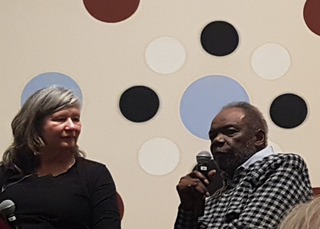
Sam Gilliam is a color field painter and lyrical abstractionist artist. Gilliam, an African American, is associated with the Washington Color School, a group of Washington, D.C. area artists that developed a form of abstract art from color field painting in the 1950s and 1960s. His works have also been described as belonging to abstract expressionism and lyrical abstraction. He works on stretched, draped and wrapped canvas, and adds sculptural 3D elements. He is recognized as the first artist to introduce the idea of a draped, painted canvas hanging without stretcher bars around 1965. This was a major contribution to the Color Field School.
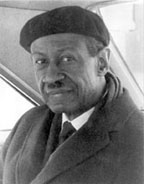
James Amos Porter was an African-American art historian, artist and teacher. He is best known for establishing the field of African-American art history and was influential in the African American Art movement.
The Ascent of Ethiopia is a 1932 painting by Lois Mailou Jones. This painting tells the story of a journey of African Americans who, through years of sacrifice, have established a heritage built on their trials and tribulations. This story displays how they pride themselves on their accomplishments and achievements. Indirectly, it reveals how these people have struggled to make it in a society that is different from their norm. From the time they lived in Africa until their journey to America beginning the fight to reach their artistic and intellectual peaks, Jones depicts this story by using certain elements of design, line, color, and space. The works she created throughout her life tell the story of many different cultures. In this painting she chooses to represent her own culture. As Tritobia Benjamin, a student of Jones states, “Jones and others employed the portrait as a means of conveying profound respect for their race” (25).

Alma Woodsey Thomas was an African-American Expressionist painter and art educator best known for her colorful abstract paintings. She lived and worked primarily in Washington, D.C. and The Washington Post described her as a force in the Washington Color School. The Wall Street Journal describes her as a previously "underappreciated artist" who is more recently recognized for her "exuberant" works, noteworthy for their pattern, rhythm and color. Thomas remains an influence to young and old as she was a cornerstone for the Fine Arts at Howard University, started a successful art career later in her life, and took major strides during times of segregation as an African-American female artist.

Thelma Johnson Streat was an African-American artist, dancer, and educator. She gained prominence in the 1940s for her art, performance and work to foster intercultural understanding and appreciation.

Malvin Gray Johnson was an African-American painter, born and raised in Greensboro, North Carolina.

The Lord is My Shepherd is an 1863 oil on wood painting by American artist Eastman Johnson. The painting measures 16 5/8 x 13 1/8 in. and is on display at the Smithsonian American Art Museum.

Céline Marie Tabary was an artist and arts professor at Howard University who championed African-American art in 1940s Washington, D.C. She emigrated from France in 1938, teaching and working in Washington, D.C. through the 1950s, before returning to France. Tabary won the Landscape Prize in 1944 from the National Museum, Washington, D.C.

William Ellisworth Artis was an African-American sculptor, whose favorite medium was clay. The freedom of modeling gave him a broad range of expression. During the latter part of his life, he began to focus on potting.
Jane Stuart was an American painter, best known for her miniature paintings and portraits, particularly those made of George Washington. She worked on and later copied portraits made by her father, Gilbert Stuart, and created her own portraits. In the early 19th-century, she assumed the responsibility of supporting her family after her father's death. She first worked in Boston, but later moved to Newport, Rhode Island, where she was the first woman who painted portraits. In 2011, she was inducted into the Rhode Island Heritage Hall of Fame.

Juan Logan is an American artist from Nashville, Tennessee. His paintings, sculptures, and installations are reflective of his experiences of racial and institutional power structures in the South and prompt viewers to consider social responsibility.
Tritobia Hayes Benjamin was an African American art historian and educator. She began teaching in 1970 as professor of Art History at Howard University, College of Fine Arts, specializing in African-American art History and American art. Benjamin became the Associate Dean of the Division of Fine Arts in the College of Arts and Sciences at Howard University, and had served as Gallery Director.
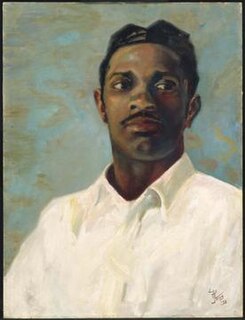
Portrait of Hudson is a painting by Lois Mailou Jones. It is in the collection of the Museum of Fine Arts, Boston (MFA) in Boston, Massachusetts in the United States.

Les Fétiches is a painting by Lois Mailou Jones. It is in the collection of the Smithsonian American Art Museum in Washington, D.C. in the United States. It is one of many in her body of work featuring African masks and is one of her best known paintings.
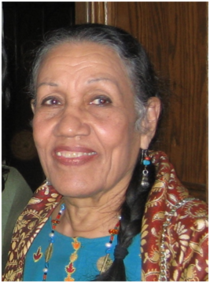
Georgia Mills Jessup was an African-American painter, sculptor, ceramicist, muralist, and collage artist.


