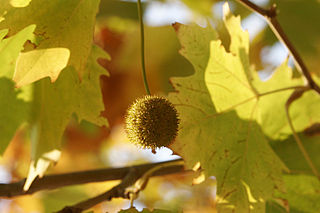
Platanaceae, the plane family, is a family of flowering plants in the order Proteales. The family consists of only a single extant genus Platanus, with twelve known species. The plants are tall trees, native to temperate and subtropical regions of the Northern Hemisphere. The hybrid London plane is widely planted in cities worldwide.

New Bedford is a city in Bristol County, Massachusetts, United States. It is located on the Acushnet River in what is known as the South Coast region. It is the largest city in the region and second largest city in the Providence-Warwick-New Bedford Metropolitan Region. Up through the 17th century, the area was the territory of the Wampanoag Indians. English colonists bought the land on which New Bedford would later be built from the Wampanoag in 1652, and the original colonial settlement that would later become the city was founded by English Quakers in the late 17th century. The town of New Bedford itself was officially incorporated in 1787.

Platanus occidentalis, also known as American sycamore, American planetree, western plane, occidental plane, buttonwood, and water beech, is a species of Platanus native to the eastern and central United States, the mountains of northeastern Mexico, extreme southern Ontario, and extreme southern Quebec. It is usually called sycamore in North America, a name which can refer to other types of trees in other parts of the world; in the United Kingdom, for example, the name syacamore typically refers to Acer pseudoplatanus. The American sycamore is a long-lived species, typically surviving at least 200 years and likely as long as 500–600 years.
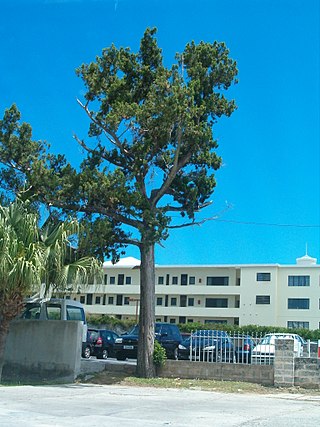
Bermuda's ecology has an abundance of unique flora and fauna due to the island's isolation from the mainland of North America. The wide range of endemic species and the islands form a distinct ecoregion, the Bermuda subtropical conifer forests. The variety of species found both on land and in the waters surrounding Bermuda have varying positive and negative impacts on the ecosystem of the island, depending on the species. There are varying biotic and abiotic factors that have threatened and continue to threaten the island's ecology. There are, however, also means of conservation that can be used to mitigate these threats.

The Buttonwood Park Zoo, located in New Bedford, Massachusetts, is a zoo located in the center of Buttonwood Park. Opened in 1894, it is the third-oldest zoo in New England and the 12th-oldest zoo in the United States. Located on a 7 acres (2.8 ha) campus, the zoo is owned and operated by the City of New Bedford, with the support of the Buttonwood Park Zoological Society. It is located on part of the Buttonwood Park Historic District, and federally designated on the National Register of Historic Places.
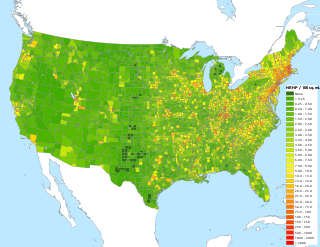
The National Register of Historic Places in the United States is a register including buildings, sites, structures, districts, and objects. The Register automatically includes all National Historic Landmarks as well as all historic areas administered by the U.S. National Park Service. Since its introduction in 1966, more than 97,000 separate listings have been added to the register.

Glochidion is a genus of flowering plants, of the family Phyllanthaceae, known as cheese trees or buttonwood in Australia, and leafflower trees in the scientific literature. It comprises about 300 species, distributed from Madagascar to the Pacific Islands. Glochidion species are used as food plants by the larvae of some Lepidoptera species including Aenetus eximia and Endoclita damor. The Nicobarese people have attested to the medicinal properties found in G. calocarpum, saying that its bark and seed are most effective in curing abdominal disorders associated with amoebiasis.

Effie M. Morrissey is a schooner skippered by Robert Bartlett that made many scientific expeditions to the Arctic, sponsored by American museums, the Explorers Club and the National Geographic Society. She also helped survey the Arctic for the United States Government during World War II. She is currently designated by the United States Department of the Interior as a National Historic Landmark as part of the New Bedford Whaling National Historical Park. She is the State Ship of Massachusetts.
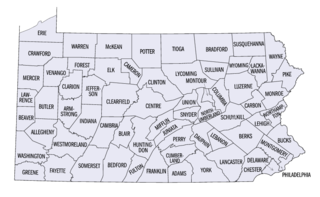
This is a list of properties and districts listed on the National Register of Historic Places in Pennsylvania. As of 2015, there are over 3,000 listed sites in Pennsylvania. All 67 counties in Pennsylvania have listings on the National Register.
Buttonbush is a common name for several plants and may refer to:
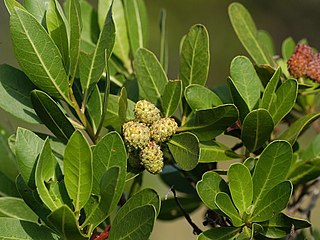
Conocarpus is a genus of two species of flowering plants in the family Combretaceae, native to tropical regions of the world. One of the species is a widespread mangrove species, and the other is restricted to a small area around the southern Red Sea coasts, where it grows alongside seasonal rivers.
Clinton is a family name.

The Gibraltar Botanic Gardens or La Alameda Gardens are a botanical garden in Gibraltar, spanning around 6 hectares. The Rock Hotel lies above the park.

The Buttonwood Covered Bridge is a covered bridge built in either 1878 or 1898 over Blockhouse Creek in Jackson Township, Lycoming County in the U.S. state of Pennsylvania. It uses a queen post with king post truss and is 74 feet 2 inches (22.6 m) long. The bridge was placed on the National Register of Historic Places in 1980, and had a major restoration in 1998. It is the shortest and most heavily used of the three covered bridges remaining in Lycoming County.

Buttonwood Park Historic District is a historic district on Kempton Street, Rockdale Avenue, Hawthorne Street and Brownell Avenue in New Bedford, Massachusetts. Its focal point is Buttonwood Park, a 97-acre (39 ha) municipal park planned by Charles Eliot in the 1890s, and part of its surrounding neighborhood. The neighborhood was developed in the first decades of the 20th century as a complement to the park, and contains a fine selection of Colonial Revival and Craftsman style houses. The district was added to the National Register of Historic Places in 2000.
Kapok fibre is a cotton-like plant fibre obtained from the seed pods of a number of trees in the Malvaceae family, which is used for stuffing mattresses and pillows, for padding and cushioning, and as insulation.
The following is a timeline of the history of New Bedford, Massachusetts, United States.
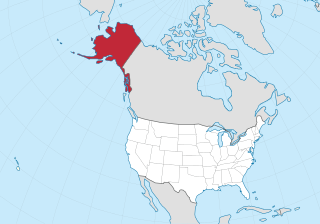
Paleontology in Alaska refers to paleontological research occurring within or conducted by people from the U.S. state of Alaska. During the Late Precambrian, Alaska was covered by a shallow sea that was home to stromatolite-forming bacteria. Alaska remained submerged into the Paleozoic era and the sea came to be home to creatures including ammonites, brachiopods, and reef-forming corals. An island chain formed in the eastern part of the state. Alaska remained covered in seawater during the Triassic and Jurassic. Local wildlife included ammonites, belemnites, bony fish and ichthyosaurs. Alaska was a more terrestrial environment during the Cretaceous, with a rich flora and dinosaur fauna.
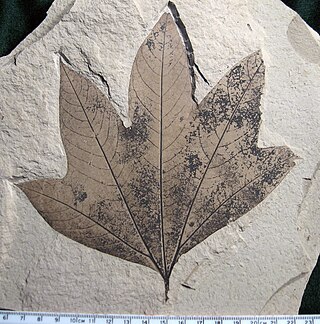
Macginitiea is an extinct genus in the family Platanaceae ranging from the Late Paleocene to Late Eocene of North America, known from the Clarno Formation of central Oregon and other areas ranging from California to Texas and North to Alberta. The genus is strictly used to describe leaves, but has been found in close association with other fossil platanoid organs, which collectively have been used for whole plant reconstructions. Macginitiea and its associated organs are important as together they comprise one of the most well-documented and ubiquitous fossil plants, particularly in the Paleogene of North America.

