
Tonkin, also spelled Tongkin, Tonquin or Tongking, is in the Red River Delta Region of northern Vietnam.

Bắc Kạn is the capital of Bắc Kạn Province, Vietnam. The province's only city, it is bordered by Bạch Thông District to the north, north-east and west and Chợ Mới District to the south-east and south-west.

Ninh Thuận is a province in the South Central Coast region of Vietnam.

Vietnam Railways is the state-owned operator of the railway system in Vietnam. The principal route is the 1,600 km (990 mi) single track North-South Railway line, running between Hanoi and Ho Chi Minh City. This was built at the metre gauge in the 1880s during the French colonial rule. There are also standard gauge lines running from Hanoi to the People’s Republic of China, eventually leading to Beijing, and some mixed gauge in and around Hanoi.

Huế railway station is a railway station in the city of Huế, Vietnam on the main North–South Railway. The street address is 2 Bui Thi Xuan Street, Huế, Thừa Thiên–Huế Province, Vietnam.

The Bắc Ninh Campaign was one of a series of clashes between French and Chinese forces in northern Vietnam during the Tonkin campaign (1883–86). The campaign, fought during the period of undeclared hostilities that preceded the Sino-French War, resulted in the French capture of Bắc Ninh and the complete defeat of China's Guangxi Army.
The Tonkin Campaign was an armed conflict fought between June 1883 and April 1886 by the French against, variously, the Vietnamese, Liu Yongfu's Black Flag Army and the Chinese Guangxi and Yunnan armies to occupy Tonkin and entrench a French protectorate there. The campaign, complicated in August 1884 by the outbreak of the Sino-French War and in July 1885 by the Cần Vương nationalist uprising in Annam, which required the diversion of large numbers of French troops, was conducted by the Tonkin Expeditionary Corps, supported by the gunboats of the Tonkin Flotilla. The campaign officially ended in April 1886, when the expeditionary corps was reduced in size to a division of occupation, but Tonkin was not effectively pacified until 1896.

The Capture of Hưng Hóa was an important French victory in the Tonkin Campaign (1883–86).
The Tientsin Accord or Li–Fournier Convention, concluded on 11 May 1884, was intended to settle an undeclared war between France and China over the sovereignty of Tonkin. The convention, negotiated by Li Hung-chang for China and capitaine de vaisseau François-Ernest Fournier for France, provided for a Chinese troop withdrawal from Tonkin in return for a comprehensive treaty that would settle details of trade and commerce between France and China and provide for the demarcation of its disputed border with Vietnam.
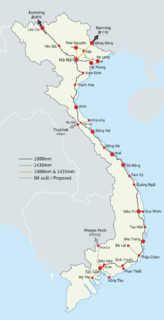
The railway system in Vietnam is owned and operated by the state-owned Vietnam Railways. The principal route, the single track North-South Railway running between Hanoi and Ho Chi Minh City, accounts for 1,726 kilometres (1,072 mi) of the network's total length of 2,600 kilometres (1,600 mi). The national railway network uses mainly metre gauge, although there are several standard gauge and mixed gauge lines in the North of the country.

Bắc Giang is a province of Vietnam. It is located in the Northeast region of the country, being situated 50 kilometres (31 mi) to the east of Hanoi. The province covers an area of 3,827.45 square kilometres and, as of 2008, it had a population of 1,628,400.

Bắc Giang railway station is a railway station in Vietnam. It serves the town of Bắc Giang, in Bắc Giang Province.
Kép railway station is a railway station in Vietnam. It serves the town of Kép, in Bắc Giang Province.
Lan Mẫu railway station is a railway station in Vietnam. It serves the town of Lan Mẫu, in Bắc Giang Province.

The North–South railway is the principal railway line serving the country of Vietnam. It is a single-track metre gauge line connecting the capital Hanoi in the north to Ho Chi Minh City in the south, for a total length of 1,726 km (1,072 mi). Trains travelling this line are sometimes referred to as the Reunification Express, although no particular train carries this name officially. The line was established during French colonial rule, and was completed over a period of nearly forty years, from 1899 to 1936. As of 2005, there were 278 stations on the Vietnamese railway network, of which 191 were located along the North–South line.
The Phùng Nguyên culture of Vietnam is a name given to a culture of the Bronze Age in Vietnam which takes its name from an archeological site in Phùng Nguyên, 18 km (11 mi) east of Việt Trì discovered in 1958. It was during this period that rice cultivation was introduced into the Red River region from southern China. The most typical artifacts are pediform adzes of polished stone.
Non Nước Bridge is a concrete bridge on Highway 10, Vietnam (vi), built in 1995 over the River Đáy between Ninh Bình town, capital of Ninh Bình Province, and Ý Yên District, Nam Định Province. There was also a railway bridge.


