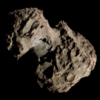
Comet Giacobini–Zinner is a periodic comet in the Solar System. It was discovered by Michel Giacobini, who observed it in the constellation of Aquarius on 20 December 1900. It was recovered two orbits later by Ernst Zinner, while he was observing variable stars near Beta Scuti on 23 October 1913.
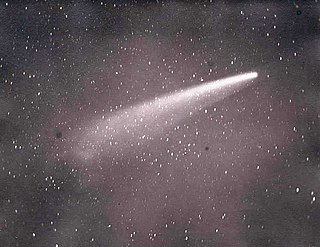
The Great Comet of 1882, formally designated as C/1882 R1, 1882 II, and 1882b, was a comet which became very bright in September 1882. It was a member of the Kreutz Sungrazers, a family of comets which pass within 1 R☉ of the Sun's photosphere at perihelion.

605 Juvisia is a minor planet, specifically an asteroid orbiting in the asteroid belt that was discovered 27 August 1906 in Heidelberg by German astronomer Max Wolf. It was named after the commune Juvisy-sur-Orge, France, where French astronomer Camille Flammarion had his observatory.
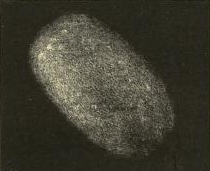
5D/Brorsen was a periodic Jupiter-family comet discovered on February 26, 1846, by Danish astronomer Theodor Brorsen. The comet was last seen in 1879 and is now considered lost.
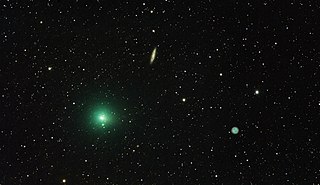
41P/Tuttle–Giacobini–Kresák is a periodic comet in the Solar System. The comet nucleus is estimated to be 1.4 kilometers in diameter.

47P/Ashbrook–Jackson is a periodic comet in the Solar System.
The Comet of 1729, also known as C/1729 P1 or Comet Sarabat, was an assumed parabolic comet with an absolute magnitude of −3, possibly the brightest ever observed for a comet; it is therefore considered to be potentially the largest comet ever seen. With an assumed eccentricity of 1, it is unknown if this comet will return in a hundred thousand years or be ejected from the Solar System.

C/1989 X1 (Austin) was a comet discovered by New Zealand amateur Rodney R. D. Austin on December 6, 1989. The comet at discovery was predicted to become easily visible by naked eye in spring 1990, however it failed to become that bright.

The Great Southern Comet of 1887, or C/1887 B1 using its International Astronomical Union (IAU) designation, was a bright comet seen from the Southern Hemisphere during January 1887. Later calculations indicated it to be part of the Kreutz Sungrazing group. It came to perihelion on 11 January 1877 at a distance of 0.00483 AU (723 thousand km) with a velocity of 606.1 km/s. Since the Sun has a radius of 696000 km, the comet passed about 27000 km from the surface of the Sun.
C/2001 OG108 (LONEOS) is a Halley-type comet with an orbital period of 48.51 years. It was discovered on 28 July 2001 by the LONEOS telescope at Lowell Observatory. Of the short-period comets with known diameters and perihelion inside the orbit of Earth, C/2001 OG108 is the second largest after Comet Swift–Tuttle.
In observational astronomy, the observation arc of a Solar System body is the time period between its earliest and latest observations, used for tracing the body's path. It is usually given in days or years. The term is mostly used in the discovery and tracking of asteroids and comets. Arc length has the greatest influence on the accuracy of an orbit. The number, spacing of intermediate observations, and timestamps have a lesser effect.

64P/Swift–Gehrels is a periodic comet in the Solar System which has a current orbital period of 9.23 years.

205P/Giacobini is a periodic Jupiter-family comet with an orbital period of 6.68 years. It was discovered by Michel Giacobini on 4 September 1896 and then it was lost until it was recovered by Koichi Itagaki on 10 September 2008. The comet was then found to have fragmented into three pieces.

C/2018 V1 (Machholz–Fujikawa–Iwamoto) is a comet that follows a slightly hyperbolic trajectory. It was visually discovered on 7 November 2018 by Donald Machholz using an 18.5-inch reflecting telescope, and was independently co-discovered by Shigehisa Fujikawa and Masayuki Iwamoto respectively. It reached perihelion on 3 December 2018.
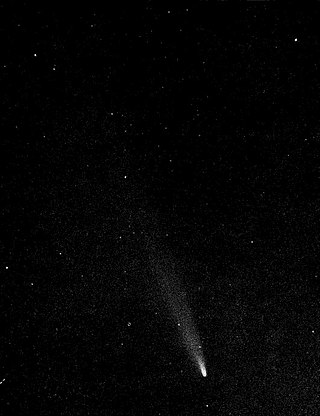
The Southern Comet of 1947 was a bright comet that became visible in the southern hemisphere in December 1947. At that point, it was the brightest comet seen in two decades and is one of the brightest comets seen since 1935, with an estimated maximum apparent magnitude of -3.
C/2024 X1 (Fazekas) is a Jupiter-family comet. It was discovered by Mt. Lemmon Survey scientist, J. B. Fazekas.

C/1907 G1 (Grigg–Mellish) is a long-period comet discovered independently by John Grigg and John E. Mellish in April 1907. The comet has been identified as the parent body of the delta Pavonids meteor shower.
Comet Brooks–Swift, also known as C/1883 D1 by its modern nomenclature, is a hyperbolic comet that was visible telescopically to Earth in the early months of 1883. It was discovered independently by two American astronomers, William Robert Brooks and Lewis A. Swift.

Comet Swift, also known as C/1899 E1 from its modern nomenclature, is a hyperbolic comet that became visible to the naked eye in early 1899. It is one of 13 comets discovered by American astronomer, Lewis A. Swift.
C/1862 N1 (Schmidt), sometimes referred to as C/1862 N1 (Schmidt–Temple), is a non-periodic comet discovered by Johann Friedrich Julius Schmidt on 2 July 1862.