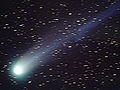
Gale's Comet photographed by Ferdinand Quénisset on 14–16 October 1912. [1] | |
| Discovery [2] | |
|---|---|
| Discovered by | Walter Frederick Gale |
| Discovery site | Sydney, Australia |
| Discovery date | 9 September 1912 |
| Designations | |
| 1912 II, 1912a [3] | |
| Orbital characteristics [4] | |
| Epoch | 19 November 1912 (JD 2419725.5) |
| Observation arc | 207 days |
| Number of observations | 30 |
| Perihelion | 0.716 AU |
| Eccentricity | 1.00045 |
| Orbital period | 3.3 million years (inbound) [5] |
| Inclination | 79.810° |
| 298.25° | |
| Argument of periapsis | 25.623° |
| Mean anomaly | 0.0007° |
| Last perihelion | 5 October 1912 |
| Earth MOID | 0.257 AU |
| Jupiter MOID | 1.523 AU |
| Physical characteristics [6] | |
| Comet total magnitude (M1) | 6.1 |
| 4.0 (1912 apparition) | |
C/1912 R1 (Gale) is a non-periodic comet that was observed between September 1912 and May 1913. It is the second of three comets discovered by Australian astronomer, Walter Frederick Gale.