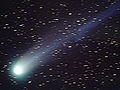
| Comet LINEAR and ι Draconis photographed from Mount Laguna, California on 11 July 2007 | |
| Discovery [1] | |
|---|---|
| Discovery site | LINEAR |
| Discovery date | 13 November 2006 |
| Orbital characteristics [2] | |
| Epoch | 13 June 2007 (JD 2454264.5) |
| Observation arc | 274 days |
| Number of observations | 1,025 |
| Perihelion | 1.015 AU |
| Eccentricity | 1.000249 |
| Inclination | 134.79° |
| 66.027° | |
| Argument of periapsis | 174.12° |
| Last perihelion | 10 August 2007 |
| Earth MOID | 0.0047 AU |
| Jupiter MOID | 2.8204 AU |
| Physical characteristics | |
Mean radius | 0.723 km (0.449 mi) [a] |
| Comet total magnitude (M1) | 8.0 [3] |
| 7.5 (2007 apparition) | |
C/2006 VZ13 (LINEAR) is a non-periodic comet discovered by the LINEAR survey on 13 November 2006.
The object was initially believed to be an asteroid due to its stellar appearance in the early images. [1] However, observers soon detected a small coma and the telltale green cometary cast. [1]
The comet peaked at approximately magnitude +7.5, [4] much brighter than predicted. [5] The comet made its closest approach to Earth on 14 July 2007 at a distance of 0.575 AU (86.0 million km). [2] It reached perihelion on 10 August 2007 at a distance of 1.015 AU (151.8 million km).
Infrared measurements from the NASA Infrared Telescope Facility (IRTF) in July 2007 yielded a mean grain temperature of 275±5 K, which was 6 percent higher than the equivalent radiative equilibrium blackbody of the comet at its distance from the Sun, which was approximately 1.02 AU at the time. [6] Spectroscopic observations on the following month reveal that the comet's composition is depleted of carbon compounds, comparable to what was observed from 9P/Tempel. [7]