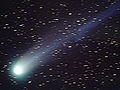
C/2025 R2 (SWAN), formerly known as SWAN25B, is a long-period comet discovered on 11 September 2025 by Vladimir Bezugly through SWAN imagery. The comet peaked around apparent magnitude +6[7][b] in late September 2025.
The comet was first spotted in images from the SWAN instrument onboard the Solar and Heliospheric Observatory (SOHO) by amateur astronomer Vladimir Bezugly on 11 September 2025. The presence of the comet was confirmed by other amateur astronomers, having an estimated magnitude of 7.4 and featuring a tail about 2 degrees long.[8] C/2025 R2 is officially the 20th comet discovered through SOHO's SWAN instrument according to its discoverer, Vladimir Bezugly.[9][10][c] The comet upon discovery was located in the constellation of Virgo and it was better seen from the southern hemisphere, where it was higher in the sky after sunset.[11]
This is a time-lapse of C/2025 R2 (SWAN) captured in October 2025. It shows 40 minutes of movement. The core is going in the direction of the tail because the comet has already passed the sun and is leaving the inner solar system.
C/2025 R2 was not discovered earlier in part because of the Holetschek effect as the comet was less than 30 degrees from the Sun between August 7 – September 13. Additionally, since the comet wasn't detected by ground-based surveys while it was at opposition in February 2025,[d] the comet was probably inactive at the time, had a very low albedo, or its nucleus is less than a kilometer in radius.[6] Between August and September the comet had rapidly brightened from magnitude 11 to magnitude 8.[12] The comet reached an apparent magnitude of 6.2 on 16 September 2025.
The comet underwent an outburst later in September and its magnitude was reported to have reach mag 5.9. At that time it was in the same region of the sky as 3I/ATLAS and C/2025 K1 (ATLAS), the latter of which came very close to each other from the Earth's perspective on 29 September.[13] On 2 October, it passed near Zubenelgenubi,[11] and it passed directly over Messier 16 on 17 October.[14] It was around magnitude 6 during its closest approach to Earth on 20 October 2025.[15] Coincidentally another comet, C/2025 A6 (Lemmon), was expected to be magnitude 4 around the same time.
On 2 November 2025, a possible fragmentation event was observed from the Two-meter Twin Telescope (TTT3) of the Teide Observatory, with reports indicating that either the nucleus is splitting into two or it may be in the process of releasing a substantial fragment.[16] The fragmentation probably occurred around mid-October.
C/2025 R2 (SWAN) came to perihelion one day after discovery on 12 September 2025 at a distance of 0.5AU (75millionkm) from the Sun.
Earth passed near the comet's meteoroid stream around 6 October 2025 and it had a chance of producing a weak meteor shower with a radiant only a few degrees from the Sun.[8] Meteor showers are more likely when a periodic comet is near perihelion as the debris from the previous passage will have only slowly spread out along the comet's orbit. But the distance to Earth's orbit (E-MOID) is a fairly large 0.048AU (7.2millionkm; 4.5millionmi), and the comet has such a long orbital period that the dust is likely too diluted to generate a shower.[e]
The comet made its closest approach to Earth at a distance of 0.26AU (39millionkm; 24millionmi) on 20 October 2025.[18][19] It crossed the celestial equator on 3 November 2025.
Orbital period
The comet is dynamically old having come from 180 AU (6 times farther out than Neptune) and therefore did not come directly from the Oort cloud region. As the comet was discovered near perihelion, the closest approach to the Sun is well known. The orbital period and aphelion (farthest distance from the Sun) is somewhat constrained by the low spatial resolution of about 1° per pixel STEREO-A observations in August, and without the STEREO-A observations, there is a modest 122-day observation arc for the orbit determination. The inbound orbital period was about 830 years and the outbound orbital period is about 760 years.[4]
Physical characteristics
Spectra of the central part of the coma of C/2025 R2 (SWAN) were taken with the Échelle spectrograph FLECHAS at the University Observatory Jena on 18 October 2025. In the wavelength range between 5000 and 7500 Å many emission features were detected in the spectrum of C/2025 R2 (SWAN), the most prominent ones are those of C2, NH2, and [OI]. In contrast to C/2025 A6 (Lemmon), no Na emission was detected in the spectrum of the coma of C/2025 R2 (SWAN).[20]
↑Using JPL #18, the comet is expected to come to aphelion (farthest distance from the Sun) around the year 2406 at about 166 AU.
12Since the surface brightness of a diffuse coma+nucleus is harder to detect than a point-like star of the same magnitude, a comet realistically needs reach an apparent magnitude of ≈4.5 to be visible to the naked eye under a rural dark sky. Magnitude 6 is a good target for 40mm binoculars and magnitude 8 is a good target for 70mm binoculars.
↑This figure includes 273P/Pons–Gambart, which was recovered and identified through SWAN imagery in 2012. Therefore, C/2025 R2 is actually only the 19th comet discovered through SWAN alone.
↑In February 2025, C/2025 R2 was about 2.4AU (360millionkm) from Earth and 3.4AU (510millionkm) from the Sun.[6]
This page is based on this Wikipedia article Text is available under the CC BY-SA 4.0 license; additional terms may apply. Images, videos and audio are available under their respective licenses.