C/2025 R3 (PanSTARRS)

Last updated

C/2025 R3 (PanSTARRS)
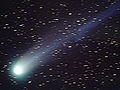
C2025 R3 (PanSTARRS) on 16 March 2026.jpg
Comet C/2025 R3 (PanSTARRS) imaged on 16 March 2026
Discovery [1]
Discovered by Pan-STARRS
Discovery date8 September 2025
Designations
CK25R030 [2]
Orbital characteristics [3] [4]
Epoch 22 November 2025 (JD 2461001.5)
Observation arc 190 days
Earliest precovery date7 September 2025
Number of
observations
509
Aphelion 6000  AU (inbound) [3]
ejection (outbound)
Perihelion 0.499 AU (75 million km)
Semi-major axis 3000 AU (inbound)
Eccentricity 0.99983 (inbound)
1.00024 (outbound)
Orbital period 170000 years (inbound)
ejection (outbound)
Inclination 124.73°
38.69°
Argument of
periapsis
162.23°
Mean anomaly -0.00259°
Next perihelion19 April 2026
TJupiter -0.498
Earth MOID 0.489 AU
Jupiter MOID 1.45 AU
Physical characteristics
Comet total
magnitude
(M1)
12.5±0.6
9
(2026-03-15) [5]

C/2025 R3 (PanSTARRS) is a hyperbolic Oort cloud comet that will reach perihelion on 19 April 2026. Around perihelion may reach a naked eye visibility of around apparent magnitude +2. [5] [6] The comet was discovered by PanSTARRS in images obtained on 8 September 2025. [1]
Contents

Observational history

Discovery

The comet was spotted in images obtained by the 1.8-m Ritchey-Chretien telescope at Haleakala, Hawaii, as part of the PanSTARRS survey, at an apparent magnitude of about 20. The head of the comet appeared diffuse, about 2.5 arcseconds across, and there was no tail visible. [1] A broad tail 10 arcseconds long was visible in follow-up images by the Canada-France-Hawaii Telescope. On 11 September the comet was 3.60 AU (539 million km) from the Sun. [2]

Follow-up observations

As of early March 2026, it is visible in telescopes just before sunrise about 25 degrees from the Sun. In mid March it had brighened to about magnitude 9. [5] On 7 April 2026 it will be 33 degrees from the Sun. [7] It will come to perihelion, at 0.499 astronomical units (74,600,000 km; 46,400,000 mi), on 19 April 2026 when it will be 20 degrees from the Sun. [8] Afterwards it will move between the Sun and Earth and its brightness could be boosted by forward scattering. [6] It will reach solar conjunction on 25 April 2026 around 05:24 UT when it will be 3.5 degrees from the Sun. [9] The comet will pass 0.489 AU (73.2 million km) from Earth on 26 April 2026. [10] [8]

Its future (outbound) trajectory shows the comet being ejected from the Solar System. [3]

See also

References

  1. 1 2 3 Y. Ramanjooloo; R. Weryk; R. Wainscoat; et al. (18 September 2025). D. W. Green (ed.). "Comet C/2025 R3 (PanSTARRS)". Central Bureau for Astronomical Telegrams. 5607: 1. Bibcode:2025CBET.5607....1R.
  2. 1 2 Y. Ramanjooloo; A. Nastasi; A. Aletti; A. Novichonok; R. Weryk (18 September 2025). "Comet C/2025 R3 (PanSTARRS)". Minor Planet Electronic Circulars. 2025-S104.
  3. 1 2 3 Horizons output. "Barycentric Osculating Orbital Elements for PanSTARRS (C/2025 R3)". Archived from the original on 4 March 2026. Retrieved 18 March 2026. (Solution using the Solar System's barycenter (Sun+Jupiter). Select Ephemeris Type:Elements and Center:@0)
    Inbound period (PR) = 6.06E+07 / 365.25 days = 165900 years
  4. "C/2025 R3 (PanSTARRS) – JPL Small-Body Database Lookup". ssd.jpl.nasa.gov. Jet Propulsion Laboratory. Archived from the original on 14 March 2026. Retrieved 18 March 2026.
  5. 1 2 3 "COBS Observation list: C/2025 R3". Crni Vrh Observatory. Retrieved 3 March 2026. Comet C/2025 R3 (PanSTARRS) Lightcurve
  6. 1 2 J. Carter (2 January 2026). "Will Comet C/2025 R3 (PanSTARRS) be the 'great comet' of 2026?". Space.com. Retrieved 5 March 2026.
  7. "Sun-Observer-Target angle (local maximum) for PanSTARRS (C/2025 R3) on 2026-Apr-07". JPL Horizons . Retrieved 3 March 2026.
  8. 1 2 G. van Buitenen. "C/2025 R3 (PanSTARRS)". astro.vanbuitenen.nl. Retrieved 3 March 2026.
  9. "Solar conjunction (Sun-Observer-Target angle) for PanSTARRS (C/2025 R3) on 2026-Apr-25". JPL Horizons . Retrieved 8 March 2026.
  10. "Earth approach on 2026-Apr-26". JPL Horizons. Archived from the original on 5 March 2026. Retrieved 18 March 2026.