
The Global Positioning System (GPS), originally Navstar GPS, is a satellite-based radio navigation system owned by the United States government and operated by the United States Space Force. It is one of the global navigation satellite systems (GNSS) that provide geolocation and time information to a GPS receiver anywhere on or near the Earth where there is an unobstructed line of sight to four or more GPS satellites. It does not require the user to transmit any data, and operates independently of any telephonic or Internet reception, though these technologies can enhance the usefulness of the GPS positioning information. It provides critical positioning capabilities to military, civil, and commercial users around the world. Although the United States government created, controls and maintains the GPS system, it is freely accessible to anyone with a GPS receiver.

Galileo is a global navigation satellite system (GNSS) that went live in 2016, created by the European Union through the European Space Agency (ESA), operated by the European Union Agency for the Space Programme (EUSPA), headquartered in Prague, Czechia, with two ground operations centres in Fucino, Italy, and Oberpfaffenhofen, Germany. The €10 billion project is named after the Italian astronomer Galileo Galilei.
Telecommunications in Western Sahara include radio, television, fixed and mobile telephones, and the Internet.

The BeiDou Navigation Satellite System is a satellite-based radio navigation system owned and operated by the China National Space Administration. It is one of the global navigation satellite systems that provide geolocation and time information to a BDS receiver anywhere on or near the Earth where there is an unobstructed line of sight to four or more BDS satellites. It does not require the user to transmit any data, and operates independently of any telephonic or Internet reception, though these technologies can enhance the usefulness of the BDS positioning information.

The National Reconnaissance Office (NRO) is a member of the United States Intelligence Community and an agency of the United States Department of Defense which designs, builds, launches, and operates the reconnaissance satellites of the U.S. federal government, and provides satellite intelligence to several government agencies, particularly signals intelligence (SIGINT) to the NSA, imagery intelligence (IMINT) to the NGA, and measurement and signature intelligence (MASINT) to the DIA. The NRO announced in 2023 that it plans within the following decade to quadruple the number of satellites it operates and increase the number of signals and images it delivers by a factor of ten.

The National Centre for Space Studies is the French national space agency headquartered in central Paris and it comes under the supervision of the French Ministries of Defence and Research.

The Mitre Corporation is an American not-for-profit organization with dual headquarters in Bedford, Massachusetts, and McLean, Virginia. It manages federally funded research and development centers (FFRDCs) supporting various U.S. government agencies in the aviation, defense, healthcare, homeland security, and cybersecurity fields, among others.
A white hat is an ethical security hacker. Ethical hacking is a term meant to imply a broader category than just penetration testing. Under the owner's consent, white-hat hackers aim to identify any vulnerabilities or security issues the current system has. The white hat is contrasted with the black hat, a malicious hacker; this definitional dichotomy comes from Western films, where heroic and antagonistic cowboys might traditionally wear a white and a black hat, respectively. There is a third kind of hacker known as a grey hat who hacks with good intentions but at times without permission.

The Korea Aerospace Research Institute, established in 1989, is the aeronautics and space agency of South Korea. Its main laboratories are located in Daejeon, in the Daedeok Science Town. KARI's vision is to continue building upon indigenous launch capabilities, strengthen national safety and public service, industrialize satellite information and applications technology, explore the Moon, and develop environmentally-friendly and highly-efficient cutting-edge aircraft and core aerospace technology. Current projects include the KSLV-2 launcher. Past projects include the 1999 Arirang-1 satellite. The agency was founded in 1989. Prior to South Korea's entry into the Institute for Advanced Engineering (IAE) in 1992, it focused primarily on aerospace technology.
The Aerospace Corporation is an American nonprofit corporation that operates a federally funded research and development center (FFRDC) in El Segundo, California. The corporation provides technical guidance and advice on all aspects of space missions to military, civil, and commercial customers. As the FFRDC for national-security space, Aerospace works closely with organizations such as the United States Space Force and the National Reconnaissance Office (NRO) to provide "objective technical analyses and assessments for space programs that serve the national interest". Although the USSF and NRO are the primary customers, Aerospace also performs work for civil agencies such as NASA and NOAA as well as international organizations and governments in the national interest.
The National Information Assurance Certification and Accreditation Process (NIACAP) formerly was the minimum-standard process for the certification and accreditation of computer and telecommunications systems that handle U.S. national-security information. NIACAP was derived from the Department of Defense Certification and Accreditation Process (DITSCAP), and it played a key role in the National Information Assurance Partnership.

The Romanian Space Agency is a public institution that coordinates Romania's national space technology research programs and activities related to space research. ROSA, established in 1991, is subordinate to the Romanian Ministry of Education.
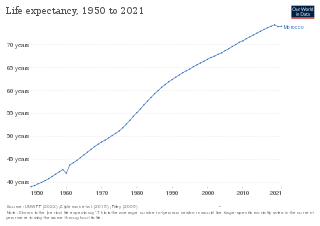
Morocco became an independent country in 1956. At that time there were only 400 private practitioners and 300 public health physicians in the entire country. By 1992, the government had thoroughly improved their health care service and quality. Health care was made available to over 70% of the population. Programs and courses to teach health and hygiene have been introduced to inform parents and children on how to correctly care for their own and their families' health.

The Committee on National Security Systems (CNSS) is a United States intergovernmental organization that sets policies for the security of the US security systems. The CIA triad are the three main security goals of CNSS.
A cyberattack is any offensive maneuver that targets computer information systems, computer networks, infrastructures, personal computer devices, or smartphones. An attacker is a person or process that attempts to access data, functions, or other restricted areas of the system without authorization, potentially with malicious intent. Depending on the context, cyberattacks can be part of cyber warfare or cyberterrorism. A cyberattack can be employed by sovereign states, individuals, groups, societies or organizations and it may originate from an anonymous source. A product that facilitates a cyberattack is sometimes called a cyber weapon. Cyberattacks have increased over the last few years. A well-known example of a cyberattack is a distributed denial of service attack (DDoS).
Certified Penetration Testing Engineer (C)PTE) is an internationally recognized cyber security certification administered by the United States-based information security company Mile2. The accreditation maps to the Committee on National Security Systems' 4013 education certification. The C)PTE certification is considered one of five core cyber security certifications.

Mile2 is an information technology security company that develops and provides proprietary accredited cybersecurity certifications. The company's technology security programs are utilized in the private and public sectors, including by Boeing, Canada's Department of National Defense, the National Security Agency, the United States Air Force, the Committee on National Security Systems (CNSS), the U.S. Federal Bureau of Investigation and others.

The United States Space Force (USSF) is the space service branch of the U.S. Armed Forces. Along with the U.S. Air Force, it is part of the Department of the Air Force, led by the secretary of the Air Force. Its military heads are the chief of space operations, who is one of the Joint Chiefs of Staff, and vice chief of space operations.
The United Kingdom Global Navigation Satellite System was a United Kingdom Space Agency (UKSA) research programme which, between May 2018 and September 2020, developed outline proposals for a United Kingdom (UK) owned and operated conventional satellite navigation system, as a British alternative to the European Union (EU) owned and operated Galileo Global Navigation Satellite System. The main reason was to provide a national and independent system, to ensure UK security following its withdrawal from the EU as a result of Brexit. It was fully supported by the Ministry of Defence.
