This page is based on this
Wikipedia article Text is available under the
CC BY-SA 4.0 license; additional terms may apply.
Images, videos and audio are available under their respective licenses.

The Front for the Liberation of the Enclave of Cabinda is a guerrilla and political movement fighting for the independence of the Angolan province of Cabinda. Formerly under Portuguese administration, with the independence of Angola from Portugal in 1975, the territory became an exclave province of the newly independent Angola. The FLEC fights the Cabinda War in the region occupied by the former kingdoms of Kakongo, Loango and N'Goyo.

The Alvor Agreement, signed on 15 January 1975, granted Angola independence from Portugal on 11 November, ending the war for independence while marking the transition to the Angolan Civil War.
The Popular Movement for the Liberation of Cabinda is or was a militant separatist group fighting for the independence of Cabinda from Angola. The MPLC split off from the Front for the Liberation of the Enclave of Cabinda (FLEC) in June 1979. Over the last two decades there seems to exist no evidence that the movement still exists.

Shaba II was a brief conflict fought in the Zairean province of Shaba in 1978. The conflict broke out on 11 May 1978 after 6,500 rebels from the Congolese National Liberation Front (FNLC), a Katangese separatist militia, crossed the border from Angola into Zaire in an attempt to achieve the province's secession from the Zairian regime of Mobutu Sese Seko. The FNLC captured the important mining town of Kolwezi.
The Movement for the Liberation of the Enclave of Cabinda is a defunct, separatist organization that campaigned for the independence of Cabinda province from Portugal. MLEC merged with the Action Committee of the Cabinda National Union and the Mayombe National Alliance in 1963 to form the Front for the Liberation of the Enclave of Cabinda. Cabinda is now a province and an exclave of Angola.
The Mayombe National Alliance is a defunct, separatist organization that campaigned for the independence of Cabinda province from Portugal. ALLIAMA merged with the Action Committee of the Cabinda National Union and the Movement for the Liberation of the Enclave of Cabinda in 1963 to form the Front for the Liberation of the Enclave of Cabinda (FLEC). Cabinda is now a province and an exclave of Angola.
Democratic Front of Cabinda is a separatist rebel group that fights for the independence of Cabinda province from Angola.

Henrique N'zita Tiago was President of the Armed Forces of Cabinda, a rebel group that fights for the independence of Cabinda from Angola. He died in Paris on 3 June 2016. It was reported that Tiago was 88 years old when he died, and that he would be buried in France – as Cabinda was not independent at the time of his death.

The Front for the Liberation of the State of Cabinda is a separatist group created by Cabindese expatriates in the Netherlands in 1996. This group adopted a blue, yellow and black flag with the Silambuco monument in the center.
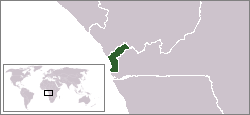
The Togo national football team bus attack was a terrorist attack that occurred on 8 January 2010 as the Togo national football team traveled through the Angolan province of Cabinda on the way to the 2010 Africa Cup of Nations tournament, which began on 10 January. A little-known offshoot of the Front for the Liberation of the Enclave of Cabinda (FLEC), a group promoting independence for the province of Cabinda, known as the Front for the Liberation of the Enclave of Cabinda – Military Position (FLEC-PM), claimed responsibility for the attack. Bus driver Mário Adjoua, the team's assistant manager Abalo Amelete, and media officer Stanislas Ocloo were killed, with several others injured. Secretary General of the FLEC-PM Rodrigues Mingas, currently exiled in France, claimed the attack was not aimed at the Togolese players but at the Angolan forces at the head of the convoy. Authorities reported two suspects were detained in connection with the attacks.
Rodrigues Mingas is the leader of the Front for the Liberation of the Enclave of Cabinda, the FLEC/PM-Military Position (Portuguese: Frente para a Libertação do Enclave de Cabinda, a guerrilla the independence movement of Cabinda organisation fighting since 1975 for the total independence of the oil rich Angolan province of Cabinda, one of the country's 14 provinces rich with oil reserves.
This is a list of events in 2010s in Angola: