
The Scythians or Scyths in composition) and sometimes also referred to as the Pontic Scythians, were an ancient Eastern Iranic equestrian nomadic people who had migrated during the 9th to 8th centuries BC from Central Asia to the Pontic Steppe in modern-day Ukraine and Southern Russia, where they remained established from the 7th century BC until the 3rd century BC.

The Indo-Scythians were a group of nomadic people of Iranic Scythian origin who migrated from Central Asia southward into the northwestern Indian subcontinent: the present-day South Asian regions of Afghanistan, Pakistan, Eastern Iran and northern India. The migrations persisted from the middle of the second century BCE to the fourth century CE.

Zoilus I Dicaeus was an Indo-Greek king who ruled in Afghanistan and Pakistan and occupied the areas of the Paropamisade and Arachosia previously held by Menander I. He may have belonged to the dynasty of Euthydemus I.
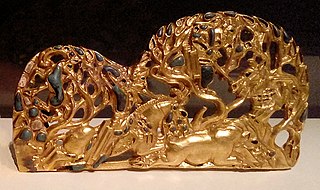
Scytho-Siberian art is the art associated with the cultures of the Scytho-Siberian world, primarily consisting of decorative objects such as jewellery, produced by the nomadic tribes of the Eurasian Steppe, with the western edges of the region vaguely defined by ancient Greeks. The identities of the nomadic peoples of the steppes is often uncertain, and the term "Scythian" should often be taken loosely; the art of nomads much further east than the core Scythian territory exhibits close similarities as well as differences, and terms such as the "Scytho-Siberian world" are often used. Other Eurasian nomad peoples recognised by ancient writers, notably Herodotus, include the Massagetae, Sarmatians, and Saka, the last a name from Persian sources, while ancient Chinese sources speak of the Xiongnu or Hsiung-nu. Modern archaeologists recognise, among others, the Pazyryk, Tagar, and Aldy-Bel cultures, with the furthest east of all, the later Ordos culture a little west of Beijing. The art of these peoples is collectively known as steppes art.

The Ziwiye hoard is a treasure hoard containing gold, silver, and ivory objects, also including a few gold pieces with the shape of a human face, that was uncovered in a plot of land outside Ziwiyeh castle, near the city of Saqqez in Kurdistan province, Iran, in 1947.

Calathus is a genus of ground beetle native to the Palearctic. There are at least 190 described species in Calathus.

The Ordos culture was a material culture occupying a region centered on the Ordos Loop during the Bronze and early Iron Age from c. 800 BCE to 150 BCE. The Ordos culture is known for significant finds of Scythian art and may represent the easternmost extension of Indo-European Eurasian nomads, such as the Saka, or may be linkable to Palaeo-Siberians or Yeniseians. Under the Qin and Han dynasties, the area came under the control of contemporaneous Chinese states.

A calathus or kalathos was a basket in the form of a top hat, used to hold wool or fruit, often used in ancient Greek art as a symbol of abundance and fertility. These baskets were made by weaving together reeds or twigs. They were typically used by women to store skeins of wool, but they had other uses in the household. In Roman times, there are reports for baskets of these sorts to be used in agricultural activities like bringing in the fruits from the fields.
Melanocephalus is an epithet often used as the second word of a binomial name. It derives from Greek words meaning 'black-headed'. It is used in the names of the following species:
Calathus brevis is a species of ground beetle from the Platyninae subfamily that is endemic to Spain.
Calathus distinguendus is a species of ground beetle from the Platyninae subfamily that can be found in Bulgaria, Greece, Kosovo, Moldova, Montenegro, North Macedonia, Serbia, Voivodina, southern part of Russia and European part of Turkey. It is also found in Georgia, Asia Minor, Caucasus, and Crimea. It have 1 millimetre (0.039 in) long genitalia.

Calathus fuscipes is a species of ground beetle from the Platyninae subfamily that can be found everywhere in Europe except for Andorra, Monaco, San Marino, Vatican City and various islands.
Calathus hispanicus is a species of ground beetle from the Platyninae subfamily that can be found in Portugal and Spain.
Calathus jakupicensis is a species of ground beetle from the Platyninae subfamily that is endemic to North Macedonia. It was described by Borislav V. Guéorguiev who discovered it on Karadzica mountain in North Macedonia in 2008. It was named after the massif it was discovered on. It occurs in the subalpine zone.
Calathus korax is a species of ground beetle from the Platyninae subfamily that is endemic to Greece.
Calathus montivagus is a species of ground beetle from the Platyninae subfamily that can be found in Italy and Sicily.
Calathus vivesi is a species of ground beetle from the Platyninae subfamily that is endemic to Spain.
Calathus gregarius is a species of ground beetle in the family Carabidae. It is found in North America.
Calathus ruficollis is a species of ground beetle in the family Carabidae. It is found in western North America, covering the California Floristic Province and continuing to the Pacific Northwest. Calathus ruficollis is flightless, predaceous, and nocturnal.
Scythians were an ancient Iranian people of the Pontic steppe.
