
Arizona State Route 51 (SR 51), also known as the Piestewa Freeway, is a numbered state highway in Phoenix, Arizona. It connects Interstate 10 just outside Downtown Phoenix with Loop 101 on the north side of Phoenix, making it one of the area's major freeways. It is a largely north–south route and is known for traversing the Piestewa Peak Recreation Area. The peak was named after Lori Piestewa, the first Native American woman to die in combat in the U.S. Military. Prior to this time, the freeway was known as the Squaw Peak Parkway, a name considered offensive by many Native Americans. Rapid growth and increased traffic demand on the east side of Metro Phoenix made the Piestewa Freeway necessary.

In the Whyte notation for classifying the wheel arrangement of steam locomotives, an 0-8-8-0 is a locomotive with two sets of eight driving wheels and neither leading wheels nor trailing wheels. Two sets of driving wheels would give far too long a wheelbase to be mounted in a fixed locomotive frame, so all 0-8-8-0s have been articulated locomotives of the Mallet type, whether simple or compound. In the UIC classification, this arrangement would be, refined to Mallet locomotives, (D)D. The type was sometimes called Angus in North America.

The Phoenix Mountains are a mountain range located in central Phoenix, Arizona. With the exception of Mummy Mountain, they are part of the Phoenix Mountain Preserve. They serve as a municipal park and offer hiking, mountain biking and equestrian trails at a variety of different access points.

The Strasburg Rail Road is the oldest continuously operating railroad in the western hemisphere and the oldest public utility in the Commonwealth of Pennsylvania. Chartered in 1832, the Strasburg Rail Road continues to operate under its original charter and original name. Located just outside of the town of Strasburg, Pennsylvania, the railroad is a heritage railroad offering excursion trains, hauled by steam locomotives, through the heart of world-famous Pennsylvania Dutch Country. Strasburg currently has five (5) serviceable historic steam locomotives on its roster and has the nation's largest fleet of historic wooden passenger coaches in operation. The Strasburg Rail Road is also one of the few railroads in the United States to occasionally use steam locomotives to haul revenue freight trains. It hosts 300,000 visitors per year.

Ross Winans (1796–1877) was an American inventor, mechanic, and builder of locomotives and railroad machinery. He is also noted for design of pioneering cigar-hulled ships. Winans, one of the United States' first multi-millionaires, was involved in national and state politics, a southern-sympathizer and was a vehement "states' rights" advocate. His outspoken anti-federal stance as a member of the Maryland House of Delegates, the lower chamber of the General Assembly, led to his temporary arrest on board a Baltimore and Ohio Railroad train returning from an early session of the legislature held in the western Maryland town of Frederick to avoid the Union Army-occupied state capital of Annapolis in April–May, 1861, to consider the possibilities of state secession, during the early decisive period of the American Civil War. Winans was related to James McNeill Whistler through marriage.
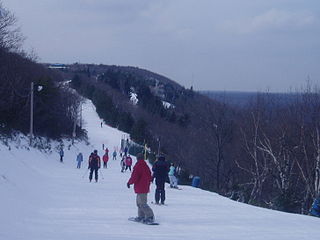
Camelback Mountain Resort is a ski and snowboard resort located in the Pocono Mountains region in Pocono Township and Jackson Township, Monroe County, Pennsylvania, adjacent to, and partially within Big Pocono State Park. In the 1950s when developers were working to expand the original solitary ski run, they negotiated with the then PA DER for permission to use a small portion of the state park for the ski area in exchange for $1 a year and the obligation to maintain the entire park.

Big Pocono State Park is a 1,305.6-acre (528.4 ha) Pennsylvania state park in Jackson and Pocono townships in Monroe County, Pennsylvania in northeastern Pennsylvania in the United States. The park is on Camelback Mountain and is maintained jointly by the Pennsylvania Department of Conservation and Natural Resources and Camelback Ski Corporation.
Trump International Hotel & Residence was a proposed real estate development in Phoenix, Arizona.
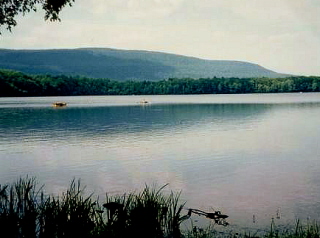
Camelback Mountain or Big Pocono is a conspicuous geographic feature on the Pocono Plateau. It is not a mountain, but rather a peninsular section of the Pocono Plateau, that when viewed from three sides, appears to be a mountain. The summit of Big Pocono "Mountain" is actually nearly level with land to the west and northwest, together comprising the top of the Glaciated Pocono Plateau, which is part of the larger Allegheny Plateau.
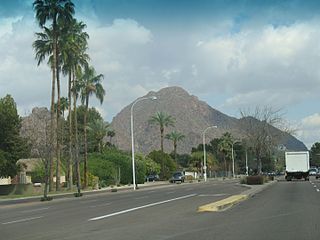
The Camelback East Village, also sometimes referred to as East Phoenix or the East Side, is one of the 15 villages that make up Phoenix, Arizona, United States. It is adjacent to the suburbs Paradise Valley and Scottsdale and sits between Piestewa Peak and Camelback Mountain. There are two main cores of the village. The first is the 24th Street and Camelback Road core and the other is the 44th Street and Van Buren Avenue core.
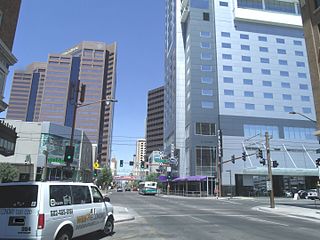
The Central Avenue Corridor is a significant stretch of north-south Central Avenue, in Phoenix, Arizona. Roughly bounded by Camelback Road to its north, and McDowell Road to its south, this is one of Phoenix's most vital and heavily trafficked stretches of roadway. It is also one of the region's largest centers of employment, with nearly 60,000 people being employed within a three-mile (5 km) radius of this swath of Central Avenue. Major employers here include major banks and financial institutions, hi-tech companies, and several significant law firms and government agencies.

Arcadia is a neighborhood in Phoenix and Scottsdale, Arizona. It is bounded 44th Street to 68th Street and Camelback Road to the canal. Arcadia contains well-kept homes on large lots; these homes command relatively high property values. Built on former citrus groves, Arcadia is known for well-irrigated, mature landscaping. Several yards prominently feature orange, lemon and grapefruit trees as reminders of the area's past; the area used to be occupied by citrus farmers from 1919 to the mid-1950s. In the mid-1950s, the rest of Phoenix caught up with the farms and the area suburbanized with characteristic ranch homes on large lots. Arcadia High School serves and derives its name from the neighborhood. Arcadia is frequently listed as the top place to live in all of Phoenix Metro due to its ideal location for both work and fun, vibrant food / culture, walk-ability, and plush landscape. It is also just south of the desired hiking destinations of Camelback Mountain and Piestewa Peak. Much of Phoenix's cycling scene pedals through this neighborhood, as Campbell / Lafeyette is one of the main Phoenix cycling corridors.
Pennsylvania Railroad's E1 class comprised three experimental Atlantic 4-4-2 locomotives built in 1899 to compete with the Reading Railroad on the Philadelphia, Pennsylvania, to Atlantic City, New Jersey, high-speed seashore passenger train service. These engines were designed as cab-center or camelback locomotives with wide fireboxes and 80" drivers that carried 50,000 lbs per axle. They proved capable in fast service but the inherent danger of separating the engineer from the fireman was unacceptable to the PRR so they were sold to their subsidiary the Long Island Rail Road in 1903. While the camelback design was unfavorable the Atlantic style proved to be everything the Pennsylvania Railroad needed at that time. They went on to acquire 596 additional units over the next fifteen years.
Many arterial roads in the Phoenix metropolitan area have the same name in multiple cities or towns. Some roads change names or route numbers across town borders, resulting in occasional confusion. For example, the road known as Apache Boulevard in Tempe continues east as Main Street in neighboring Mesa and then as Apache Trail in Apache Junction. Although Broadway Road maintains the same name through Goodyear, Avondale, Phoenix, Tempe, Mesa, and Apache Junction, each town uses a different reference point for address numbers.

The Phoenix Mountains Preserve is a group of parks located among the Phoenix Mountains in Phoenix, Arizona, United States. The Phoenix Mountains Park and Recreation Area, the first of these parks to be preserved, has been designated as a Phoenix Point of Pride.. Two of the parks rank among the world's largest city parks.

Black Mountain is located in north-central Maricopa County, Arizona, between the towns of Carefree and Cave Creek.

The David and Gladys Wright House is a Frank Lloyd Wright residence built in 1952 in the Arcadia neighborhood of Phoenix, Arizona. It has historically been listed with an address of 5212 East Exeter Boulevard, but currently has an entrance on the 4500 block of North Rubicon Avenue. Parking and access is through the Camelback Church of Christ at 5225 E. Camelback Road.


