Related Research Articles

Backgammon is a two-player board game played with counters and dice on tables boards. It is the most widespread Western member of the large family of tables games, whose ancestors date back nearly 5,000 years to the regions of Mesopotamia and Persia. The earliest record of backgammon itself dates to 17th-century England, being descended from the 16th-century game of Irish.
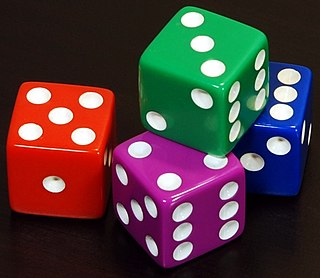
Dice are small, throwable objects with marked sides that can rest in multiple positions. They are used for generating random values, commonly as part of tabletop games, including dice games, board games, role-playing games, and games of chance.

Monopoly is a multi-player economics-themed board game. In the game, players roll two dice to move around the game board, buying and trading properties and developing them with houses and hotels. Players collect rent from their opponents and aim to drive them into bankruptcy. Money can also be gained or lost through Chance and Community Chest cards and tax squares. Players receive a stipend every time they pass "Go" and can end up in jail, from which they cannot move until they have met one of three conditions. House rules, hundreds of different editions, many spin-offs, and related media exist. Monopoly has become a part of international popular culture, having been licensed locally in more than 103 countries and printed in more than 37 languages. As of 2015, it was estimated that the game had sold 275 million copies worldwide.

Boggle is a word game in which players try to find as many words as they can from a grid of lettered dice, within a set time limit. It was invented by Allan Turoff and originally distributed by Parker Brothers. The game is played using a plastic grid of lettered dice, in which players look for words in sequences of adjacent letters.
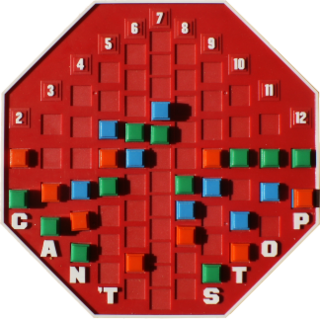
Can't Stop is a board game designed by Sid Sackson originally published by Parker Brothers in 1980; however, that edition has been long out of print in the United States. It was reprinted by Face 2 Face Games in 2007. An iOS version was developed by Playdek and released in 2012. The goal of the game is to "claim" three of the columns before any of the other players can. But the more that the player risks rolling the dice during a turn, the greater the risk of losing the advances made during that turn.
A Gamut of Games is an innovative book of games written by Sid Sackson and first published in 1969. It contains rules for a large number of paper and pencil, card, and board games. Many of the games in the book had never before been published. It is considered by many hobbyist gamers to be an essential text for anyone interested in abstract strategy games, and a number of the rules were later expanded into full-fledged published board games.

Parcheesi is a brand-name American adaptation of the Indian cross and circle board game Pachisi, published by Parker Brothers and Winning Moves Games USA.

Sorry! is a board game that is based on the ancient Indian cross and circle game Pachisi. Players move their three or four pieces around the board, attempting to get all of their pieces "home" before any other player. Originally manufactured by W.H. Storey & Co in England and now by Hasbro, Sorry! is marketed for two to four players, ages 6 and up. The game title comes from the many ways in which a player can negate the progress of another, while issuing an apologetic "Sorry!"

Yahtzee is a dice game made by Milton Bradley. It was first marketed under the name of Yahtzee by game entrepreneur Edwin S. Lowe in 1956. The game is a development of earlier dice games such as Poker Dice, Yacht and Generala. It is also similar to Yatzy, which is popular in Scandinavia.
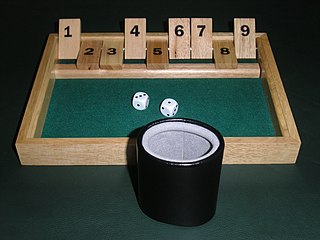
Shut the box is a game of dice for one or more players, commonly played in a group of two to four for stakes. Traditionally, a counting box is used with tiles numbered 1 to 9 where each can be covered with a hinged or sliding mechanism, though the game can be played with only a pair of dice, pen, and paper. Variations exist where the box has 10 or 12 tiles. In 2018 the game had a renaissance in Liverpool, England, when it became the house game at Hobo Kiosk pub on the Baltic Triangle. It was popularized by DJ duo Coffee and Turntables and became the most played board game in Merseyside for 4 years in a row.

Nard is an historical Persian tables game for two players that is sometimes considered ancestral to backgammon. It is still played today, albeit in a different form. As in other tables games, the playing pieces are moved around a board according to rolls of dice. It uses a standard tables board, but has a different opening layout and rules of play from that of backgammon.

Railway Rivals is a railroad-themed board game that was originally published by Rostherne Games in 1973. A German language edition was released by Bütehorn in 1979, and a mass-market edition in the UK by Games Workshop in 1985. The game involves railway building and operations.
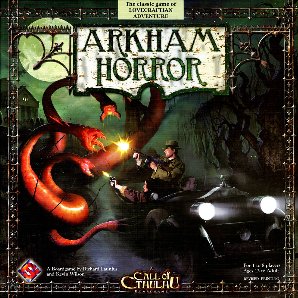
Arkham Horror is a cooperative adventure board game designed by Richard Launius, originally published in 1987 by Chaosium. The game is based on Chaosium's roleplaying game Call of Cthulhu, which is set in the Cthulhu mythos of H.P. Lovecraft and other horror writers. The game's second edition was released by Fantasy Flight Games in 2005, with a third edition in 2018.
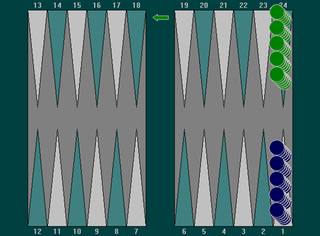
Tapa (Тапа) is a tables game played in Bulgaria and North Macedonia. It is also played in Greece, where it is known as Plakoto. The word tapa means bottle cap.
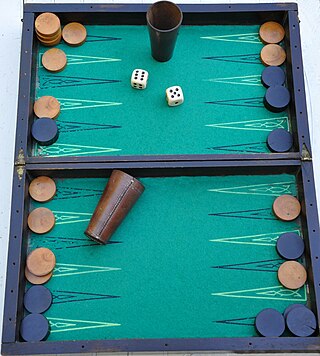
Jacquet is a tables game, played on the same type of board as Backgammon, that was once very popular in France and several other parts of Europe. It probably emerged around 1800, but is attested by 1827. In the 20th century it replaced the classic French backgammon equivalent — the game of Trictrac — until Jacquet itself was superseded by Anglo-American games in the 1960s.
A number of related games under the Yahtzee brand have been produced. They all commonly use dice as the primary tool for game play, but all differ generally. As Yahtzee itself has been sold since 1954, the variants released over the years are more recent in comparison, with the oldest one, Triple Yahtzee, developed in 1972, eighteen years after the introduction of the parent game.
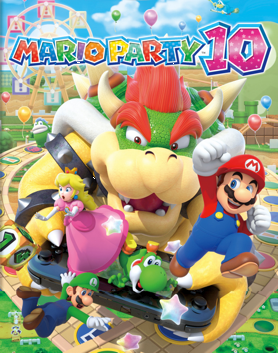
Mario Party 10 is a 2015 party video game. It was developed by NDcube and published by Nintendo for the Wii U. It was the only game in the series released for the Wii U, and was followed by Super Mario Party for the Nintendo Switch in 2018. Mario Party 10 received mixed reviews from critics. Critics praised the Bowser Party mode, the minigames, and utilization of the Wii U GamePad, but the decision to keep the gameplay changes first introduced in Mario Party 9 was criticized.
Black Monday is a card game published in 1988 by Hexagames.

Sagrada is a dice-drafting board game published by Floodgate Games.
Hexagames was a German game publisher in Dreieich, which existed from 1982 to 1992. It was one of the most famous German game publishers of the 1980s, notable for publishing games such as Lines of Action (1988) and Cosmic Encounter (1992).
References
- 1 2 Walker, Brian (September–October 1989). "General Games". Games International (9): 7.
- 1 2 3 "Can't Stop Express Online Game". www.eaglegames.net. Retrieved 2022-11-28.
- ↑ "Can't Stop Express". BoardGameGeek. Retrieved 2022-11-28.