
8 mm film is a motion picture film format in which the film strip is eight millimetres (0.31 in) wide. It exists in two main versions – the original standard 8 mm film, also known as regular 8 mm, and Super 8. Although both standard 8 mm and Super 8 are 8 mm wide, Super 8 has a larger image area because of its smaller and more widely spaced perforations.
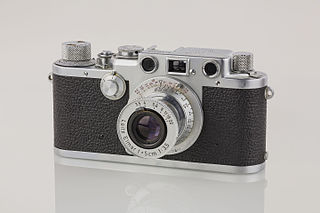
A camera is an instrument used to capture and store images and videos, either digitally via an electronic image sensor, or chemically via a light-sensitive material such as photographic film. As a pivotal technology in the fields of photography and videography, cameras have played a significant role in the progression of visual arts, media, entertainment, surveillance, and scientific research. The invention of the camera dates back to the 19th century and has since evolved with advancements in technology, leading to a vast array of types and models in the 21st century.
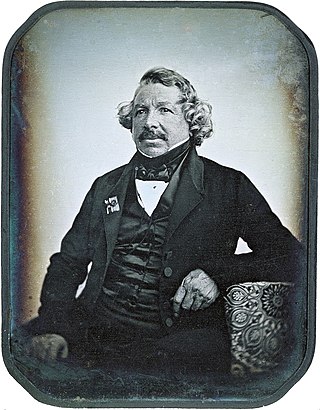
Daguerreotype was the first publicly available photographic process, widely used during the 1840s and 1860s. "Daguerreotype" also refers to an image created through this process.

Astrophotography, also known as astronomical imaging, is the photography or imaging of astronomical objects, celestial events, or areas of the night sky. The first photograph of an astronomical object was taken in 1840, but it was not until the late 19th century that advances in technology allowed for detailed stellar photography. Besides being able to record the details of extended objects such as the Moon, Sun, and planets, modern astrophotography has the ability to image objects outside of the visible spectrum of the human eye such as dim stars, nebulae, and galaxies. This is accomplished through long time exposure as both film and digital cameras can accumulate and sum photons over long periods of time or using specialized optical filters which limit the photons to a certain wavelength.

135 film, more popularly referred to as 35 mm film or 35 mm, is a format of photographic film with a film gauge of 35 mm (1.4 in) loaded into a standardized type of magazine for use in 135 film cameras.

120 is a film format for still photography introduced by Kodak for their Brownie No. 2 in 1901. It was originally intended for amateur photography but was later superseded in this role by 135 film. 120 film survives to this day as the only medium format film that is readily available to both professionals and amateur enthusiasts.

126 film is a cartridge-based film format used in still photography. It was introduced by Kodak in 1963, and is associated mainly with low-end point-and-shoot cameras, particularly Kodak's own Instamatic series of cameras.
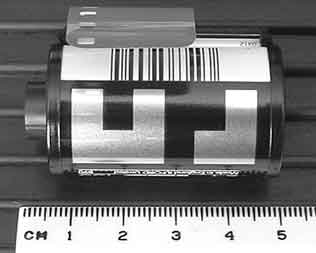
DX encoding is an ANSI and I3A standard, originally introduced by Kodak in March 1983, for marking 135 and APS photographic film and film cartridges. It consists of several parts, a latent image DX film edge barcode on the film below the sprocket holes, a code on the cartridge used by automatic cameras, and a barcode on the cartridge read by photo-finishing machines.
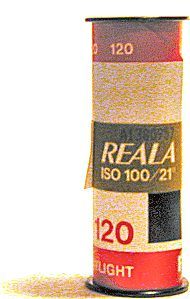
Roll film or rollfilm is any type of spool-wound photographic film protected from white light exposure by a paper backing. The term originated in contrast to sheet film. Confusingly, roll film was originally often referred to as "cartridge" film because of its resemblance to a shotgun cartridge.
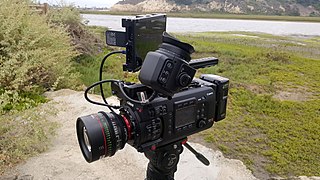
A movie camera is a type of photographic camera that rapidly takes a sequence of photographs, either onto film stock or an image sensor, in order to produce a moving image to display on a screen. In contrast to the still camera, which captures a single image at a time, the movie camera takes a series of images by way of an intermittent mechanism or by electronic means; each image is a frame of film or video. The frames are projected through a movie projector or a video projector at a specific frame rate to show the moving picture. When projected at a high enough frame rate, the persistence of vision allows the eyes and brain of the viewer to merge the separate frames into a continuous moving picture.
Panoramic photography is a technique of photography, using specialized equipment or software, that captures images with horizontally elongated fields of view. It is sometimes known as wide format photography. The term has also been applied to a photograph that is cropped to a relatively wide aspect ratio, like the familiar letterbox format in wide-screen video.

A darkroom is used to process photographic film, make prints and carry out other associated tasks. It is a room that can be made completely dark to allow the processing of light-sensitive photographic materials, including film and photographic paper. Various equipment is used in the darkroom, including an enlarger, baths containing chemicals, and running water.

Color photography is photography that uses media capable of capturing and reproducing colors. By contrast, black-and-white or gray-monochrome photography records only a single channel of luminance (brightness) and uses media capable only of showing shades of gray.
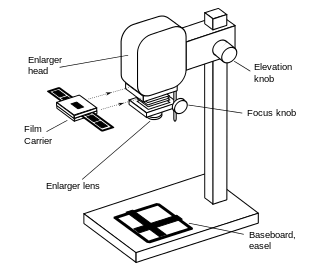
An enlarger is a specialized transparency projector used to produce photographic prints from film or glass negatives, or from transparencies.

The history of photography began with the discovery of two critical principles: The first is camera obscura image projection, the second is the discovery that some substances are visibly altered by exposure to light. There are no artifacts or descriptions that indicate any attempt to capture images with light sensitive materials prior to the 18th century.

The history of the camera began even before the introduction of photography. Cameras evolved from the camera obscura through many generations of photographic technology – daguerreotypes, calotypes, dry plates, film – to the modern day with digital cameras and camera phones.

Photographic film is a strip or sheet of transparent film base coated on one side with a gelatin emulsion containing microscopically small light-sensitive silver halide crystals. The sizes and other characteristics of the crystals determine the sensitivity, contrast, and resolution of the film. Film is typically segmented in frames, that give rise to separate photographs.

The Cirkut is a rotating panoramic camera of the type known as "full rotation". It was patented by William J. Johnston in 1904 and manufactured by Rochester Panoramic Camera Company starting in 1905; during that same year, the company was acquired by Century Camera Co.. The manufacture of the camera continued through 1949.

Pigeon photography is an aerial photography technique invented in 1907 by the German apothecary Julius Neubronner, who also used pigeons to deliver medications. A homing pigeon was fitted with an aluminium breast harness to which a lightweight time-delayed miniature camera could be attached. Neubronner's German patent application was initially rejected, but was granted in December 1908 after he produced authenticated photographs taken by his pigeons. He publicized the technique at the 1909 Dresden International Photographic Exhibition, and sold some images as postcards at the Frankfurt International Aviation Exhibition and at the 1910 and 1911 Paris Air Shows.

Cold camera photography is a technique used by astrophotographers to reduce the electronic noise that accumulates during long exposures with the electronic sensors in DSLRs and dedicated CMOS or CCD astro-cameras. Cooling is usually accomplished with a Peltier thermo-electric cooler. By cooling the camera's sensor one can take longer shots without the worry of the chip heating up, thereby reducing thermal, shot and read noise.


