Related Research Articles
Ronald Grant Taylor was an English-Australian actor best known as the abrasive General Henderson in the Gerry Anderson science fiction series UFO and for his lead role in Forty Thousand Horsemen (1940).
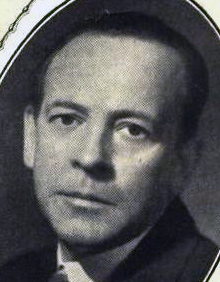
Frank Harvey was a British-born actor, producer, and writer, best known for his work in Australia.
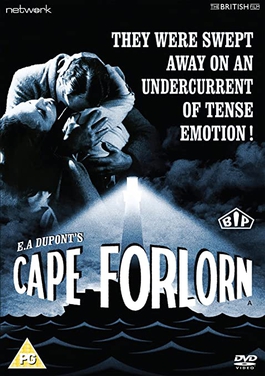
Cape Forlorn is a 1931 British drama film directed by Ewald André Dupont and starring Fay Compton, Frank Harvey and Ian Hunter. It was the English-language version of a British International Pictures multiple-language production with France and Germany which also made Le cap perdu and Menschen im Käfig. The film is also known as The Love Storm.
Menschen im Käfig is a 1930 British-made drama film directed by Ewald André Dupont and starring Conrad Veidt, Fritz Kortner and Tala Birell. It was the German-language version of the 1931 British International Pictures film Cape Forlorn. A French-language version Le cap perdu was also produced at the same time. It was based on a story by Frank Harvey.

Muriel Myee Steinbeck was an Australian actress who worked extensively in radio, theatre, television and film. She is best known for her performance as the wife of Sir Charles Kingsford Smith in Smithy (1946) and for playing the lead role in Autumn Affair (1958–59), Australia's first television serial.
Campbell Copelin was an English actor, who moved to Australia in the 1920s and worked extensively in film, theatre, radio and television. He had a notable association with J.C. Williamson Ltd and frequently collaborated with F. W. Thring and Frank Harvey. He often played villains.
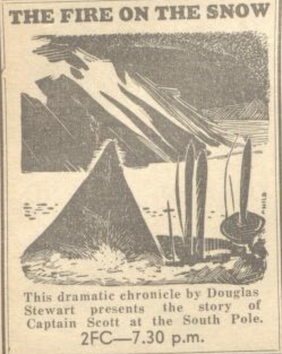
The Fire on the Snow is a 1941 Australian verse play by Douglas Stewart about the Terra Nova Expedition to Antarctica by Robert Falcon Scott. It premiered on ABC radio on 6 June 1941 to great acclaim and inspired a series of Australian verse dramas on ABC radio.
Ned Kelly is a 1942 radio play by Douglas Stewart about the outlaw Ned Kelly. It was later adapted into a stage play which was in turn adapted for television.
Alfred Noel Joseph Rubie was an Australian modernist painter, portrait and commercial photographer, playwright and pharmacy proprietor who worked in Sydney during the 1920s and into the 1960s. In addition to his work as a painter and photographer, Rubie was involved with the Independent Theatre as a photographer, actor, writer, and costume and set designer.
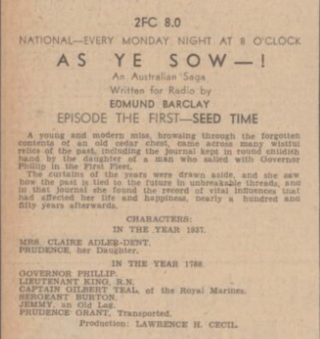
As Ye Sow is a 1937 Australian radio serial by Edmund Barclay. It told the story of six generations of Australians in early colonial Australia.
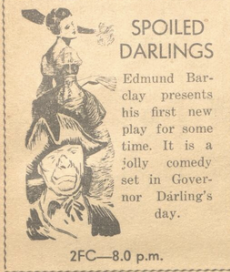
Spoiled Darlings is a 1940 Australian romantic comedy radio play by Edmund Barclay that was broadcast nationally on the ABC.

An Antarctic Epic is a 1933 Australian radio drama by Edmund Barclay about the Scott Expedition to Antarctica. It was the first radio drama script by Barclay who went on to become arguably Australia's leading radio writer.

Mr Smart Guy is a 1941 Australian play by Alec Coppel that was later filmed as Smart Alec (1951).
The Love Story of Anne is 1936 Australian play by Frank Harvey. Unlike the majority of Harvey's stage plays it had an Australian setting. Harvey later said the play "did well".
Reunion is a 1938 Australian radio play by Rex Rienits.
Merry-Go-Round is a 1936 Australian radio play by Max Afford. It won first prize in the ABC Radio Contest for best play.
With Cain Go Wander is a 1953 Australian original radio play by Edmund Barclay.
Into the Light is a 1938 Australian radio serial by Edmund Barclay. It followed on from this success with As Ye Sow.
Five White Fingers is a 1939 Australian radio play by Max Afford. Described as a "macarbe comedy" it was one of his most popular early works.
References
- ↑ ""STRONG MEAT"". The Daily News . Perth: National Library of Australia. 3 April 1930. p. 1 Edition: HOME FINAL EDITION. Retrieved 7 December 2012.
- ↑ ""CAPE FORLORN"". The Sun . No. 6051. New South Wales, Australia. 2 April 1930. p. 2 (LAST RACE EDITION). Retrieved 4 September 2023– via National Library of Australia.
- ↑ ""Critics are Useful Sometimes"", ABC Weekly, Sydney, 3 (33), 16 August 1941, retrieved 4 September 2023– via Trove
- ↑ "THE THEATRE AND ITS PEOPLE". Table Talk . No. 3308. Victoria, Australia. 1 October 1931. p. 16. Retrieved 4 September 2023– via National Library of Australia.
- ↑ "Jonathan Listens to Plays: "On Borrowed Time" Different", The Wireless Weekly: The Hundred per Cent Australian Radio Journal, Sydney: Wireless Press, 37 (36), September 12, 1942, retrieved 4 September 2023– via Trove
- ↑ "Actor's Play in Caltex Theatre". The Age. No. 30, 815. Victoria, Australia. 4 February 1954. p. 1 ("THE AGE" RADIO SUPPLEMENT). Retrieved 4 September 2023– via National Library of Australia.
- ↑ "Commercial", ABC Weekly, Sydney, 16 (4), 23 January 1954, retrieved 4 September 2023– via Trove
- ↑ "AMUSEMENTS". The Age . No. 23, 858. Victoria, Australia. 28 September 1931. p. 9. Retrieved 4 September 2023– via National Library of Australia.