
Palestine typically refers to:

Cappadocia is a historical region in Central Anatolia, largely in the Nevşehir, Kayseri, Kırşehir, Aksaray, Malatya, Sivas and Niğde provinces in Turkey.

The Kızılırmak, also known as the Halys River is the longest river entirely within Turkey. It is a source of hydroelectric power and is not used for navigation.

Macedonia most commonly refers to:

Göreme, located among the "fairy chimney" rock formations, is a town in Cappadocia, a historical region of Turkey. It is in the Nevşehir Province in Central Anatolia and has a population of around 2,000 people.
Africa is the world's second largest continent.
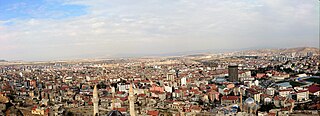
Nevşehir, formerly Neapolis and Muşkara, is a city and the capital district of Nevşehir Province in the Central Anatolia Region of Turkey. According to the 2010 census, the population of the district is 117,890 of which 85,634 live in the city of Nevşehir. The district covers an area of 535 km2 (207 sq mi), and the town lies at an elevation of 1,224 m (4,016 ft).
Syria is a country in the Middle East, incorporating north-eastern Levant and Eastern Mesopotamia. Syria, Siria, and Suryani may also refer to:
Sasima was a town of ancient Cappadocia and in the late Roman province of Cappadocia Secunda, located 24 Roman miles to the south of Nazianzus.

The Kingdom of Pontus was a Hellenistic-era kingdom, centered in the historical region of Pontus and ruled by the Mithridatic dynasty of Persian origin, which may have been directly related to Darius the Great and the Achaemenid dynasty. The kingdom was proclaimed by Mithridates I in 281 BC and lasted until its conquest by the Roman Republic in 63 BC. The Kingdom of Pontus reached its largest extent under Mithridates VI the Great, who conquered Colchis, Cappadocia, Bithynia, the Greek colonies of the Tauric Chersonesos, and for a brief time the Roman province of Asia. After a long struggle with Rome in the Mithridatic Wars, Pontus was defeated. The western part of it was incorporated into the Roman Republic as the province Bithynia et Pontus; the eastern half survived as a client kingdom until 62 AD.

Cappadocia was a province of the Roman Empire in Anatolia, with its capital at Caesarea. It was established in 17 AD by the Emperor Tiberius, following the death of Cappadocia's last king, Archelaus.

Bithynia and Pontus was the name of a province of the Roman Empire on the Black Sea coast of Anatolia (Turkey). It was formed during the late Roman Republic by the amalgamation of the former kingdoms of Bithynia and Pontus. The amalgamation was part of a wider conquest of Anatolia and its reduction to Roman provinces.
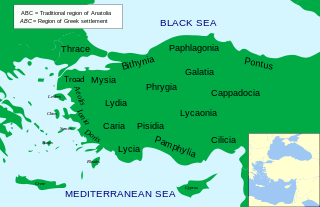
Anatolia in Classical Antiquity was first divided into several Iron Age kingdom, most notably Lydia in the west, Phrygia in the center and Urartu in the east. Anatolia fell under Achaemenid Persian rule c. 550 BC. In the aftermath of the Greco-Persian Wars, all of Anatolia remained under Persian control except for the Aegean coast, which was incorporated in the Delian League in the 470s BC. Alexander the Great finally wrested control of the whole region from Persia in the 330s BC. After Alexander's death, his conquests were split amongst several of his trusted generals, but were under constant threat of invasion from both the Gauls and other powerful rulers in Pergamon, Pontus, and Egypt.
Pontus, from the Ancient Greek word for a sea, may refer to:

The Cappadocian calendar was a solar calendar that was derived from the Persian Zoroastrian calendar. It is named after the historic region Cappadocia in present-day Turkey, where it was used. The calendar, which had 12 months of 30 days each and five epagomenal days, originated between 550 and 330 BC, when Cappadocia was part of the Persian Achaemenid Empire. The Cappadocian calendar was identical to the Zoroastrian calendar; this can be seen in its structure, in the Avestan names and in the order of the months. The Cappadocian calendar reflects the Iranian cultural influence in the region. Extant evidence of the calendar dates back to Late Antiquity through the accounts of Greek astronomers, by which time it had already been adapted to the Julian calendar.
Ariarathia or Ariaratheia was a town of ancient Cappadocia, in the Sargarausene region, inhabited during Hellenistic, Roman, and Byzantine times. It was founded by Ariarathes IV of Cappadocia. It was detached from Cappadocia and assigned to the province of Armenia Minor when that province was established. It became the seat of a bishop; no longer a residential bishopric, it remains a titular see of the Roman Catholic Church.
Ciscissus or Kiskisos was a town and bishopric of ancient Cappadocia. In Roman and Byzantine times the town's name was sometimes shortened to Cissus and belonged to the Roman province of Cappadocia Prima. It became a Christian bishopric, a suffragan of the metropolitan see of Caesarea in Cappadocia, the capital of the province. The names of two of its bishops are known from extant contemporary documents: Plato was at the Trullan Council of 692, and Soterichus at the Second Council of Nicaea in 787. No longer a residential bishopric, Ciscissus is today listed by the Catholic Church as a titular see.
This page is based on this
Wikipedia article Text is available under the
CC BY-SA 4.0 license; additional terms may apply.
Images, videos and audio are available under their respective licenses.

