
A stored-value card (SVC) is a payment card with a monetary value stored on the card itself, not in an external account maintained by a financial institution. This means no network access is required by the payment collection terminals as funds can be withdrawn and deposited straight from the card. Like cash, payment cards can be used anonymously as the person holding the card can use the funds. They are an electronic development of token coins and are typically used in low-value payment systems or where network access is difficult or expensive to implement, such as parking machines, public transport systems, closed payment systems in locations such as ships or within companies.
A cash advance is a service provided by most credit card and charge card issuers. The service allows cardholders to withdraw cash, either through an ATM or over the counter at a bank or other financial agency, up to a certain limit; for a credit card, this will be the credit limit.
The Australian Health Care Card is a card issued by the Australian Government which evidences the entitlement of the cardholder to concessions, such as the cost of some prescription medicines, medical services, and other government concessions. Eligibility for the card is determined by the eligibility for various federal government welfare payments. The benefits are clearly shown on the card. Some benefits are only available to recipients of certain Centrelink benefits.
A chargeback is a return of money to a payer of some transaction, especially a credit card transaction.

Credit card interest is a way in which credit card issuers generate revenue. A card issuer is a bank or credit union that gives a consumer a card or account number that can be used with various payees to make payments and borrow money from the bank simultaneously. The bank pays the payee and then charges the cardholder interest over the time the money remains borrowed. Banks suffer losses when cardholders do not pay back the borrowed money as agreed. As a result, optimal calculation of interest based on any information they have about the cardholder's credit risk is key to a card issuer's profitability. Before determining what interest rate to offer, banks typically check national, and international, credit bureau reports to identify the borrowing history of the card holder applicant with other banks and conduct detailed interviews and documentation of the applicant's finances.

Payment cards are part of a payment system issued by financial institutions, such as a bank, to a customer that enables its owner to access the funds in the customer's designated bank accounts, or through a credit account and make payments by electronic acc transfer and access automated teller machines (ATMs). Such cards are known by a variety of names including bank cards, ATM cards, client cards, key cards or cash cards.
3-D Secure is a protocol designed to be an additional security layer for online credit and debit card transactions. The name refers to the "three domains" which interact using the protocol: the merchant/acquirer domain, the issuer domain, and the interoperability domain.

The Shanghai Public Transportation Card (SPTC) is a contactless card, utilizing RFID technology, which can be used to access many forms of public transport and related services in and around Shanghai.
The Payment Card Industry Data Security Standard is an information security standard for organizations that handle branded credit cards from the major card schemes.
A credit card balance transfer is the transfer of the outstanding debt in a credit card account to an account held at another credit card company.
Credit card fraud is an inclusive term for fraud committed using a payment card, such as a credit card or debit card. The purpose may be to obtain goods or services or to make payment to another account, which is controlled by a criminal. The Payment Card Industry Data Security Standard is the data security standard created to help financial institutions process card payments securely and reduce card fraud.
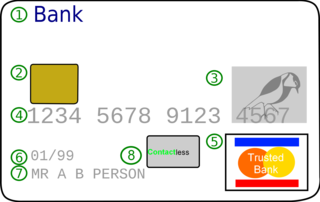
A credit card is a payment card issued to users (cardholders) to enable the cardholder to pay a merchant for goods and services based on the cardholder's accrued debt. The card issuer creates a revolving account and grants a line of credit to the cardholder, from which the cardholder can borrow money for payment to a merchant or as a cash advance. There are two credit card groups: consumer credit cards and business credit cards. Most cards are plastic, but some are metal cards, and a few gemstone-encrusted metal cards.
"Safe & Sound" is the 62nd episode of the American television series Prison Break and was broadcast on September 22, 2008 in the United States on the Fox Network.

The Documento nacional de identidad (DNI) or carnet de identidad is the Spanish national identity card. It is a laminated card or polycarbonate, which details the name and surnames of the holder along with date of birth, address, parents, sex, residential address, city and province of birth, and contains a photograph and an identification number consisting of 8 digits plus a control letter. This number is also used for tax purposes, receiving the name of Número de identificación fiscal (NIF).

The American Express Centurion Card, known informally as the Amex Black Card, is an invitation-only charge card issued by American Express. An invitation is extended to Platinum Card holders after they meet certain criteria. The Centurion Card comes in personal and business variants.

Overseas Citizenship of India (OCI) is a form of permanent residency available to people of Indian origin and their spouses which allows them to live and work in India indefinitely. Despite the name, OCI status is not citizenship and does not grant the right to vote in Indian elections or hold public office. The Indian government can revoke OCI status in a wide variety of circumstances. As of 2020, there are 6 million holders of OCI cards among the Indian Overseas diaspora.

A card security code is a series of numbers that, in addition to the bank card number, is embossed or printed on a card. The CSC is used as a security feature for card not present transactions, where a personal identification number (PIN) cannot be manually entered by the cardholder. It was instituted to reduce the incidence of credit card fraud.
In a credit card or debit card account, a dispute is a situation in which a customer questions the validity of a transaction that was registered to the account. Customers dispute charges for a variety of reasons, including unauthorized charges, excessive charges, failure by the merchant to deliver merchandise, defective merchandise, dissatisfaction with the product(s) or service(s) received, or billing errors.

The Dominican national identity card is a polycarbonate card containing the holder's full name, city of birth, nationality, sex, date of birth, civil status, occupation, polling station, and residential address, as well as a photograph that adheres to ISO/IEC 19794-5. The card can also optionally include the holder's blood type. Formerly, it included the holder's race.

Apple Card is a credit card created by Apple Inc. and issued by Goldman Sachs, designed primarily to be used with Apple Pay on Apple devices such as an iPhone, iPad, Apple Watch, or Mac. Currently, it is available only in the United States.
