
Carrier's stamp is a type of postage stamp used by private mail carriers to deliver mail directly to an addressee from the post office.
Carrier's stamp is a type of postage stamp used by private mail carriers to deliver mail directly to an addressee from the post office.
When the postal service was first organized, the delivery of mail was only from one post office to another post office and not directly to the addressee. This created the need for private mail carriers.
In the United States, this specialized category of stamps existed mainly from 1842 to 1860.

A postmark is a postal marking made on an envelope, parcel, postcard or the like, indicating the place, date and time that the item was delivered into the care of a postal service, or sometimes indicating where and when received or in transit. Modern postmarks are often applied simultaneously with the cancellation or killer that marks postage stamps as having been used. Sometimes a postmark alone is used to cancel stamps, and the two terms are often used interchangeably. Postmarks may be applied by handstamp or machine, using methods such as rollers or inkjets, while digital postmarks are a recent innovation.

The United States Postal Service (USPS), also known as the Post Office, U.S. Mail, or simply the Postal Service, is an independent agency of the executive branch of the United States federal government responsible for providing postal service in the United States, its insular areas and associated states. It is one of a few government agencies explicitly authorized by the Constitution of the United States. As of 2023, the USPS has 525,469 career employees and 114,623 non-career employees.
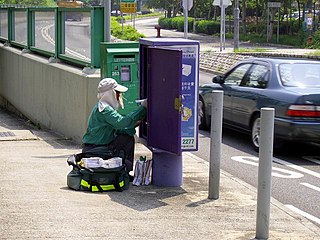
The mail or post is a system for physically transporting postcards, letters, and parcels. A postal service can be private or public, though many governments place restrictions on private systems. Since the mid-19th century, national postal systems have generally been established as a government monopoly, with a fee on the article prepaid. Proof of payment is usually in the form of an adhesive postage stamp, but a postage meter is also used for bulk mailing.
Canada Post Corporation, trading as Canada Post, is a Canadian Crown corporation that functions as the primary postal operator in Canada.

Postal service in the United States began with the delivery of stampless letters whose cost was borne by the receiving person, later encompassed pre-paid letters carried by private mail carriers and provisional post offices, and culminated in a system of universal prepayment that required all letters to bear nationally issued adhesive postage stamps.
This is a list of philatelic topics.

A postal marking is any kind of annotation applied to a letter by a postal service. The most common types are postmarks and cancellations; almost every letter will have those. Less common types include forwarding addresses, routing annotations, warnings, postage due notices and explanations, such as for damaged or delayed mail, and censored or inspected mail. A key part of postal history is the identification of postal markings, their purpose, and period of use.
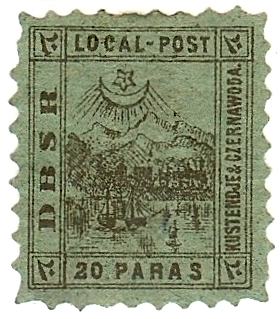
A local post is a mail service that operates only within a limited geographical area, typically a city or a single transportation route. Historically, some local posts have been operated by governments, while others, known as private local posts have been for-profit companies. Today, many stamp collectors operate hobbyists' local posts, issuing their own postal stamps known as "locals" or "cinderellas" for other collectors but rarely carrying any mail.

Dead letter mail or undeliverable mail is mail that cannot be delivered to the addressee or returned to the sender. This is usually due to lack of compliance with postal regulations, an incomplete address and return address, or the inability to forward the mail when both correspondents move before the letter can be delivered. Largely based on the British model that emerged in the late eighteenth century, many countries developed similar systems for processing undeliverable mail.
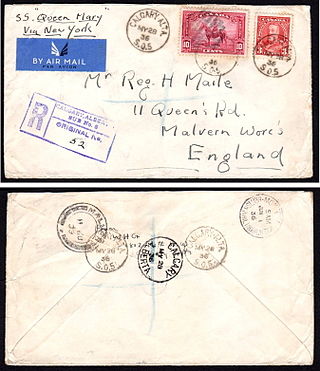
Registered mail is a postal service in many countries which allows the sender proof of mailing via a receipt and, upon request, electronic verification that an article was delivered or that a delivery attempt was made. Depending on the country, additional services may also be available, such as:
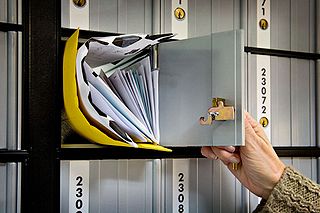
A post office box is a uniquely addressable lockable box located on the premises of a post office.

A letter box, letterbox, letter plate, letter hole, mail slot or mailbox is a receptacle for receiving incoming mail at a private residence or business. For outgoing mail, post boxes are often used for depositing the mail for collection, although some letter boxes are also capable of holding outgoing mail for a carrier to pick up. Letterboxes or mailboxes use the following primary designs:

The American Letter Mail Company was started by Lysander Spooner in 1844, competing against the legal monopoly of the United States Post Office.

Rural Free Delivery (RFD), since 1906 officially rural delivery, is a program of the United States Post Office Department to deliver mail directly to rural destinations. The program began in the late 19th century. Before that, people living in rural areas had to pick up mail themselves at sometimes distant post offices or pay private carriers for delivery.
The Festiniog Railway Letter Service is an officially authorised service within the United Kingdom railway system for posting and transmission of letters, and under certain circumstances also delivering the letters directly to intended recipients. The service operates on the Ffestiniog Railway and the Welsh Highland Railway in North Wales and similar services are operated on the Talyllyn Railway and other heritage railways in the UK. The service was also offered until 1984 by British Railways as successors to the many constituent railway companies that had in 1891 signed an agreement with the G.P.O. and it was BR that regulated the terms and the charges in conjunction with the post office.

U.S. Special Delivery was a postal service paid for with additional postage for urgent letters and postal packets which are delivered in less time than by standard or first class mail service. Its meaning is different and separate from express mail delivery service. Essentially it meant that a postal packet was delivered from a post office to the addressee immediately once it arrived at the post office responsible for delivering it, rather than waiting for the next regular delivery to the addressee.

The postage stamps and postal history of Guam is an overview of the postage stamps and postal history of the United States territory of Guam. Its postal service is linked to those of the Philippines during the Spanish Empire and, since 1898, to the United States of America. A peculiarity is that, for a short period in the 1930s, Guam had a local post service.
Rowan v. Post Office Dept., 397 U.S. 728 (1970), is a case in which the United States Supreme Court ruled that an addressee of postal mail has sole, complete, unfettered and unreviewable discretion to decide whether he or she wishes to receive further material from a particular sender, and that the sender does not have a constitutional right to send unwanted material into someone's home. It thus created a quasi-exception to free speech in cases in which a person is held as a "captive audience".

Colombia is a country in north-western South America. Colombia is bordered by Venezuela, Brazil, Ecuador, Peru, Panama and the Caribbean Sea and the Pacific Ocean. With a population of over 45 million people, Colombia has the second largest population in South America, after Brazil. The capital is Bogotá.

The U.S. Parcel Post stamps of 1912–13 were the first such stamps issued by the U.S. Post Office Department and consisted of twelve denominations to pay the postage on parcels weighing 16 ounces and more, with each denomination printed in the same color of "carmine-rose". Their border design was similar while each denomination of stamp bore its own distinctive image in the center (vignette). Unlike regular postage items, whose rates were determined by weight in ounces, Parcel Post rates were determined and measured by increments in pounds. The new stamps were soon widely used by industry, farmers and others who lived in rural areas. Partly owing to some confusion involving their usage, their exclusive use as Parcel Post stamps proved short lived, as regular postage stamps were soon allowed to be used to pay parcel postage rates.
 | This philatelic article is a stub. You can help Wikipedia by expanding it. |