
Look up catenary in Wiktionary, the free dictionary.
Catenary is a mathematical curve.
Catenary may also refer to:
Catenary is a mathematical curve.
Catenary may also refer to:


In physics and geometry, a catenary is the curve that an idealized hanging chain or cable assumes under its own weight when supported only at its ends in a uniform gravitational field.

An arch is a curved vertical structure spanning an open space underneath it. Arches may support the load above them, or they may perform a purely decorative role. As a decorative element, the arch dates back to the 4th millennium BC, but structural load-bearing arches became popular only after their adoption by the Ancient Romans in the 4th century BC.
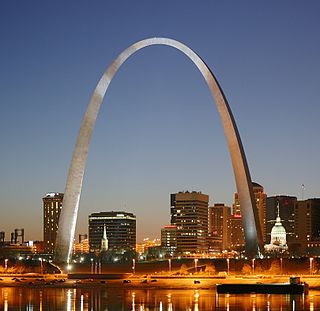
The Gateway Arch is a 630-foot-tall (192 m) monument in St. Louis, Missouri, United States. Clad in stainless steel and built in the form of a weighted catenary arch, it is the world's tallest arch and Missouri's tallest accessible structure. Some sources consider it the tallest human-made monument in the Western Hemisphere. Built as a monument to the westward expansion of the United States and officially dedicated to "the American people", the Arch, commonly referred to as "The Gateway to the West", is a National Historic Landmark in Gateway Arch National Park and has become a popular tourist destination, as well as an internationally recognized symbol of St. Louis.
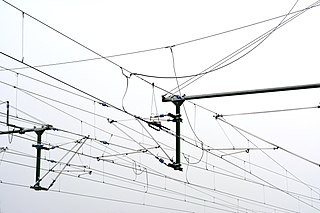
An overhead line or overhead wire is an electrical cable that is used to transmit electrical energy to electric locomotives, electric multiple units, trolleybuses or trams. The generic term used by the International Union of Railways for the technology is overhead line. It is known variously as overhead catenary, overhead contact line (OCL), overhead contact system (OCS), overhead equipment (OHE), overhead line equipment, overhead lines (OHL), overhead wiring (OHW), traction wire, and trolley wire.

In geometry, a catenoid is a type of surface, arising by rotating a catenary curve about an axis. It is a minimal surface, meaning that it occupies the least area when bounded by a closed space. It was formally described in 1744 by the mathematician Leonhard Euler.
In mathematics, a Cohen–Macaulay ring is a commutative ring with some of the algebro-geometric properties of a smooth variety, such as local equidimensionality. Under mild assumptions, a local ring is Cohen–Macaulay exactly when it is a finitely generated free module over a regular local subring. Cohen–Macaulay rings play a central role in commutative algebra: they form a very broad class, and yet they are well understood in many ways.
Catena or catenae (plural) may refer to:

In geometry, a tractrix is the curve along which an object moves, under the influence of friction, when pulled on a horizontal plane by a line segment attached to a pulling point that moves at a right angle to the initial line between the object and the puller at an infinitesimal speed. It is therefore a curve of pursuit. It was first introduced by Claude Perrault in 1670, and later studied by Isaac Newton (1676) and Christiaan Huygens (1693).

In mathematics, the Borromean rings are three simple closed curves in three-dimensional space that are topologically linked and cannot be separated from each other, but that break apart into two unknotted and unlinked loops when any one of the three is cut or removed. Most commonly, these rings are drawn as three circles in the plane, in the pattern of a Venn diagram, alternatingly crossing over and under each other at the points where they cross. Other triples of curves are said to form the Borromean rings as long as they are topologically equivalent to the curves depicted in this drawing.

A pantograph is an apparatus mounted on the roof of an electric train, tram or electric bus to collect power through contact with an overhead line. The term stems from the resemblance of some styles to the mechanical pantographs used for copying handwriting and drawings.
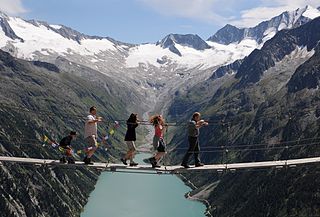
A simple suspension bridge is a primitive type of bridge in which the deck of the bridge lies on two parallel load-bearing cables that are anchored at either end. They have no towers or piers. The cables follow a shallow downward catenary arc which moves in response to dynamic loads on the bridge deck.
Masayoshi Nagata was a Japanese mathematician, known for his work in the field of commutative algebra.

The Seventh Street Improvement Arches are a double-arched masonry highway bridge that formerly spanned the St. Paul and Duluth Railroad tracks in Saint Paul, Minnesota, United States. The Seventh Street Improvement Arches are historically significant for its rarity and the technically demanding nature of its skewed, helicoidal spiral, stone-arch design. The bridge is one of the few of its type in the United States, and is the only known bridge of its type in Minnesota. It was built from 1883 to 1884 by Michael O'Brien and McArthur Brothers of Chicago and was designed by William A. Truesdell. The bridge was listed on the National Register of Historic Places in 1989 and on the American Society of Civil Engineers Historic Civil Engineering Landmarks in 2000.
In mathematics, a commutative ring R is catenary if for any pair of prime ideals p, q, any two strictly increasing chains

A parabolic arch is an arch in the shape of a parabola. In structures, their curve represents an efficient method of load, and so can be found in bridges and in architecture in a variety of forms.

A catenary arch is a type of architectural arch that follows an inverted catenary curve. The catenary curve has been employed in buildings since ancient times. It forms an underlying principle to the overall system of vaults and buttresses in stone vaulted Gothic cathedrals and in Renaissance domes. It is not a parabolic arch, although the non-circumferential curves used in arch designs look similar, and match at shallow profiles, so a catenary is often misclassified as a parabola.

The New York, New Haven and Hartford Railroad pioneered electrification of main line railroads using high-voltage, alternating current, single-phase overhead catenary. It electrified its mainline between Stamford, Connecticut, and Woodlawn, New York, in 1907 and extended the electrification to New Haven, Connecticut, in 1914. While single-phase AC railroad electrification has become commonplace, the New Haven's system was unprecedented at the time of construction. The significance of this electrification was recognized in 1982 by its designation as a Historic Mechanical Engineering Landmark by the American Society of Mechanical Engineers (ASME).

In mathematics, a minimal surface of revolution or minimum surface of revolution is a surface of revolution defined from two points in a half-plane, whose boundary is the axis of revolution of the surface. It is generated by a curve that lies in the half-plane and connects the two points; among all the surfaces that can be generated in this way, it is the one that minimizes the surface area. A basic problem in the calculus of variations is finding the curve between two points that produces this minimal surface of revolution.
A weighted catenary is a catenary curve, but of a special form: if a catenary is the curve formed by a chain under its own weight, a weighted catenary is the curve formed if the chain's weight is not consistent along its length. Formally, a "regular" catenary has the equation

The Glebe and Wentworth Park railway viaducts are a series of two heritage-listed railway bridges and arch viaducts that carry the Inner West Light Rail across Wentworth Park, Jubilee Park, and Johnstons Creek in the inner western Sydney suburb of Glebe in the City of Sydney local government area of New South Wales, Australia. They were designed by the New South Wales Government Railways and built from 1892 to 1922 by day labour. They are also known as Wentworth Park Viaduct, Jubilee Park Viaduct and Glebe Viaducts. The viaducts were added to the New South Wales State Heritage Register on 2 April 1999.