Máel Coluim mac Domnaill was king of Alba, becoming king when his cousin Constantine II abdicated to become a monk. He was the son of Donald II.
The Conmhaícne Mara or Conmaicne Mara, were an early people of Ireland. Their tuath was located in the extreme west of County Galway, Republic of Ireland, giving their name to Connemara, an anglicised form of Conmhaicne Mara.
The Ó Duibhgeannáin clan were a family of professional historians in medieval and early modern Ireland.
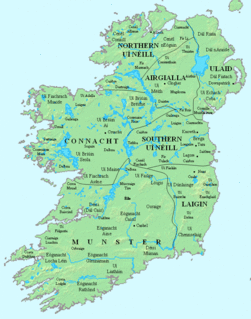
The Conmhaícne or Conmaicne were a people of early Ireland, perhaps related to the Laigin, who dispersed to various parts of Ireland. They settled in Connacht and Longford, giving their name to several Conmaicne territories. T. F. O'Rahilly's assertion the Conmaicne were non-Goidelic is not widely accepted.
Máel Muire is the fifth alleged bishop of St Andrews, though at that period the bishop of the Scots did not necessarily have one episcopal seat. He is mentioned in the bishop-list of the 15th-century historian Walter Bower as the successor of Cellach II, the latter of whom reign for at least 25 years. Nothing else is known about Máel Muire. However, he cannot have been bishop before 988/9, because that is the earliest likely date for the end of the episcopate of his predecessor Cellach. The next firm date for any bishop of the Scots is 1055, when the Annals of Tigernach records the death of bishop Máel Dúin, and obviously this date is too far ahead to be of very much use.
Cellach of Armagh or Celsus or Celestinus (1080–1129) was Archbishop of Armagh and an important contributor to the reform of the Irish church in the twelfth century. He is venerated in the Roman Catholic Church as Saint Cellach. Though a member of the laicised ecclesiastical dynasty of Clann Sínaig, he took holy vows and gained priestly ordination. This put an end to the anomalous state of affairs, in effect since 966, whereby the supreme head of the Irish Church had been a layman. Following the Synod of Ráith Bressail, in which a diocesan structure for Ireland was established, he became the first metropolitan primate of all Ireland.
The Uí Briúin were a royal dynasty of Connacht. Their eponymous apical ancestor was Brión, son of Eochaid Mugmedon and Mongfind, and an elder half brother of Niall of the Nine Hostages. They formed part of the Connachta, along with the Uí Fiachrach and Uí Ailello, putative descendants of Eochaid Mugmedon's sons Fiachra and Ailill. The Uí Ailello were later replaced as the third of the Three Connachta, through genealogical sleight of hand, by the Uí Maine.
Sechnassach mac Blathmaic followed his father Blathmac mac Áedo Sláine and uncle Diarmait mac Áedo Sláine as High King of Ireland and King of Brega. He belonged to the Síl nÁedo Sláine kindred of the southern Uí Néill, named for his grandfather Áed Sláine.
Loingsech mac Óengusso was an Irish king who was High King of Ireland. Loingsech was a member of the northern Cenél Conaill branch of the Uí Néill. Although his father Óengus had not been High King, his grandfather Domnall mac Áedo had been.
Cellach mac Máele Coba was an Irish king and is said to have been High King of Ireland.
Conall mac Máele Coba, called Conall Cóel, was an Irish king and is said to have been High King of Ireland.
Cellach Cualann mac Gerthidi was the last Uí Máil king of Leinster. Cellach's byname is derived from the land of Cualu which lay around Glendalough.
Rogallach mac Uatach was a king of Connacht from the Uí Briúin branch of the Connachta. He was the son of Uatu mac Áedo, a previous king. He married Muireann, the great-great-great-granddaughter of Túathal Máelgarb, High King of Ireland. He acquired the throne of Connacht after defeating the previous king Colmán mac Cobthaig of the Ui Fiachrach Aidhne, who was slain at the Battle of Cennbag in 622. Professor Francis Byrne believes he is the first reasonable representative of this branch to be said to have held the throne of Connacht
Cellach mac Rogallaig was a King of Connacht from the Uí Briúin Sil Cellaig branch of the Connachta. He was the son of Rogallach mac Uatach, a previous king. He succeeded his nephew Muiredach Muillethan mac Fergusso as king in 702.
Forggus mac Cellaig was a King of Connacht from the Uí Briúin branch of the Connachta. He was the son of Cellach mac Rogallaig, a previous king and brother of Domnall mac Cellaig. The sept of Uí Briúin he belonged to was the Síl Cellaig of Loch Cime named for his father. He reigned from 742 to 756.
Cellach mac Dúnchada was a King of Leinster of the Uí Dúnchada sept of the Uí Dúnlainge branch of the Laigin. He was the son of Dúnchad mac Murchado, and Taileflaith. This sept had their royal seat at Líamhain. He ruled from 760 to 776.
Cellach mac Fáelchair or Cellach Raigni was a King of Osraige in modern County Kilkenny. He was the son of Fáelchar Ua Máele Ódrain, a previous king.
Events from the 8th century in Ireland.
The Conmhaícne Mheáin Maigh or Conmaicne Mhein or Conmaicne Máenmaige or Conmaicne Críche Meic Erca, were an early people of Ireland, their tuath comprising the barony of Loughrea, in County Galway.
The Conmhaícne Dúna Móir, or Cenéoil Dubáin were an early people of Ireland. Their tuath comprised at least the barony of Dunmore, in County Galway.
