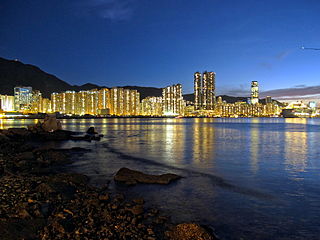
The Eastern District located on northeastern part of Hong Kong Island, being one of the 18 administrative districts of Hong Kong. It had a population of 529,603 in 2021 The district has the second highest population while its residents have the third highest median household income among the 18 districts.

Wan Chai District is one of the 18 districts of Hong Kong. Of the four on Hong Kong Island, it is north-central, and had 166,695 residents in 2021, an increase from 152,608 residents in 2011. The district has the second-highest educationally qualified residents with the highest-bracket incomes, the second-lowest population and the third-oldest quotient. It is a relatively affluent district, with one in five persons having liquid assets of more than HKD 1 million.
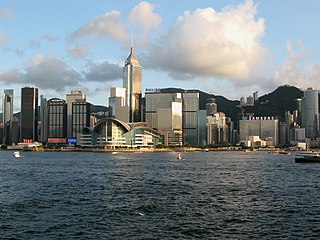
Wan Chai is located in the western part of Wan Chai District on the northern shore of Hong Kong Island, Hong Kong. It is bounded by Canal Road to the east, Arsenal Street to the west, and Bowen Road to the south. The area north of Gloucester Road is often called Wan Chai North.

Hong Kong Island is an island in the southern part of Hong Kong. The island, known originally and on road signs simply as "Hong Kong", had a population of 1,289,500 and a population density of 16,390 per square kilometre (42,400/sq mi), as of 2023. It is the second largest island in Hong Kong, with the largest being Lantau Island. Hong Kong Island forms one of the three areas of Hong Kong, with the other two being Kowloon and the New Territories.

The Island line is one of ten lines of the MTR, the mass transit system in Hong Kong. It runs from Kennedy Town in the Western district to Chai Wan in the Eastern District on Hong Kong Island, passing through the territory's major business districts of Central, Wan Chai and Causeway Bay, and connecting them with built-up areas on the north shore of the island.

Tai Tam Road in Hong Kong links the districts of Chai Wan and Stanley on Hong Kong Island. This road connects Chai Wan Road, the northern end of Shek O Road, Turtle Cove, Tai Tam and Stanley. The Tai Tam Tuk Reservoir's dam constitutes a section of the road that is particularly narrow.

Exhibition Centre (Chinese: 會展; Cantonese Yale: wuih jín) is an MTR station on the East Rail line. It serves the Hong Kong Convention and Exhibition Centre and other parts of Wan Chai North, on Hong Kong Island, Hong Kong.

The Hong Kong Convention and Exhibition Centre (HKCEC) is one of the two major convention and exhibition venues in Hong Kong, along with AsiaWorld–Expo. It is located in Wan Chai North, Hong Kong Island. Built along the Victoria Harbour, it is linked by covered walkways to nearby hotels and commercial buildings. The venue was designed by Skidmore, Owings & Merrill LLP, in association with Wong & Ouyang (HK) Ltd. Larry Oltmanns led the design as the Design Partner with SOM.
Mài is a Chinese surname. It is commonly transliterated as Mak in Hong Kong, based on the Cantonese pronunciation, though other transliterations exist. "麥" is the standard character in both Traditional and Simplified scripts but 麦 is also a variant seen in both. The meaning of the Chinese character is either wheat or barley. According to a 2013 study, 麦 was the 200th most common surname, shared by 550,000 people or 0.041% of China's population, with Guangdong being the province with the most.
The Sixth Ministerial Conference of the World Trade Organization, also known as the WTO Hong Kong Ministerial Conference and abbreviated as MC6, was held at the Hong Kong Convention and Exhibition Centre, Wan Chai, Hong Kong from 13 to 18 December 2005. Representatives from 148 countries were expected to attend the event, as well as over 10,000 protesters led by the Hong Kong People’s Alliance on WTO and made up of largely South Korean farmers. The conference approved a declaration which many participants described as marking "significant progress". However, due to violent protesters, police officers were deployed with batons, riot gas, and other non-lethal weapons. Around 910 people were arrested. Of these, 14 were charged, but none were convicted.

Cài is a Chinese-language surname that derives from the name of the ancient Cai state. In 2019 it was the 38th most common surname in China, but the 9th most common in Taiwan, where it is usually romanized as "Tsai", "Tsay", or "Chai" and the 8th most common in Singapore, where it is usually romanized as "Chua", which is based on its Teochew and Hokkien pronunciation. Koreans use Chinese-derived family names and in Korean, Cai is 채 in Hangul, "Chae" in Revised Romanization, It is also a common name in Hong Kong where it is romanized as "Choy", "Choi" or "Tsoi". In Macau, it is spelled as "Choi". In Malaysia, it is romanized as "Choi" from the Cantonese pronunciation, and "Chua" or "Chuah" from the Hokkien or Teochew pronunciation. It is romanized in the Philippines as "Chua" or "Chuah", and in Thailand as "Chuo" (ฉั่ว). Moreover, it is also romanized in Cambodia as either "Chhay" or "Chhor" among people of full Chinese descent living in Cambodia and as “Tjhai”, "Tjoa" or "Chua" in Indonesia.

The Island Eastern Corridor (IEC) is an expressway built along the northeastern shore of Hong Kong Island in Hong Kong. It starts from Causeway Bay in the west and ends in Chai Wan in the east. It is mostly part of Route 4. The section between Causeway Bay and Quarry Bay consists mainly of viaducts built along Victoria Harbour.

According to the 2016 census, Islam is practised by 4.1% of the population of Hong Kong, or about 300,000 Muslims. Of this number, 50,000 are Chinese, 150,000 are Indonesians and 30,000 are Pakistanis, with the rest from other parts of the world. The vast majority of Muslims in Hong Kong are Sunni.

Yao, also romanized as Yiu in Cantonese, is one of the most ancient Chinese surnames, the "Eight Great Xings of High Antiquity". It is also unique that, along with Jiang 姜 it is still in common use in the modern day. It is listed 101st in the Hundred Family Surnames, and as the 51st most common surname in Mainland China.

Central and Wan Chai Reclamation is a project launched by the government of Hong Kong since the 1990s to reclaim land for different purposes. This includes transportation improvements such as the Hong Kong MTR station, Airport Express Railway & Central-Wan Chai Bypass, as well as public recreation space such as the Central Harbourfront Event Space, Tamar Park and the Hong Kong Observation Wheel.
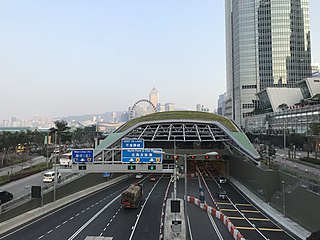
The Central–Wan Chai Bypass is a 4-kilometre (2.5 mi) trunk road running between Sheung Wan and Fortress Hill on Hong Kong Island. The original design consists of a 2.3 km dual three-lane tunnel running under new reclamation areas provided by the Central and Wan Chai Reclamation project, and also connections to Connaught Road West flyover and Island Eastern Corridor. It substitutes Connaught Road Central, Harcourt Road, Gloucester Road and Victoria Park Road to be part of Route 4.
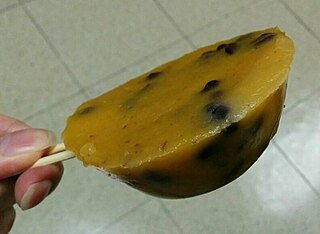
Put chai ko is a popular snack in Hong Kong. It is a rice cake made from white or brown sugar, long-grain rice flour with a little wheat starch or cornstarch. Sometimes red beans are also added. The batter is poured into porcelain bowls and steamed until cooked through. Then it is allowed to cool and served at room temperature. Traditionally, the hawker inserts two bamboo skewers into the cake to turn it out and the eater holds the skewers to consume. At present, most put chai ko are sold in plastic bags.
Wan Chai is a metropolitan area in Hong Kong.

French International School "Victor Segalen" of Hong Kong is a French international school in Hong Kong. It is the only accredited French school in Hong Kong (linked by an agreement with the Agency for French Teaching Abroad. It has over 2,500 students in four different campuses. Since September 2014, FIS expanded its operations to a new campus in Hung Hom. In September 2018, the FIS opened its new campus in Tseung Kwan O, closing the Hung Hom Campus.
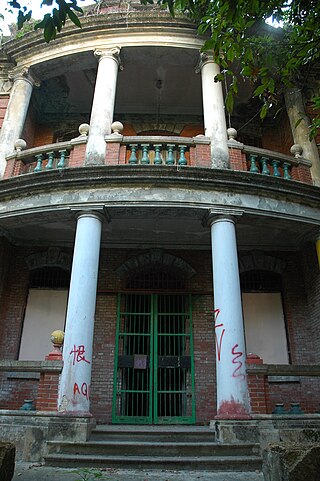
Nam Koo Terrace is a Grade I Historic Building located at No. 55 Ship Street, Wan Chai, Hong Kong, popularly known as "The Wan Chai Haunted House". The building is currently owned by Hopewell Holdings, a large property development company based in Hong Kong.
