
The municipality and town of Jamay is located in the eastern portion of Jalisco, Mexico, at coordinates 20°17.4′N102°42.6′W, at a height of 1,530 meters (5,020 ft) above sea level. The municipality extends from 20° 25' to 20° 13' N, and from 102° 38' to 102° 44' W.
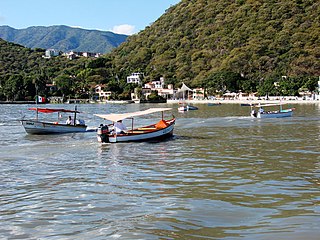
Lake Chapala is Mexico's largest freshwater lake. It lies in the municipalities of Chapala, Jocotepec, Poncitlán, and Jamay, in Jalisco, and in Venustiano Carranza and Cojumatlán de Régules, in Michoacán.

Chapala is a town and municipality in the central Mexican state of Jalisco, located on the north shore of Lake Chapala, Mexico's largest freshwater lake. According to the 2015 census, its population is 50,738 for the municipality. The municipality includes about 11,000 in the town of Ajijic.
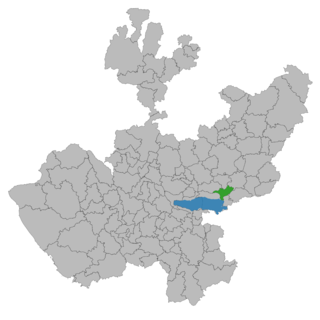
Ocotlán is a city and municipality in Jalisco, Mexico. Its industry includes furniture production.

The Lerma River is Mexico's second longest river. It is a 750 km-long (470 mi) river in west-central Mexico that begins in Mexican Plateau at an altitude over 3,000 metres (9,843 ft) above sea level, and ends where it empties into Lake Chapala, Mexico's largest lake, near Guadalajara, Jalisco. Lake Chapala is the starting point of Río Grande de Santiago, which some treat as a continuation of the Lerma River. In combination, the two are often called the Lerma Santiago River. The Lerma River is notorious for its pollution, but the water quality has demonstrated considerable improvement in recent years due mostly to government environmental programs and through massive upgrading projects of sanitation works.

The Río Grande de Santiago, or Santiago River, is a river in western Mexico. It flows westwards from Lake Chapala through the states of Jalisco and Nayarit to empty into the Pacific Ocean. It one of the longest rivers in Mexico, measuring up 433 km (269 mi) long.
Isla de los Alacranes is an island in Lake Chapala, in the Mexican state of Jalisco.

Ajijic is a town about 4.8 kilometres (3.0 mi) west from the town of Chapala, part of the municipality, in the State of Jalisco, Mexico. It is situated on the north shore of Lake Chapala, surrounded by mountains. Ajijic enjoys a moderate climate year-round. The population of Ajijic was 11,439 as of the 2020 census.
Yurécuaro is a town and a municipality in the region of the Chapala cienega at the north-west in the Mexican state of Michoacán, at a height of 1530 meters (5065 ft) above sea level. Its limits to the north with the state of Jalisco separated by the Lerma river, at west with La Piedad, at south with Ecuandureo and to the southeast with Tanhuato. The distance to the state capital Morelia is 125 miles and to Guadalajara is 85 miles.
The Coca people are part of one of the oldest indigenous group who live in what is now the state of Nayarit, Mexico. The ancestral group were the Concheros, who first settled in coves on the Pacific coast of Nayarit, and made houses out of sea shells. Their Gods were the ocean and the wind. They became known in the passing years as the shaft tomb culture, because of cylindrical tombs spread throughout Nayarit and Jalisco, spreading down the west side of Lake Chapala all the way to Colima.
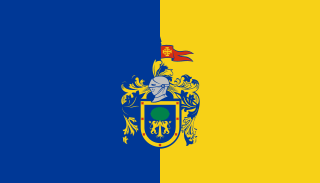
Jalisco, officially the Free and Sovereign State of Jalisco, is one of the 32 Federal Entities of Mexico. It is located in Western Mexico and is bordered by six states which are Nayarit, Zacatecas, Aguascalientes, Guanajuato, Michoacán, and Colima. Jalisco is divided into 125 municipalities, and its capital city is Guadalajara.

Ayotlán Municipality is a municipality, in Jalisco in central-western Mexico. The municipality covers an area of 518.57 km2.

Jocotepec is a town and municipality, in Jalisco in central-western Mexico. The municipality covers an area of 384.36 km². As of 2005, the municipality had a total population of 37,972.

Tuxcueca is a town and municipality, in Jalisco in central-western Mexico. The municipality covers an area of 298.94 km².

The Tuxpan River, also known as the Coahuayana River is a river of Mexico. It originates in the Trans-Mexican Volcanic Belt south of Lake Chapala. It flows southwards through Tuxpan Municipality, Jalisco, and then forms the eastern border of Colima with Michoacán before emptying into the Pacific Ocean.
Adolfo "Tito" Antuñano Morán was a former World Championship water skier.

The 2015 North Indian Ocean cyclone season was an event in the annual cycle of tropical cyclone formation. The North Indian Ocean cyclone season has no official bounds, but cyclones tend to form between months of April and December, with the peak from May to November. These dates conventionally delimit the period of each year when most tropical cyclones form in the northern Indian Ocean.

Extremely Severe Cyclonic Storm Chapala was a powerful tropical cyclone that caused moderate damage in Somalia and Yemen during November 2015. Chapala was the third named storm of the 2015 North Indian Ocean cyclone season. It developed as a depression on 28 October off western India, and strengthened a day later into a cyclonic storm. Chapala then rapidly intensified amid favorable conditions. On 30 October, the India Meteorological Department (IMD) estimated that Chapala attained peak three-minute sustained winds of 215 km/h (135 mph). The American-based Joint Typhoon Warning Center (JTWC) estimated sustained winds of 240 km/h (150 mph), making Chapala among the strongest cyclones on record in the Arabian Sea. After peak intensity, Chapala skirted the Yemeni island of Socotra on 1 November, becoming the first hurricane-force storm there since 1922. High winds and heavy rainfall resulted in an island-wide power outage, and severe damage was compounded by Cyclone Megh, which struck Yemen a week later.
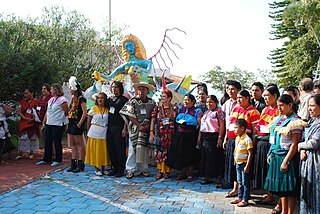
Feria Maestros del Arte is a non profit organization and annual three-day event held to support Mexican handcrafts and folk art in Chapala, Jalisco, Mexico. Unlike other fairs of this type, invited participants are not charged booth fees or percentages, and are even afforded transport and accommodations with area families. The Feria has grown from thirteen artisan participants to over eighty, and the organization is legally recognized in Mexico and the United States.
