See also
 | This disambiguation page lists articles about people with the same name. If an internal link led you here, you may wish to change the link to point directly to the intended article. |
Charles Vane was an English pirate.
Charles Vane may also refer to:
| | This disambiguation page lists articles about people with the same name. If an internal link led you here, you may wish to change the link to point directly to the intended article. |

The Long Parliament was an English Parliament which lasted from 1640 until 1660. It followed the fiasco of the Short Parliament, which had convened for only three weeks during the spring of 1640 after an 11-year parliamentary absence. In September 1640, King Charles I issued writs summoning a parliament to convene on 3 November 1640. He intended it to pass financial bills, a step made necessary by the costs of the Bishops' Wars in Scotland. The Long Parliament received its name from the fact that, by Act of Parliament, it stipulated it could be dissolved only with agreement of the members; and, those members did not agree to its dissolution until 16 March 1660, after the English Civil War and near the close of the Interregnum.

Sir Henry Vane was an English politician, statesman, and colonial governor. He was briefly present in North America, serving one term as the Governor of the Massachusetts Bay Colony, and supported the creation of Roger Williams' Rhode Island Colony and Harvard College. A proponent of religious tolerance, he returned to England in 1637 following the Antinomian controversy. As governor, he defended Anne Hutchinson and her right to teach religious topics in her home which put him in direct conflict with the Puritan leaders in the Massachusetts Colony. Eventually, Mrs. Hutchinson was banned from the colony.
Chuck, Charlie or Charles Stewart may refer to:
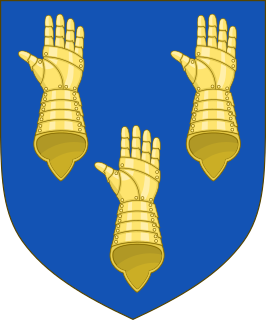
Baron Inglewood, of Hutton in the Forest in the County of Cumberland, is a title in the Peerage of the United Kingdom.
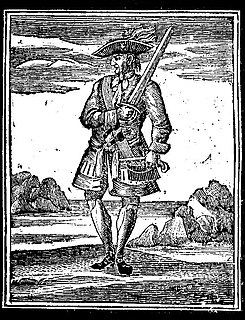
John Rackham, commonly known as Calico Jack, was an English pirate captain operating in the Bahamas and in Cuba during the early 18th century. His nickname was derived from the calico clothing that he wore, while Jack is a nickname for "John".
Marquess of Londonderry, of the County of Londonderry, is a title in the Peerage of Ireland.
Baron Barnard, of Barnard Castle in the Bishopric of Durham, is a title in the Peerage of England. It was created in 1698 for Christopher Vane, who had previously served as a member of parliament for County Durham and Boroughbridge. Vane was the son of Sir Henry Vane the Younger and grandson of Sir Henry Vane the Elder. His grandson, the third Baron, notably served as Paymaster of the Forces and as Lord Lieutenant of County Durham. In 1754 he was created Viscount Barnard, of Barnard Castle in the County of Durham, and Earl of Darlington, in the County of Durham. Lord Darlington was the husband of Lady Grace FitzRoy, daughter of Charles FitzRoy, 2nd Duke of Cleveland, the illegitimate son of King Charles II by his mistress Barbara Villiers, 1st Duchess of Cleveland.
A weather vane, wind vane, or weathercock is an instrument used for showing the direction of the wind. It is typically used as an architectural ornament to the highest point of a building. The word vane comes from the Old English word fana, meaning 'flag'.

Duke of Cleveland is a title that has been created twice, once in the Peerage of England and once in the Peerage of the United Kingdom. The dukedoms were named after Cleveland in northern England.
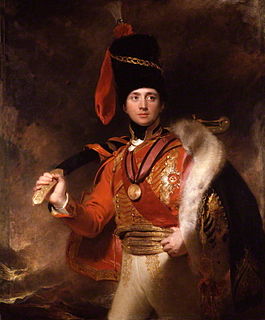
Charles William Vane, 3rd Marquess of Londonderry,, was an Irish soldier in the British army, a politician, and a nobleman. As a soldier he fought in the French Revolutionary Wars, in the suppression of the Irish Rebellion of 1798, and in the Napoleonic wars. He excelled as a cavalry commander on the Iberian Peninsula under John Moore and Arthur Wellesley.
This is a list of people who have served as Lord Lieutenant of Durham.

A rotary vane pump is a positive-displacement pump that consists of vanes mounted to a rotor that rotates inside a cavity. In some cases these vanes can have variable length and/or be tensioned to maintain contact with the walls as the pump rotates. It was invented by Charles C. Barnes of Sackville, New Brunswick, who patented it on June 16, 1874. There have been various improvements, including a variable vane pump for gases (1909). They are considered less suitable than other vacuum pumps for high-viscosity and high-pressure fluids, and are complex to operate. They can endure short periods of dry operation, and are considered good for low-viscosity fluids.

George Henry Robert Charles William Vane-Tempest, 5th Marquess of Londonderry, KP, styled Viscount Seaham between 1823 and 1854 and known as The Earl Vane between 1854 and 1872, was a British aristocrat, businessman, diplomat and Conservative politician.

Charles Vane was an English pirate who operated in the Bahamas during the end of the Golden Age of Piracy.
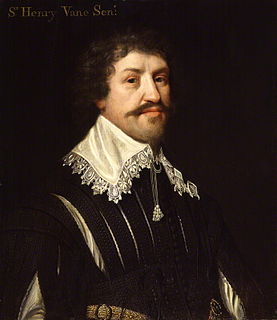
Sir Henry Vane, the elder was an English politician who sat in the House of Commons at various times between 1614 and 1654. He served King Charles in many posts including secretary of state, but on the outbreak of the English Civil War joined the Parliamentary cause. He was the third cousin of Francis Fane, 1st Earl of Westmorland.
Out from the Shadow is a 1911 American short silent drama film directed by D. W. Griffith and starring Blanche Sweet.

Frances Anne Vane, Marchioness of Londonderry was a wealthy English heiress and noblewoman. She was the daughter of Sir Henry Vane-Tempest, 2nd Baronet. She married Charles William Stewart, 1st Baron Stewart. She became a marchioness in 1822 when Charles succeeded his half-brother as 3rd Marquess of Londonderry.
Charles Vane was a British stage and film actor. Vane appeared in more than fifty films during the silent era including the lead in When It Was Dark (1919).
The House of Fortescue is a 1916 British silent drama film directed by Frank Wilson and starring Stewart Rome, Violet Hopson and Lionelle Howard. An Australian millionaire marries a woman to help save her father's business from ruin.
Calvary is a 1920 British silent drama film directed by Edwin J. Collins and starring Malvina Longfellow, Henry Victor and Charles Vane.