Related Research Articles


Erzulie is a family of loa, or spirits, in Vodou.
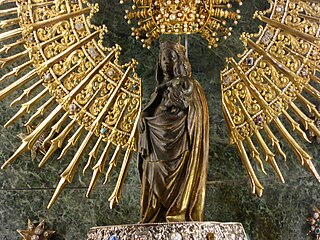
Our Lady of the Pillar is the name given to the Blessed Virgin Mary in the context of the traditional belief that Mary, while living in Jerusalem, supernaturally appeared to the Apostle James the Greater in AD 40 while he was preaching in what is now Spain. Those who adhere to this belief consider this appearance to be the only recorded instance of Mary exhibiting the mystical phenomenon of bilocation. Among Catholics, it is also considered the first Marian apparition, and unique because it happened while Mary was still living on Earth.
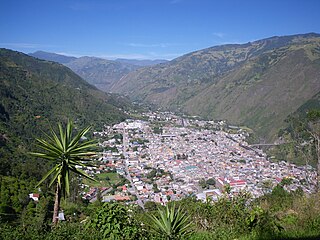
Baños de Agua Santa, commonly referred to as Baños, is a city in eastern Tungurahua Province of Ecuador. Baños is the second most populous city in Tungurahua, after the capital Ambato, and is a major tourist center. Baños is known as the "Gateway to the Amazon," as it is the last city still located in the mountain region before reaching the jungle and other towns that are located in the Amazon River basin.

Santurtzi is a port town in the province of Biscay, in the autonomous community of Basque Country, Spain. It is located in the Bilbao Abra bay, near the mouth of the Nervión river, on its left bank, 14 km downriver from Bilbao and forms part of the Greater Bilbao agglomeration. It has a population of 45,853 (2019) and a land area of 6.77 km².

Brazilian mythology is the subset of Brazilian folklore with cultural elements of diverse origin found in Brazil, comprising folk tales, traditions, characters and beliefs regarding places, people, and entities. The category was originally restricted to indigenous elements, but has been extended to include:

Saint Marina of Aguas Santas (Marina of Ourense) (c.120–135 AD) is a virgin martyr from Aguas Santas, in the province of Ourense. The story of her life as it has been preserved is a mixture of fact and legends.
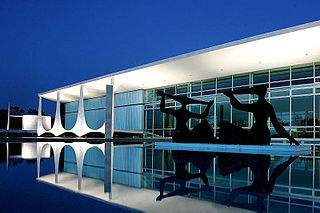
Iara, also spelled Uiara, Yara or Hiara or Mãe das Águas, is a figure from Brazilian mythology based on the ancient Tupi and Guaraní mythology. The word derives from Old Tupi yîara = y ("water") + îara = "lady of the lake". Depending on the oral tradition and the context of the story, she can be seen either as a water nymph, a siren, or a beautiful mermaid that lives in the Amazon River.
The Morenada is an Andean folk dance whose origins are still under debate. This dance is practiced mainly in Bolivia as well as in Peru and in recent years with Bolivian immigration in Chile, Argentina and other countries.
Our Lady of Charity is a celebrated Marian title of the Blessed Virgin Mary venerated in many Catholic countries.
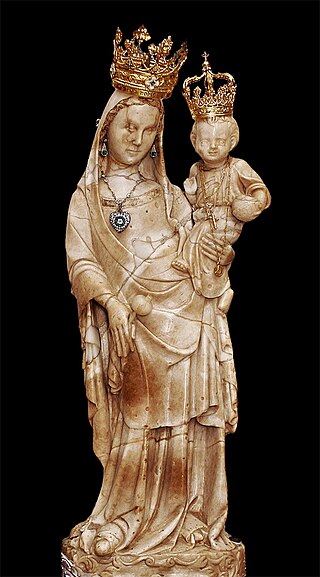
The Virgin of Miracles or Saint Mary of La Rábida is a religious Roman Catholic image venerated at the La Rabida Monastery in the city of Palos de la Frontera.

The Cantabrian Water Dog is a landrace breed of dog developed in the coast of Cantabria, northern Spain, as an assistant to fishermen. The breed was classified and recognized by the Breeds Committee of the Spanish Ministry of Environment on 22 March 2011. It is recognised by the Royal Canine Society of Spain as a variety of the Spanish water dog.

Our Lady of the Most Holy Rosary, Queen of the Caracol, known locally as Mahal na Birhen ng Santo Rosaryo, Reyna ng Karakol or Nuestra Señora Virgen del Santissimo Rosario, Reina de Caracol, is the patroness of the Municipality of Rosario, formerly known as Salinas, in Cavite province, Philippines.
Luz Amparo Cuevas Arteseros was a Spanish Roman Catholic seer. She claimed that the Virgin of the Sorrows appeared to her in Prado Nuevo estate in the Madrilenian municipality of El Escorial on 14 June 1981. Following these statements arose a religious movement that has mobilized thousands of people who go to the place of Marian apparitions. She was called "El Escorial seer" referring to the village where Amparo claimed to have seen the apparitions.

Yemọja is the major water spirit from the Yoruba religion. She is the mother of all Orishas. She is also the mother of humanity. She is an orisha, in this case patron spirit of rivers, particularly the Ogun River in Nigeria, and oceans in Cuban and Brazilian orisa religions. She is often syncretized with either Our Lady of Regla in the Afro-Cuban diaspora or various other Virgin Mary figures of the Catholic Church, a practice that emerged during the era of the Trans-Atlantic slave trade. Yemọja is said to be motherly and strongly protective, and to care deeply for all her children, comforting them and cleansing them of sorrow. She is said to be able to cure infertility in women, and cowrie shells represent her wealth. She does not easily lose her temper, but when angered she can be quite destructive and violent, as the flood waters of turbulent rivers. She is the creator of “human bodies” along with her partner Obatala.Yemoja might be an evolution of the Orisha Yemoo.
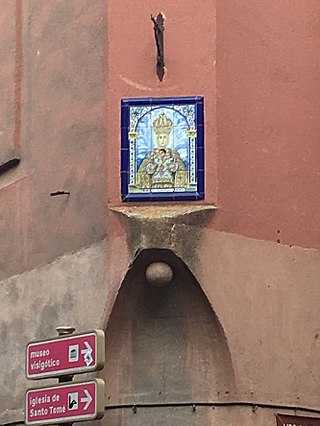
Before the standardization of modern plumbing, 2 common ways existed to access water in Toledo, Spain. These include the Tagus river that runs alongside the city, water wells and water reservoirs. Water wells and reservoirs were generally placed inside the city centre, or in some cases, individual housing. They were generally denoted by a water well or reservoir indicator (pictured). Generally the indicators consisted of small stone balls. In cases of a fire, the public would know who had a water well or reservoir. Many streets that had these wells/reservoirs were entitled as such, with many sharing the name "Well Street".

The Our Lady of the Rosary of Orani, or simply Our Lady of Orani, refers to the reputed Marian apparition of the Blessed Virgin Mary in both the towns of Orani and Samal in Bataan, as well as the image associated with the event.

The Monumento a la Virgen de la Paz is a colossal statue honoring Mary. Completely made out of concrete, it is located 11 kilometres (6.8 mi) southwest of the city of Trujillo in Venezuela. At 46.72 metres (153.3 ft) tall it is the 48th tallest statue in the world, the tallest statue in South America and the second-tallest in the Americas, the fourth-tallest statue depicting a woman in the world, and the second-tallest statue of Mary in the world. It is 16 metres (52 ft) across, with a base that is 18 metres (59 ft) deep, and weighs 1,200 tonnes.
The Bird that Spoke the Truth is a New Mexican folktale. It is related to the motif of the calumniated wife and classified in the international Aarne-Thompson-Uther Index as type ATU 707, "The Three Golden Children".
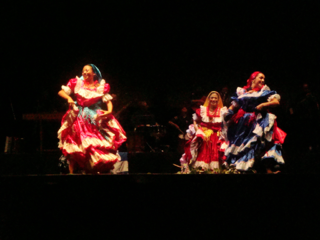
The folklore of El Salvador shares common traits with the rest of the Mesoamerican region. In El Salvador, the presence of the ancestral civilizations of the Mayans, Toltecs, Nahuas, among others, left their presence in many aspects of daily life in the region.
References
- ↑ "Chasca, La Virgen del Agua". Guanaquin. Archived from the original on 3 December 2013. Retrieved 30 August 2016.
{{cite web}}: CS1 maint: bot: original URL status unknown (link)
