
Alboin was king of the Lombards from about 560 until 572. During his reign the Lombards ended their migrations by settling in Italy, the northern part of which Alboin conquered between 569 and 572. He had a lasting effect on Italy and the Pannonian Basin; in the former his invasion marked the beginning of centuries of Lombard rule, and in the latter his defeat of the Gepids and his departure from Pannonia ended the dominance there of the Germanic peoples.
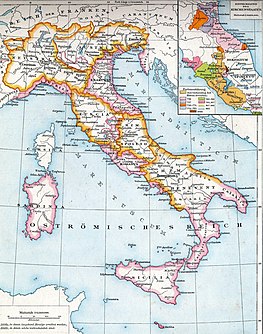
The Lombards or Langobards were a Germanic people who ruled most of the Italian Peninsula from 568 to 774, with origins near the Elbe in northern Germany and Scania in southern Sweden before the Migration Period.
Pope Stephen III was the bishop of Rome and ruler of the Papal States from 7 August 768 to his death. Stephen was a Benedictine monk who worked in the Lateran Palace during the reign of Pope Zachary. In the midst of a tumultuous contest by rival factions to name a successor to Pope Paul I, Stephen was elected with the support of the Roman officials. He summoned the Lateran Council of 769, which sought to limit the influence of the nobles in papal elections. The Council also opposed iconoclasm.
Year 770 (DCCLXX) was a common year starting on Monday of the Julian calendar. The denomination 770 for this year has been used since the early medieval period, when the Anno Domini calendar era became the prevalent method in Europe for naming years.
Pope Paul I was the bishop of Rome and ruler of the emerging Papal States from 29 May 757 to his death. He first served as a Roman deacon and was frequently employed by his brother, Pope Stephen II, in negotiations with the Lombard kings.
Year 960 (CMLX) was a leap year starting on Sunday of the Julian calendar.

Carloman I, also Karlmann, was king of the Franks from 768 until his death in 771. He was the second surviving son of Pepin the Short and Bertrada of Laon and was a younger brother of Charlemagne. His death allowed Charlemagne to take all of Francia and begin his expansion into other kingdoms.

Chlothar I was a king of the Franks of the Merovingian dynasty and one of the four sons of Clovis I.

Desiderius (also known as Daufer or Dauferius was king of the Lombards in northern Italy, ruling from 756 to 774. He is chiefly remembered for his connection to Charlemagne, who married his daughter and conquered his realm. Desiderius was the last Lombard ruler to exercise regional kingship.

Aistulf was the Duke of Friuli from 744, King of the Lombards from 749, and Duke of Spoleto from 751. His reign was characterized by ruthless and ambitious efforts to conquer Roman territory to the extent that in the Liber Pontificalis, he is described as a "shameless" Lombard given to "pernicious savagery" and cruelty.

Pepin or Pippin, born Carloman, was the son of Charlemagne and King of the Lombards (781–810) under the authority of his father.

The Duchy of Spoleto was a Lombard territory founded about 570 in central Italy by the Lombard dux Faroald. Its capital was the city of Spoleto.

Adalgis or Adelchis was an associate king of the Lombards from August 759, reigning with his father, Desiderius, until their deposition in June 774. His mother was Ansa. He is also remembered today as the hero of the play Adelchi (1822) by Alessandro Manzoni.
The Rule of the Dukes was an interregnum in the Lombard Kingdom of Italy (574/5–584/5) during which Italy was ruled by the Lombard dukes of the old Roman provinces and urban centres. The interregnum is said to have lasted a decade according to Paul the Deacon, but all other sources—the Fredegarii Chronicon, the Origo Gentis Langobardorum, the Chronicon Gothanum, and the Copenhagen continuator of Prosper Tiro—accord it twelve. Here is how Paul describes the dukes' rule:
After his death the Langobards had no king for ten years but were under dukes, and each one of the dukes held possession of his own city, Zaban of Ticinum, Wallari of Bergamus, Alichis of Brexia, Euin of Tridentum, Gisulf of Forum Julii. But there were thirty other dukes besides these in their own cities. In these days many of the noble Romans were killed from love of gain, and the remainder were divided among their "guests" and made tributaries, that they should pay the third part of their products to the Langobards. By these dukes of the Langobards in the seventh year from the coming of Alboin and of his whole people, the churches were despoiled, the priests killed, the cities overthrown, the people who had grown up like crops annihilated, and besides those regions which Alboin had taken, the greater part of Italy was seized and subjugated by the Langobards.
Garibald I was Duke of Bavaria from 555 until 591. He was the head of the Agilolfings, and the ancestor of the Bavarian dynasty that ruled the Kingdom of the Lombards.
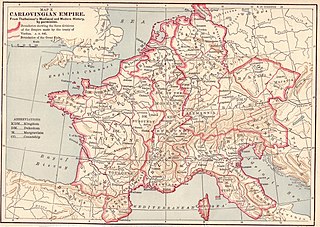
The March of Friuli was a Carolingian frontier march, established in 776 as the continuation of the Lombard Duchy of Friuli, established against the Slavs and Avars. It was ceded to the Duchy of Bavaria as the March of Verona in 952. Its territory comprised parts of modern-day Italy, Slovenia and Croatia.
Gerberga was the wife of Carloman I, King of the Franks, and sister-in-law of Charlemagne. Her flight to the Lombard kingdom of Desiderius following Carloman's death precipitated the last Franco-Lombard war, and the end of the independent kingdom of the Lombards in 774.
Chlothsind was a Frankish princess and the queen consort of the Lombard king Alboin. Her name may also be spelled Chlothsinda, Chlodosinda, Chlodosind, Chlodoswintha or Chlodosuinth.
Albsuinda was the only child of Alboin, King of the Lombards in Pannonia, and his first wife Chlothsind, daughter of the Merovingian king of the Franks Chlothar. While still young Albsuinda had lost her mother shortly before the final clash in 567 with the people of the Gepids in Pannonia, in which the Gepids were completely destroyed. After the victory her father had promptly remarried, taking as second wife Rosamund, daughter of the Gepid king Cunimund that Alboin had personally killed on the battlefield.
Chlodosinda was a Frankish princess, the daughter of King Sigebert I and Queen Brunhilda.
This page is based on this
Wikipedia article Text is available under the
CC BY-SA 4.0 license; additional terms may apply.
Images, videos and audio are available under their respective licenses.
