This article has multiple issues. Please help improve it or discuss these issues on the talk page . (Learn how and when to remove these template messages)
|
Christophe Lukasiewicz | |
|---|---|
| | |
| Nationality | French |
| Alma mater | Ecole des Beaux Arts |
| Occupation | Architect |
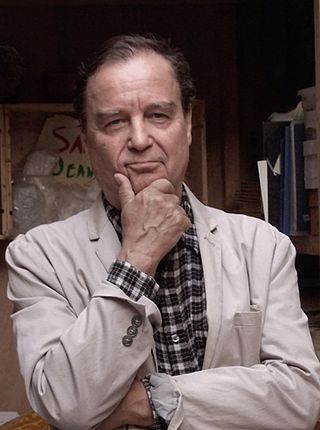
Lukasiewicz Christophe was a French architect born in 1933 in Lublin and died in 1999 in Paris.
He won in 1972 the first prize of Plan Architecture Nouvelle No. 1 (P.A.N., now called Europan) and opened his practice in 1975 by realizing this competition project.
Graduated in 1958 from the Warsaw Polytechnic University with an engineering degree in architecture, Christophe Lukasiewicz was about to complete a double degree at the Warsaw Academia Sztuk Pieknych (Ecole des Beaux Arts). Thus he met a friend, the painter Fangor, today recognized for his visual work, (Visual art and kinetic art). He also, during his studies, worked for the architect Georges Soltan (close to Team 10 designs). He offered him to work in Paris.
Assistant at the School of Fine Arts in Paris, he worked with Jozef i Ewa Brukalski as project manager in the office of the architect and professor Emile Aillaud.
Author of a large number of city plans, Christophe Lukasiewicz developed a new design of the Town Planning: parks and gardens surrounded by terraced buildings, shopping streets and markets. He developed the classic city plan (London crescent) or garden city plan seeking to build a city resulting from a millennium urbanisation (diversity of scenery, withdrawal alignment, arcades, terraces). Using industrial prefabrication process, he created an aesthetic in which useful constructions becomes decorative by his play (See Melun-Senart The arcades ILM). With this project, he initiated the creation of a cubist city.
He used during these projects all forms of architecture that connect with the environment and nature: patio, balcony, terraces, winder gardens and bay-windows around trees and green spaces.
Painter, like his father, Stanislas Lukasiewicz, architect of the mid-century in Warsaw, he had represented the environment to recreate it.
He is the author of the footbridge and lifts that allow access to the Jardin Atlantique above the Gare Montparnasse in Paris (see architecture mobile). He suggested applying its garden town planning to the Paris density. He produced a functional, human and cultural design for the city (according to English biography of Ch. Lukasiewicz), proposing the restoration of a mansion or new layout for the Avenue des Champs-Élysées, with his friend and architect Andre Schuch (architect of all new kiosk for newspapers in Paris) .
At the very end of his life and returning to Warsaw, he created in Wolomin, near Warsaw, a city generated by successive acquisitions with the same alternate architectures which give character to houses and creates urban unity. At the same time, Christophe Lukasiewicz wrote an architectural treaty (not published) completing his first book, Urbanisme des places et des rues (first book).
"In architecture forms result from the need of shelter, the search of economic and of human comfort" Christophe Lukasiewicz, architecture Treaty, circa 1994.
The grand part of Christophe Lukasiewicz archives are available at the Cité de l'Architecture et du Patrimoine of Paris department of the French Institute of Architecture (IFA).
The Gare de Lyon, officially Paris Gare de Lyon, is one of the seven large mainline railway stations in Paris, France. It handles about 148.1 million passengers annually according to the estimates of the SNCF in 2018, with SNCF railways and the RER D accounting for around 110 million and the RER A accounting for 38 million, making it the second-busiest station of France after the Gare du Nord and one of the busiest in Europe.

The following is a list of the 507 communes of the Seine-et-Marne department of France.
Marie Bracquemond was a French Impressionist artist. She was one of four notable women in the Impressionist movement, along with Mary Cassatt (1844-1926), Berthe Morisot (1841-1895), and Eva Gonzalès (1847-1883). Bracquemond studied drawing as a child and began showing her work at the Paris Salon when she was still an adolescent. She never underwent formal art training, but she received limited instruction from Jean-Auguste-Dominique Ingres (1780–1867) and advice from Paul Gauguin (1848–1903) which contributed to her stylistic approach.
Edmond Couchot was a French digital artist and art theoretician who taught at the University Paris VIII.
Jacques Gondouin de Folleville, or simply Gondouin was a French architect and designer.
Michel Roux-Spitz was a French architect.
Baron Charles Frédéric Chassériau du Chiron was a Saint Dominican architect and painter, who served as chief architect of the cities of Marseille, Algiers, in Algeria; and Cairo, in Egypt. He is particularly known for having designed the seafront of the city of Algiers.
Augustin Berque, is a French geographer, Orientalist and philosopher. He is the son of the famous Egyptologist Jacques Berque. He is professor at the École des hautes études en sciences sociales in Paris (EHESS). His specialist field of interest is Japan.
Nicolas Michelin is a French architect and urban planner. After joining forces with Finn Geipel to form LABFAC in 1985, he went on to found ANMA in 2000, which he currently runs in collaboration with his partners Michel Delplace and Cyril Trétout.
Jean-Max Albert is a French painter, sculptor, writer, and musician. He has published theory, books on artists, and a collection of poems, plays and novels inspired by quantum physics. He perpetuated experiments initiated by Paul Klee and Edgar Varèse on the transposition of musical structures into formal constructions. Albert has also created environmental sculptures using plants to create architecture.
Camille Enlart was a French archaeologist and art historian. His areas of special interest were the Middle Ages and photography.
Naïdé Ferchiou was a Tunisian archaeologist whose work dealt mainly with Roman North Africa. She excavated at several important sites, including Abthugni.
Jeanne Gaillard was a French historian and a member of the French Resistance during the Second World War.
The "Maison du Peuple" in Clichy, classified as official historical monument of France since 1983, is a building built from 1935 to 1939 in the Parisian suburb of Clichy-la-Garenne by the architects Eugène Beaudouin, Marcel Lods, the engineer Vladimir Bodiansky and Jean Prouvé..
Georges Marçais was a French orientalist, historian, and scholar of Islamic art and architecture who specialized in the architecture of North Africa.
César Denis Daly was a French architect, publisher, and writer. He was one of the most important figures in the architectural press in nineteenth-century France, whose role as owner and editor of the famed periodical the Revue générale de l'architecture et des travaux publics shaped several generations of architects in France and beyond.
Jean-Claude Dondel and Roger Dhuit were a team of French architects.
Jean-Pierre Chupin is a French and Canadian architect, researcher, and architectural theorist who specializes in reasoning by analogy, qualitative practices, architectural competitions and awards of excellence. He is a professor at the School of Architecture, Faculty of Environmental Design, Université de Montréal. He holds the Canada Research Chair in Architecture, Competitions and Mediations of Excellence (CRC-ACME). He coordinates the Laboratory for the Study of Potential Architecture (L.E.A.P) since 2012.