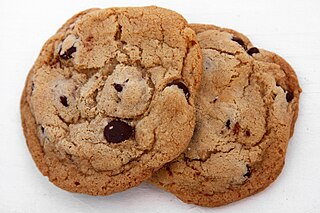
A cookie is a baked or cooked food that is small, flat and sweet. It usually contains flour, sugar and some type of oil or fat. It may include other ingredients such as raisins, oats, chocolate chips, nuts, etc.

Bread is a staple food prepared from a dough of flour and water, usually by baking. Throughout recorded history it has been a prominent food in large parts of the world and is one of the oldest man-made foods, having been of significant importance since the dawn of agriculture.
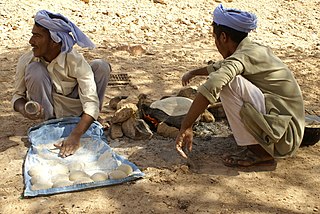
Baking is a method of cooking food that uses prolonged dry heat, normally in an oven, but can also be done in hot ashes, or on hot stones. The most common baked item is bread but many other types of foods are baked. Heat is gradually transferred "from the surface of cakes, cookies, and breads to their center. As heat travels through, it transforms batters and doughs into baked goods with a firm dry crust and a softer centre". Baking can be combined with grilling to produce a hybrid barbecue variant by using both methods simultaneously, or one after the other. Baking is related to barbecuing because the concept of the masonry oven is similar to that of a smoke pit.

A pie is a baked dish which is usually made of a pastry dough casing that covers or completely contains a filling of various sweet or savoury ingredients.

Baking powder is a dry chemical leavening agent, a mixture of a carbonate or bicarbonate and a weak acid. The base and acid are prevented from reacting prematurely by the inclusion of a buffer such as cornstarch. Baking powder is used to increase the volume and lighten the texture of baked goods. It works by releasing carbon dioxide gas into a batter or dough through an acid-base reaction, causing bubbles in the wet mixture to expand and thus leavening the mixture. The first single-acting baking powder was developed by food manufacturer Alfred Bird in England in 1843. The first double-acting baking powder was developed by Eben Norton Horsford in America in the 1860s.

Cornbread is any quick bread containing cornmeal, and a Native American cuisine. They are usually leavened by baking powder.

Biscuit is a term used for a variety of primarily flour-based baked food products. The term is applied to two distinct products. This article covers the type of biscuit found in the Commonwealth of Nations and Europe, which is typically hard, flat and unleavened. In North America, a biscuit is typically a soft, leavened quick bread, and is covered in the article Biscuit (bread).

Dough is a thick, malleable, sometimes elastic, paste made out of any grains, leguminous or chestnut crops. Dough is typically made by mixing flour with a small amount of water and/or other liquid, and sometimes includes flour yeast or other leavening agents as well as other ingredients such as various fats or flavorings.
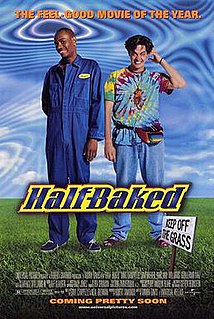
Half Baked is a 1998 American stoner comedy film starring Dave Chappelle, Jim Breuer, Harland Williams and Guillermo Díaz. The film was directed by Tamra Davis, co-written by Chappelle and Neal Brennan and produced by Robert Simonds.
Pennsylvania Dutch cuisine is the typical and traditional fare of the Pennsylvania Dutch. According to one writer, "If you had to make a short list of regions in the United States where regional food is actually consumed on a daily basis, the land of the Pennsylvania Dutch - in and around Lancaster County, Pennsylvania - would be at or near the top of that list," mainly because the area is a cultural enclave of Pennsylvania Dutch culture. Pennsylvania Dutch cuisine reflects influences of the Pennsylvania Dutch's German heritage, agrarian society, and rejection of rapid change.

The Hulman family is a family of Indiana businesspeople and philanthropists best known as the owners of the Indianapolis Motor Speedway, the Indy Racing League and Hulman & Co., which produces Clabber Girl Baking Powder.

Clabber Girl is a brand of baking powder, baking soda, and corn starch popular in the United States. It is manufactured by Hulman & Company, which also owns and operates the Indianapolis Motor Speedway and INDYCAR, the sanctioning body for American open-wheel racing. The brand also owns the Rumford baking powder label. The Clabber Girl name brand comes from the word "clabber", a type of sour milk. In the early 1800s, people mixed clabber with pearl ash, soda, cream of tartar, and a few other ingredients to make what we know today as baking powder. The first baking powder brand by Hulman and company was the "Milk Brand". In 1899, it was changed to the "Clabber Brand". In 1923, the company changed the name to "Clabber Girl".

Hulman & Company is an American private, family-owned, company founded in 1850 by Francis T. Hulman as a wholesale foods supplier of groceries, tobacco, and liquor, headquartered in Terre Haute, Indiana. Throughout the early half of the 20th century, Hulman & Co. became nationally known for its Clabber Girl baking powder which it began producing in 1899. In 1945, the company purchased the Indianapolis Motor Speedway, in what many thought was an unusual investment for a company with a rich history in the food and beverage industry. The company also owns a television production company, Wabash Valley Broadcasting, dba IMS Productions, which does in-house work for their NTT IndyCar Series, various teams in the organization, and in the past, produced NBA Indiana Pacers and Professional Bull Riders broadcasts.

Calumet Baking Powder Company was an American food company established in 1889 in Chicago, Illinois, by baking powder salesman William Monroe Wright. His newly formulated double-acting baking powder took its name from the French-derived, colonial-era word for a Native American ceremonial pipe, given to the lands now known as Calumet City, Illinois. Wright's company adopted a stylized Indian wearing a war bonnet as its trademark.
Souring is a cooking technique that uses exposure to an acid to cause a physical and chemical change in food. This acid can be added explicitly, or can be produced within the food itself by a microbe such as Lactobacillus.
John Whaite is an English baker who won the third series of The Great British Bake Off in 2012. He works as a chef, television presenter, and author. He was a presenter and judge on the ITV daytime cookery competition show Chopping Block.
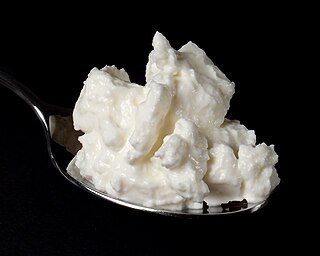
Quark or quarg is a type of fresh dairy product made by warming soured milk until the desired amount of curdling is met, and then straining it. It can be classified as fresh acid-set cheese. Traditional quark can be made without rennet, but in modern dairies small quantities of rennet are typically added. It is soft, white and unaged, and usually has no salt added. It is traditional in the cuisines of German-speaking, Slavic and Scandinavian countries.