
Stockholm County is a county or län on the Baltic Sea coast of Sweden. It borders Uppsala County and Södermanland County. It also borders Mälaren and the Baltic Sea. The city of Stockholm is the capital of Sweden. Stockholm County is divided by the historic provinces of Uppland (Roslagen) and Södermanland (Södertörn). More than one fifth of the Swedish population lives in the county. Stockholm County is also one of the statistical riksområden according to NUTS:SE, Nomenclature of Territorial Units for Statistics within the EU. With more than two million inhabitants, Stockholm is the most densely populated county of Sweden.

Upplands-Bro Municipality is a municipality in Stockholm County in east central Sweden. Its seat is located in the town of Kungsängen.

The provinces of Sweden are historical, geographical and cultural regions. Sweden has 25 provinces and they have no administrative function, but remain historical legacies and the means of cultural identification. Dialects and folklore rather follows the provincial borders than the borders of the counties.

Södermanland, sometimes referred to under its Latin form Sudermannia or Sudermania, is a historical province or landskap on the south eastern coast of Sweden. It borders Östergötland, Närke, Västmanland and Uppland. It is also bounded by lake Mälaren and the Baltic Sea.
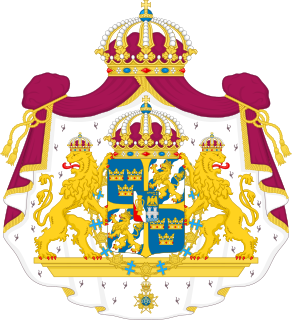
The coat of arms of the Kingdom of Sweden has a lesser and a greater version.

Three Crowns is a national emblem of Sweden, present in the coat of arms of Sweden, and composed of three yellow or gilded coronets ordered two above and one below, placed on a blue background.

Prince Bertil, Duke of Halland, was a member of the Swedish royal family. He was the third son of King Gustaf VI Adolf and his first wife, Princess Margaret of Connaught, as well as the uncle of King Carl XVI Gustaf of Sweden, Queen Margrethe II of Denmark and Queen Anne-Marie of Greece. From 1973 to 1977 he was heir presumptive to his nephew King Carl XVI Gustaf and the Swedish throne.

In English, a coronet is a small crown consisting of ornaments fixed on a metal ring. By one definition, a coronet differs from a crown in that a coronet never has arches, and from a tiara in that a coronet completely encircles the head, while a tiara does not. By a slightly different definition, a crown is worn by an emperor, empress, king or queen; a coronet by a nobleman or lady. See also diadem.

The Uppland Regiment, designation I 8, was a Swedish Army infantry regiment that traced its origins back to the 16th century. It was disbanded in 1957. The regiment's soldiers were originally recruited from the province of Uppland, and it was later garrisoned there.

The Uppland Regiment, designations Ing 3, S 1 and S 1/Fo 47, was a Swedish Army signal regiment that traced its origins back to the 19th century. It was disbanded in 2006. The regiment was garrisoned in Uppland.

Swedish heraldry encompasses heraldic achievements in modern and historic Sweden. Swedish heraldic style is consistent with the German-Nordic heraldic tradition, noted for its multiple helmets and crests which are treated as inseparable from the shield, its repetition of colours and charges between the shield and the crest, and its scant use of heraldic furs. Because the medieval history of the Nordic countries was so closely related, their heraldic individuality developed rather late. Swedish and Finnish heraldry have a shared history prior to the Diet of Porvoo in 1809; these, together with Danish heraldry, were heavily influenced by German heraldry. Unlike the highly stylized and macaronic language of English blazon, Swedish heraldry is described in plain language, using only Swedish terminology.

A crown is often an emblem of a sovereign state, usually a monarchy, but also used by some republics.
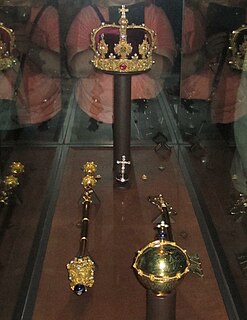
Sweden's Royal Regalia are kept deep in the vaults of the Royal Treasury, underneath the Royal Palace in Stockholm, in a museum that is open to the public. The crowns and coronets have not been worn by Swedish royalty since 1907, but they are still displayed at weddings, christenings and funerals.

Kollektivtrafikförvaltningen UL is the integrated transport authority responsible for public transport buses and trains at the county level in Uppsala County, Sweden. Their name is derived from the historical province of Uppland, which included the modern county along with part of what is now Stockholm County.

The Upplands Fotbollförbund(Uppland Football Association) is one of the 24 district organisations of the Swedish Football Association. It administers lower tier football in the historical province of Uppland.
Andreas Laurenitt Hackzelius was a priest of the Church of Sweden.

Roslags-Bro Church is a medieval Lutheran church in the Archdiocese of Uppsala in Stockholm County, Sweden. It was built during the middle of the 13th century by an important sea-route, since disappeared as a consequence of the post-glacial rebound. Immured in the church is a runestone from the 11th century.

Tensta Church is a medieval Lutheran church in the Archdiocese of Uppsala in Uppsala County, Sweden. It is a representative example of the Brick Gothic style in Sweden.


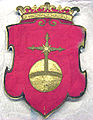 Arms of Uppland 1633–1634, in the Livrustkammaren (Royal Armoury)
 The arms in Suecia antiqua et hodierna , 1668
 Flag of Uppland


