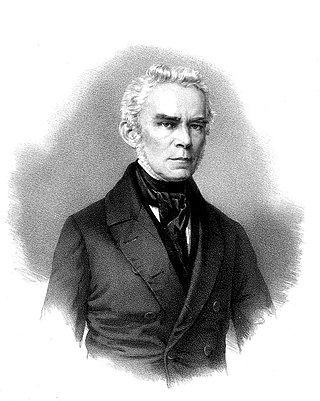
Ernst Ludwig Theodor Henke, was a German theologian and historian, and the son of the theologian Heinrich Henke (1752–1809). He was the father of anatomist Wilhelm von Henke (1834–1896).

Eberhardt August Wilhelm von Zimmermann was a German geographer and zoologist.
August Wilhelm Knoch was a German naturalist born in Braunschweig. He was a professor of physics at Collegium Carolinum.

Carl Georg Oscar Drude was a German botanist.
The Independent Socialist Party was a political party in Czechoslovakia. The party was founded in March 1923. The party included a number of former anarchists, who had joined the Czech Socialist Party in 1918. They had however been expelled from the Czechoslovak Socialist Party in 1923, as they opposed the Defense of the Republic Act. In the Czechoslovak National Assembly, the Independent Socialists formed a joint parliamentary group together with the Independent Radical Social Democratic Party of V. Brodecký. The two groups were set to merge, but Brodecký's group decided to merge with the Czechoslovak Social Democratic Workers Party. The Independent Socialist Party took the name Independent Socialist Workers Party at a congress in June 1924.
German Christian Social People's Party was an ethnic German political party in Czechoslovakia, formed as a continuation from the Austrian Christian Social Party. It was founded in November 1919 in Prague. The party had good relations with its Czechoslovak brother party.
Ruthenian [Bread-producing] Peasants Party was a political party in Czechoslovakia. The party was founded in 1920. The most prominent personality in the party was Avgustyn Voloshyn, a renowned linguist from Uzhhorod. The party published the weekly newspaper Svoboda.
The Carpatho-Russian Labour Party of Small Peasants and Landless was a political party centered in Subcarpathian Rus' region, within the Second Czechoslovak Republic. It was founded in 1919. The party had a 'Greater Russian' orientation. It was led by Andrey Gagatko, who was elected in 1924 to the parliament. The party published Russkaja zemlja.

Russian National Autonomous Party was one of political parties of ethnic Rusyns in Second Czechoslovak Republic. It was founded by Štepan Fencik, just ahead of the 1935 Czechoslovak parliamentary election, in March 1935 in Mukachevo. Fencik was elected to parliament. The party published Nash puť.
The Autonomous Agrarian Union, abbreviated AZS was a political party in Czechoslovakia, which fought for autonomy for Subcarpathian Rus' within the Second Czechoslovak Republic. The party was founded as the Subcarpathian Agrarian Union. The party published Russkij vestnik. It was represented in the Czechoslovak parliament by Ivan Kurtyak(ru).
Munkás was a Hungarian-language newspaper in Czechoslovakia. The newspaper, which was an organ of the Communist Party of Czechoslovakia, was one of the major Hungarian newspapers in Czechoslovakia in the latter half of the 1930s.
Polish People's Party was a political party in Czechoslovakia founded in autumn 1922, based amongst Polish middle-class Protestants. The chairman of the party was doctor Jan Buzek. Other prominent party activists were pastor Józef Berger and journalist Jarosław Waleczko. In the 1929 parliamentary election, Buzek was elected member of parliament. He joined the Czechoslovak Social Democratic parliamentary group. The party published the weekly newspaper Ewangelik from Český Těšín and Prawo ludu as a party newspaper.

Polish Socialist Workers Party was a political party in Czechoslovakia founded in February 1921, based amongst Polish workers. The party was active in trade union struggles, mainly mobilizing miners and workers in heavy industries. The chairman of the party was Emanuel Chobot. Other prominent members of the party were Antoni Steffek and Wiktor Sembol. The party closely cooperated with the Czechoslovak Social Democratic Party. The party published the newspaper Robotnik Śląski from Fryštát.

Emanuel Chobot was a Polish trade union activist and politician. He was the chairman of the Polish Socialist Workers Party, the social democratic party active amongst the Polish minority in Czechoslovakia. He was also the Director-General of the Consumers Association 'Gec' in Moravská Ostrava.

Karol Śliwka was a Polish communist politician. He was one of the most prominent political leaders of the Polish minority in Trans-Olza region of the First Czechoslovak Republic and a member of National Assembly of the Czechoslovak Republic from 1925 to 1938.
The Hungarian-German Social Democratic Party was a social democratic political party in Slovakia. It was founded in 1919 by social democrats from ethnic minority communities. The party had a German and a Hungarian section. The German and Hungarian social democrats in Slovakia had developed an antagonistic relationship with the Slovak social democrats, who had merged into the Czechoslovak Social Democratic Workers Party as Austria-Hungary was broken up after the First World War. Issues of contention between Hungarian/German and Slovak social democrats included views of the February Strike of 1919 and the Hungarian Soviet Republic.

Siegfried Taub was a Sudeten German Jewish politician from Czechoslovakia. Taub was the general secretary of German Social Democratic Workers Party in the Czechoslovak Republic (DSAP) from 1924. He belonged to the Moravian triumvirate, with party chairman Ludwig Czech and newspaper editor Wilhelm Niessner, that came to dominate the party leadership from the mid-1920s. Taub served as deputy speaker of the Czechoslovak parliament.

Rudolf Heinrich Paul Blasius was a German physician, bacteriologist, naturalist and ornithologist.

The Collegium Carolinum was a scientific institution in Kassel, Germany. It was founded in 1709 by Charles I, Landgrave of Hesse-Kassel and closed after the 1785 death of Frederick II, Landgrave of Hesse-Kassel. The Ottoneum housed most of its activities. However, a new anatomical theatre, the first in Germany, was used by Samuel Thomas von Sömmerring.
Ladislav Lipscher (1915–1990) was a Slovak historian and defector from Communist Czechoslovakia. Lipscher did much of his research before his defection, allowing him to base his works on then-inaccessible archives locked behind the Iron Curtain.


