Commission on Foreign Economic Policy

Last updated

The U.S. President's Commission on Foreign Economic Policy (the Randall Commission) was established on August 7, 1953 by Public Law 215 entitled "Trade Agreements Extension Act of 1953" [1] which extended the Trade Agreements Extension Act of 1951 for one year. On April 7, 1953 President Dwight D. Eisenhower requested that Congress extend for one year the Reciprocal Trade Agreements Act, a measure which had originally been passed in 1934. Under this act and its subsequent extensions, the President was authorized to negotiate agreements with other countries for tariff reduction. In his message of April 7, the President called for a commission to study U.S. foreign economic policy in general. Section 301 of this Act provided for a bipartisan commission which consisted of seventeen members: seven appointed by the President, five appointed from the Senate by the Vice President, and five from the United States House of Representatives by the Speaker. President Eisenhower appointed Clarence B. Randall, Chairman of the Board of Inland Steel Company, as Chairman of the Commission. The Commission was directed to examine and report on the subjects of international trade, foreign economic policy, and the trade aspects of national security and total foreign policy. It was to recommend appropriate policies, measures, and practices, based on its findings, in a report to Congress.

Dwight D. Eisenhower 34th president of the United States

Dwight David "Ike" Eisenhower was an American army general and statesman who served as the 34th president of the United States from 1953 to 1961. During World War II, he was a five-star general in the United States Army and served as supreme commander of the Allied Expeditionary Forces in Europe. He was responsible for planning and supervising the invasion of North Africa in Operation Torch in 1942–43 and the successful invasion of France and Germany in 1944–45 from the Western Front.

United States House of Representatives lower house of the United States Congress

The United States House of Representatives is the lower chamber of the United States Congress, the Senate being the upper chamber. Together they comprise the legislature of the United States.

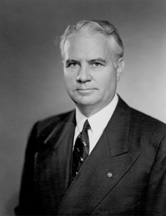
Clarence Belden Randall was an American lawyer and businessman. During the steel disputes of 1952, he served as a spokesman for the steel industry. He served as Chairman of the Board of Inland Steel Company and as an advisor to Presidents Dwight D. Eisenhower and John F. Kennedy.

The Commission held an organizational meeting with President Eisenhower on September 22, 1953 and hearings began October 2, continuing through November 19, including sessions in Paris, France, November 9–12. Most of the hearings were closed except for public hearings on October 28–29 when representatives of national associations, trade unions, etc., presented their views on foreign trade. In order to limit the number of witnesses before the Commission, Randall sent out 15,000 letters asking for written statements from individual industries, labor unions, etc. He received of 300 statements in response to these letters.

The Commission staff, composed of specialists on various aspects of foreign economic policy, digested the written testimony and information provided by the Department of State, Department of Agriculture, and other agencies, in preparing 800 pages of staff papers upon which the Commission Report was based. This report was divided into twelve sections, such as Dollar Problem, Foreign Aid, Tariff and Trade, East-West Trade, etc. and was presented to Congress on January 23, 1954.

This Commission was dissolved on April 23, 1954, three months after it presented its report to Congress.
Related Research Articles

Smoot–Hawley Tariff Act 1930 tariff act of the United States

The Tariff Act of 1930, commonly known as the Smoot–Hawley Tariff or Hawley–Smoot Tariff, was an Act implementing protectionist trade policies sponsored by Senator Reed Smoot and Representative Willis C. Hawley and was signed into law on June 17, 1930. The act raised U.S. tariffs on over 20,000 imported goods.

Fordney–McCumber Tariff Historical United States tariff

The Fordney–McCumber Tariff of 1922 was a law that raised American tariffs on many imported goods to protect factories and farms. The US Congress displayed a pro-business attitude in passing the tariff and in promoting foreign trade by providing huge loans to Europe. That, in turn, bought more US goods.

The Reciprocal Tariff Act provided for the negotiation of tariff agreements between the United States and separate nations, particularly Latin American countries. The Act served as an institutional reform intended to authorize the president to negotiate with foreign nations to reduce tariffs in return for reciprocal reductions in tariffs in the United States. It resulted in a reduction of duties.

Office of the United States Trade Representative United States trade body

The Office of the United States Trade Representative (USTR) is the United States government agency responsible for developing and recommending United States trade policy to the President of the United States, conducting trade negotiations at bilateral and multilateral levels, and coordinating trade policy within the government through the interagency Trade Policy Staff Committee (TPSC) and Trade Policy Review Group (TPRG).

Council of Economic Advisers US federal government agency

The Council of Economic Advisers (CEA) is a United States agency within the Executive Office of the President established in 1946, which advises the President of the United States on economic policy. The CEA provides much of the empirical research for the White House and prepares the annual Economic Report of the President.

Canada–United States Free Trade Agreement (CUSFTA), official name as the Free Trade Agreement between Canada and the United States of America, is a trade agreement reached by negotiators for Canada and the United States on October 4, 1987, and signed by the leaders of both countries on January 2, 1988. The agreement phased out a wide range of trade restrictions in stages over a ten-year period, and resulted in a substantial increase in cross-border trade. With the addition of Mexico in 1994 FTA was superseded by the North American Free Trade Agreement (NAFTA).

United States International Trade Commission government agency

The United States International Trade Commission is an independent, bipartisan, quasi-judicial, federal agency of the United States that provides trade expertise to both the legislative and executive branches. Furthermore, the agency determines the impact of imports on U.S. industries and directs actions against unfair trade practices, such as subsidies, dumping, patent, trademark, and copyright infringement.

The tariff history of the United States spans from 1789 to present. The first tariff law passed by the U.S. Congress, acting under the then-recently ratified Constitution, was the Tariff of 1789. Its purpose was to generate revenue for the federal government, and also to act as a protective barrier around newly starting domestic industries. An Import tax set by tariff rates was collected by treasury agents before goods could be unloaded at U.S. ports.

Bricker Amendment proposed bill to amend US Constitution

The Bricker Amendment is the collective name of a number of slightly different proposed amendments to the United States Constitution considered by the United States Senate in the 1950s. Each of these amendments would have insulated American laws and policies from foreign influence exerted through treaties, executive agreements, international law, or the United Nations. They are named for their sponsor, Republican Senator John W. Bricker of Ohio.

Presidency of Dwight D. Eisenhower

The presidency of Dwight D. Eisenhower began on January 20, 1953, when he was inaugurated as the 34th President of the United States, and ended on January 20, 1961. Eisenhower, a Republican, took office as president following a landslide win over Democrat Adlai Stevenson in the 1952 presidential election. This victory upended the New Deal Coalition that had kept the presidency in the hands of the Democratic Party for 20 years. Four years later, in the 1956 presidential election, he defeated Stevenson in a landslide again, winning a second term in office. He was succeeded in office by Democrat John F. Kennedy after the 1960 election.

Trade Act of 1974 Comprehensive United States trade law

The Trade Act of 1974 was passed to help industry in the United States become more competitive or phase workers into other industries or occupations.

The fast track authority for brokering trade agreements is the authority of the President of the United States to negotiate international agreements that Congress can approve or deny but cannot amend or filibuster. Renamed the trade promotion authority (TPA) in 2002, fast track negotiating authority is an impermanent power granted by Congress to the President. Fast track authority remained in effect from 1975 to 1994, pursuant to the Trade Act of 1974, and from 2002 to 2007 by the Trade Act of 2002. Although it technically expired in July 2007, it remained in effect for agreements that were already under negotiation until their passage in 2011. The following year, the Obama administration sought renewal of TPA, and in June 2015, it passed Congress and was signed into law by the President. Known as the Trade Preferences Extension Act of 2015, the legislation conferred on the Obama administration "enhanced power to negotiate major trade agreements with Asia and Europe."

William Smith Culbertson was an American diplomat and soldier.

The Commission on Intergovernmental Relations was created by an act of the United States Congress on July 10, 1953, to make recommendations for the solution of problems involving federal and state governments. Its final report was issued on June 28, 1955.

The U.S. Council on Foreign Economic Policy (CFEP) was a high-level organization created by President Dwight D. Eisenhower in December 1954 to coordinate the development of the foreign economic policy of the United States.

Foreign trade of the United States comprises the international imports and exports of the United States

Foreign trade of the United States comprises the international imports and exports of the United States, one of the world's most significant economic markets. The country is among the top three global importers and exporters.

Timeline of the Dwight D. Eisenhower presidency

The presidency of Dwight D. Eisenhower began on January 20, 1953 when Dwight D. Eisenhower was inaugurated as President of the United States, and ended on January 20, 1961.

China–United States trade war China–United States trade war

China and the United States are engaged in a trade war as each country continues to dispute tariffs placed on goods traded between them. US President Donald Trump had declared in his campaign to fix China's "longtime abuse of the broken international system and unfair practices". The economic disputes occurred before China's entry to the World Trade Organization but the administrations of former Presidents George H. W. Bush, Bill Clinton, George W. Bush, and Barack Obama all failed to solve the problems. In April 2018, the United States filed a request for consultation to the World Trade Organization in regard to concerns that China was violating intellectual property rights.

References

  1. Turney, Elaine C. Prange Turney and Cynthia Clark Northrup (2003). "Encyclopedia of Tariffs and Trade in U.S. History, Vol. I." Greenwood Press. p. 85.