The Mainland and Hong Kong Closer Economic Partnership Arrangement, or Closer Economic Partnership Arrangement (CEPA) for short, is an economic agreement between the Government of the Hong Kong Special Administrative Region and the Central People's Government of the People's Republic of China, signed on 29 June 2003. A similar agreement, known as the Mainland and Macau Closer Economic Partnership Arrangement, was signed between the Government of the Macau Special Administrative Region and the Central People's Government on 18 October 2003.
A European Union Association Agreement or simply Association Agreement (AA) is a treaty between the European Union (EU), its Member States and a non-EU country that creates a framework for co-operation between them. Areas frequently covered by such agreements include the development of political, trade, social, cultural and security links.
The Mainland and Macau Closer Economic Partnership Arrangement, or Closer Economic Partnership Arrangement (CEPA) for short, is an economic agreement between the Government of the Macau Special Administrative Region and the Central People's Government on October 18, 2003. A similar agreement, known as the Mainland and Hong Kong Closer Economic Partnership Arrangement, was signed between the Government of the Hong Kong Special Administrative Region and the Central People's Government of the People's Republic of China, signed on June 29, 2003.

New Zealand is party to several free trade agreements (FTAs) worldwide.

India-Singapore relations, also known as the Indo-Singaporeanrelations, are the bilateral relations between India and Singapore. Relations between the two countries have traditionally been strong and friendly, with the two nations enjoying extensive cultural and commercial relations. India and Singapore have signed the Comprehensive Economic Cooperation Agreement (CECA) and strategic-relationship agreement in order to increase trade, investments and economic cooperation, and expanded bilateral cooperation on maritime security, training forces, joint naval exercises, developing military technology and fighting terrorism.

The Comprehensive Economic Partnership Agreement (CEPA) is a free trade agreement between India and South Korea. The agreement was signed on August 7, 2009. The signing ceremony took place in Seoul and the agreement was signed by the Indian Commerce Minister, Anand Sharma and South Korean Commerce Minister, Kim Jong-Hoon. The negotiations took three-and-a-half years, with the first session being held in February 2006. The agreement was passed in the South Korean parliament on 6 November 2009. It was passed in the Indian parliament the next week. Once passed, the agreement came into effect sixty days later, on January 1, 2010. It is equivalent to a free trade agreement. The agreement will provide better access for the Indian service industry in South Korea. Services include Information technology, engineering, finance, and the legal field. South Korean car manufactures will see large tariffs cuts to below 1%. All the while, Korean corporations have flooded India with cheaper imports of raw metal, steel and finished products.
The Comprehensive Economic Partnership for East Asia (CEPEA) is a Japanese led proposal for trade co-operation, free trade agreement, among the 16 present member countries of the East Asia Summit. All those movements and efforts were taken over by the following Regional Comprehensive Economic Partnership.
The EuroNest Parliamentary Assembly is the inter-parliamentary forum in which members of the European Parliament and the national parliaments of Ukraine, Moldova, Armenia, Azerbaijan and Georgia participate and forge closer political and economic ties with the European Union. It was established in 2011 by the European Commission as a component of the Eastern Partnership. After the elections in Belarus in 2010 were declared as flawed by the OSCE, the membership of Belarus in Euronest was automatically suspended. Belarus is welcome to re-join the Assembly once political requirements have been fulfilled. In 2015, Azerbaijan's membership was suspended due to the European Union's criticism of human rights abuses by the government. In September 2016, it was announced that Azerbaijan would take the necessary steps towards restoring ties. As of 2017, the combined population of Euronest members stands at 61,927,521 people.

The European Union has concluded free trade agreements (FTAs) and other agreements with a trade component with many countries worldwide and is negotiating with many others. The European Union negotiates free trade deals on behalf of all of its member states, as the member states have granted the EU has an "exclusive competence" to conclude trade agreements. Even so, member states' governments control every step of the process :
The European Union and Indonesia have built robust commercial relations, with bilateral trade amounting to approximately €25 billion in 2012 resulting in a sizeable €5.7 billion trade surplus for Indonesia with the EU. As of 2012 EU and Indonesia has been marked by an upward trend. Whereas total trade was worth almost €16 billion in 2009, by 2011 it had already reached €23.5 billion.
The Comprehensive Economic Cooperation Agreement (CECA) is a free trade agreement between Singapore and India to strengthen bilateral trade. It was signed on 29 June 2005.
The Timor-Leste–Indonesia–Australia Growth Triangle (TIA-GT) is a combined initiative of the regions of Eastern Indonesia, Northern Australia, and the Democratic Republic of Timor-Leste. This initiative aims to promote and foster economic growth through integrated economic development in the region that these nations reside in. The growth triangle was created in 2012, after a meeting was held by Indonesian president Susilo Bambang Yudhoyono with Prime Minister of Australia Julia Gillard and Timor-Leste Prime Minister Xanana Gusmao. The initiative aims to support economic, social, and cultural development primarily by attracting investment, developing manufacturing industries, enhancing human capital, and overall building a stronger cooperative relationship between the three countries involved. The initiative also aimed to accelerate the accession of Timor-Leste into the Association of Southeast Asian Nations (ASEAN) and to fulfill goals set by Timor-Leste's Strategic Development Plan, such as increasing the nation's economic prosperity and stability. The growth triangle is often misinterpreted as a free-trade zone; however, while there are elements of free trade agreements between Indonesia and Australia specifically, the terms of the growth triangle initiative are not directly linked to these free trade agreements, and the goals of the growth triangle do not specifically encompass free trade between the three nations.

The Indonesia–Australia Comprehensive Economic Partnership Agreement is a bilateral agreement signed between Australia and Indonesia in March 2019, ratified by Australia in November 2019 and Indonesia in February 2020. The agreement contains a free trade agreement removing tariffs from nearly all products traded between both countries, in addition to loosening investment regulations in Indonesia for Australian firms and increasing the quota for Indonesians seeking vocational training in Australia.
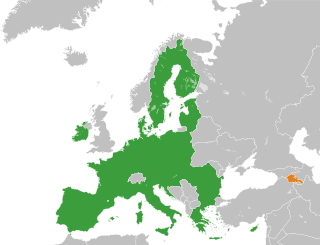
The Armenia–EU Comprehensive and Enhanced Partnership Agreement or CEPA is a partnership agreement between the European Union and Armenia. The agreement advances the bilateral relations between the European Union and Armenia to a new, partnership level and regulates cooperation in political and economic sectors, while enhancing trade relations. The agreement develops these areas further, providing a long-term basis for integrating and strengthening EU–Armenia relations. The agreement is also designed to bring Armenian laws and regulations gradually closer to the EU acquis.

The Australia-India Comprehensive Economic Cooperation Agreement (AI-CECA) is a bilateral agreement between Australia and India. The two nations launched negotiations for a Comprehensive Economic Cooperation Agreement in May 2011. On 2 April 2022, an interim agreement was signed by Ministers Dan Tehan, representing the Morrison government of Australia and Piyush Goyal, representing the Modi Government of India.
India is party to free trade agreements (FTAs) and other trade agreements with many countries and trade blocs, and is negotiating with many others. As of 2022, India has preferential access, economic cooperation and FTA with more than 50 individual countries.

The EU–Armenia Partnership and Cooperation Agreement (PCA) was a Partnership and Cooperation Agreement between the European Coal and Steel Community and Armenia. It was signed in Luxembourg and entered into force on 1 July 1999. The agreement served as the legal framework for EU–Armenia bilateral relations for 21 years, until its termination on 28 February 2021. The PCA was replaced by the Armenia–EU Comprehensive and Enhanced Partnership Agreement (CEPA), a more comprehensive and complex agreement, which entered into force on 1 March 2021.
