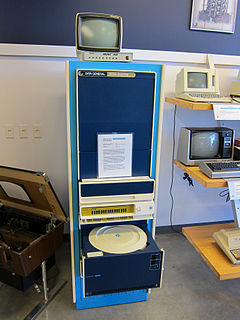
The Data General Nova is a series of 16-bit minicomputers released by the American company Data General. The first model of Nova, called simply the "Nova", was released in 1969. The Nova was packaged into a single rack mount case and had enough power to do most simple computing tasks. The Nova became popular in science laboratories around the world. It was succeeded by the Data General Eclipse, which was similar in most ways but added virtual memory support and other features required by modern operating systems.
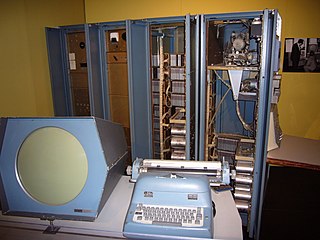
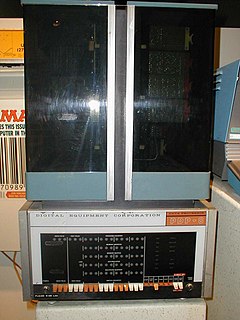
Programmed Data Processor (PDP), referred to by some customers, media and authors as "Programmable Data Processor, is a term used by the Digital Equipment Corporation from 1957 to 1990 for several lines of minicomputers. The name "PDP" intentionally avoids the use of the term "computer" because, at the time of the first PDPs, computers had a reputation of being large, complicated, and expensive machines, and the venture capitalists behind Digital would not support Digital's attempting to build a "computer"; the word "minicomputer" had not yet been coined. So instead, Digital used their existing line of logic modules to build a Programmed Data Processor and aimed it at a market that could not afford the larger computers.

A microcomputer is a small, relatively inexpensive computer with a microprocessor as its central processing unit (CPU). It includes a microprocessor, memory, and minimal input/output (I/O) circuitry mounted on a single printed circuit board(PCB). Microcomputers became popular in the 1970s and 1980s with the advent of increasingly powerful microprocessors. The predecessors to these computers, mainframes and minicomputers, were comparatively much larger and more expensive. Many microcomputers are also personal computers.

The NCR Corporation, previously known as National Cash Register, and for a brief period known as AT&T Global Information Solutions, is an American technology company that makes self-service kiosks, point-of-sale terminals, automated teller machines, check processing systems, barcode scanners, and business consumables. They also provide IT maintenance support services. NCR had been based in Dayton, Ohio, starting in 1884, but in June 2009 the company sold most of the Dayton properties and moved its headquarters to the Atlanta metropolitan area in unincorporated Gwinnett County, Georgia, near Duluth. In early January 2018, the new NCR Global Headquarters opened in Midtown Atlanta near Technology Square.
A music sequencer is a device or application software that can record, edit, or play back music, by handling note and performance information in several forms, typically CV/Gate, MIDI, or Open Sound Control (OSC), and possibly audio and automation data for DAWs and plug-ins.
Data General was one of the first minicomputer firms from the late 1960s. Three of the four founders were former employees of Digital Equipment Corporation. Their first product, the Data General Nova, was a 16-bit minicomputer. This used their own operating system, Data General RDOS (DG/RDOS), and in conjunction with programming languages like "Data General Business Basic" they provided a multi-user operating system with record locking and built-in databases far ahead of many contemporary systems. The Nova was followed by the Supernova and Eclipse product lines, all of which were used in many applications for the next two decades. The company employed an original equipment manufacturer (OEM) sales strategy to sell to third parties who incorporated Data General computers into the OEM's specific product lines. A series of missteps in the 1980s, including missing the advance of microcomputers despite the launch of the microNOVA in 1977, and the Data General-One portable computer in 1984, led to a decline in the company's market share. The company did continue into the 1990s, however, and was eventually acquired by EMC Corporation in 1999.
The history of computing hardware starting at 1960 is marked by the conversion from vacuum tube to solid-state devices such as the transistor and later the integrated circuit. By 1959 discrete transistors were considered sufficiently reliable and economical that they made further vacuum tube computers uncompetitive. Computer main memory slowly moved away from magnetic core memory devices to solid-state static and dynamic semiconductor memory, which greatly reduced the cost, size and power consumption of computers.

Donald Bruce Gillies was a Canadian computer scientist and mathematician who worked in the fields of computer design, game theory, and minicomputer programming environments.
The BUNCH was the nickname for the group of mainframe computer competitors to IBM in the 1970s. The name is derived from the names of the five companies: Burroughs, UNIVAC, NCR, Control Data Corporation (CDC), and Honeywell. These companies were grouped together because the market share of IBM was much higher than all of its competitors put together.

Simson L. Garfinkel is the US Census Bureau's Senior Computer Scientist for Confidentiality and Data Access. Previously, he was a computer scientist at the National Institute of Standards and Technology (2015-2017) and, prior to that, an associate professor at the Naval Postgraduate School in Monterey, California (2006-2015). In addition to his research, Garfinkel is a journalist, an entrepreneur, and an inventor; his work is generally concerned with computer security, privacy, and information technology.
A computer is a machine that can be instructed to carry out sequences of arithmetic or logical operations automatically via computer programming. Modern computers have the ability to follow generalized sets of operations, called programs. These programs enable computers to perform an extremely wide range of tasks. A "complete" computer including the hardware, the operating system, and peripheral equipment required and used for "full" operation can be referred to as a computer system. This term may as well be used for a group of computers that are connected and work together, in particular a computer network or computer cluster.

The Honeywell 316 was a popular 16-bit minicomputer built by Honeywell starting in 1969. It is part of the Series 16, which includes the Models 116, 316 (1969), 416 (1966), 516 (1966) and DDP-716 (1969). They were commonly used for data acquisition and control, remote message concentration, clinical laboratory systems, Remote Job Entry and time-sharing. The Series-16 computers are all based on the DDP-116 designed by Gardner Hendrie at Computer Control Company, Inc. (3C) in 1964.

The 74181 is a 4-bit slice arithmetic logic unit (ALU), implemented as a 7400 series TTL integrated circuit. The first complete ALU on a single chip, it was used as the arithmetic/logic core in the CPUs of many historically significant minicomputers and other devices.

The MADDIDA was a special-purpose digital computer used for solving systems of ordinary differential equations. It was the first computer to represent bits using voltage levels and whose entire logic was specified in Boolean algebra. Invented by Floyd Steele, MADIDDA was developed at Northrop Aircraft Corporation between 1946 and 1949 to be used as a guidance system for the Snark missile. No guidance system, however, resulted from the work on the MADDIDA, and rather it was used for aeronautical research. In 1952, the MADDIDA became the world's top-selling commercial digital computer, six units having been sold.
Computer Control Company, Inc. (1953–1966), informally known as 3C, was a pioneering minicomputer company known for its DDP-series computers, notably:
The history of video games spans a period of time between the invention of the first electronic games and today, covering a long period of invention and changes. Video gaming reached mainstream popularity in the 1970s and 1980s, when arcade video games, gaming consoles and home computer games were introduced to the general public. Since then, video gaming has become a popular form of entertainment and a part of modern culture in most parts of the world. The early history of video games, therefore, covers the period of time between the first interactive electronic game with an electronic display in 1947, the first true video games in the early 1950s, and the rise of early arcade video games in the 1970s. During this time there was a wide range of devices and inventions corresponding with large advances in computing technology, and the actual first video game is dependent on the definition of "video game" used.
Mainframe computers are computers used primarily by businesses and academic institutions for large-scale processes. Before personal computers, first termed microcomputers, became widely available to the general public in the 1970s, the computing industry was composed of mainframe computers and the relatively smaller and cheaper minicomputer variant. During the mid to late 1960s, many early video games were programmed on these computers. Developed prior to the rise of the commercial video game industry in the early 1970s, these early mainframe games were generally written by students or employees at large corporations in a machine or assembly language that could only be understood by the specific machine or computer type they were developed on. While many of these games were lost as older computers were discontinued, some of them were ported to high-level computer languages like BASIC, had expanded versions later released for personal computers, or were recreated for bulletin board systems years later, thus influencing future games and developers.

The Model V was among the early electromechanical general purpose computers, designed by George Stibitz and built by Bell Telephone Laboratories, operational in 1946.