Related Research Articles
Cormac mac Airt, also known as Cormac ua Cuinn or Cormac Ulfada, was, according to medieval Irish legend and historical tradition, a High King of Ireland. He is probably the most famous of the ancient High Kings, and may have been an authentic historical figure, although many legends have attached themselves to him, and his reign is variously dated as early as the 2nd century and as late as the 4th. He is said to have ruled from Tara, the seat of the High Kings of Ireland, for forty years, and under his rule Tara flourished, he is credited for building many of the monuments at the Hill of Tara such as the Banqueting Hall, Cormac's house and Grainne's Enclosure, named after his daughter, Gráinne. He was famous for his wise, true, and generous judgments. In the Annals of Clonmacnoise, translated in 1627, he is described as:
"absolutely the best king that ever reigned in Ireland before himself...wise learned, valiant and mild, not given causelessly to be bloody as many of his ancestors were, he reigned majestically and magnificently".

Rosscarbery is a town in County Cork, Ireland. The town is on a shallow estuary, which opens onto Rosscarbery Bay. Rosscarbery is in the Cork South-West constituency, which has three seats.
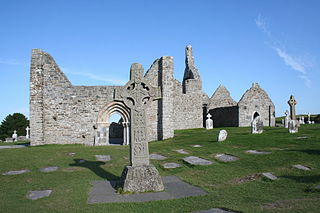
Clonmacnoise is a ruined monastery situated in County Offaly in Ireland on the River Shannon south of Athlone, founded in 544 by Saint Ciarán, a young man from Rathcroghan, County Roscommon. Until the 9th century it had close associations with the kings of Connacht. Saint Ciarán chose to found the monastery in the ancient territory of Ui Maine at a point where the major East-West land route meets the River Shannon after crossing the bogs of Central Ireland known as the Esker Riada. The strategic location of the monastery helped it become a major centre of religion, learning, craftsmanship, and trade by the 9th century; and together with Clonard it was the most famous places in Ireland, visited by scholars from all over Europe. From the ninth until the eleventh century it was allied with the kings of Meath. Many of the high kings of Tara (ardrí) and of Connacht were buried here.
Cairbre Lifechair, son of Cormac mac Airt, was, according to medieval Irish legend and historical tradition, a High King of Ireland. He came to the throne after the death of Eochaid Gonnat. During his time Bresal Belach was king of Leinster, and refused to pay the bórama or cow-tribute to the High King, but Cairbre defeated him in the Battle of Dubchomar, and from then on exacted the bórama without a battle.

Saint Ciarán of Clonmacnoise, supposedly born Ciarán mac an tSaeir, was one of the Twelve Apostles of Ireland and the first abbot of Clonmacnoise. He is sometimes called Ciarán the Younger to distinguish him from the 5th-century Saint Ciarán the Elder who was bishop of Osraige. His name produced many variant spellings, including Ceran, Kieran, Queran and Queranus.
Fedelmid mac Crimthainn was the King of Munster between 820 and 846. He was numbered as a member of the Céli Dé, an abbot of Cork Abbey and Clonfert Abbey, and possibly a bishop. After his death, he was later considered a saint in some martyrologies.
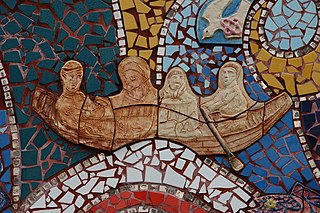
Saint Comgall, an early Irish saint, was the founder and abbot of the great Irish monastery at Bangor in Ireland.

The Bishop of Ardagh was a separate episcopal title which took its name after the village of Ardagh, County Longford in the Republic of Ireland. It was used by the Roman Catholic Church until 1756, and intermittently by the Church of Ireland until 1839.
Máel Muiremac Céilechair was an Irish cleric of the monastery of Clonmacnoise, County Offaly, and one of the principal scribes of the manuscript Lebor na hUidre.
Muirgius mac Tommaltaig was a King of Connacht from the Uí Briúin branch of the Connachta. He was the great-grandson of Indrechtach mac Muiredaig Muillethan, a previous king. The death of his father Tommaltach mac Murgail is recorded in the annals where he is called king of Mag nAi. Muirgius was of the Síl Muiredaig sept of the Uí Briúin. He reigned from 792 to 815.
Events from the 6th century in Ireland.
Brenainn mac Cairbre, 12th King of Uí Maine, died 597 or 601.
Raoiriú was an early Irish missionary, c. 500 AD.
The Abbot of Clonard was the monastic head of Clonard Abbey, which is in modern-day County Meath, Ireland. The abbey was founded by Saint Finnian in the early sixth century. After the death of Saint Finnian, the abbots bore the title "Comarbai Finnéin". However, the title was ambiguous, since it may refer to the abbots of Moville, County Down, founded by Finnian nepos Fiatach. The abbots of Clonard were sometimes called 'coarbs of Finnian and Mo Cholmóc'. Until the early twelfth century, a few of the abbots and some others at Clonard Abbey were consecrated bishops, but this did not necessarily mean they were bishops of Clonard, since the diocese of Clonard was not established until the Synod of Rathbreasail in 1111.

The Abbot of Glendalough was the head of the monastery at Glendalough, founded by Saint Kevin in the early sixth century, which is in modern-day County Wicklow, Ireland. After the death of Saint Kevin, the abbots bore the title "Comarbai Cóemgein". Until the early twelfth century, a number of abbots and others at the monastery of Glendalough had also been consecrated bishops, but this did not necessarily mean they were bishops of Glendalough, since the Diocese of Glendalough was not established until the Synod of Rathbreasail in 1111.
Cairbre Crom, 11th King of Uí Maine, fl. c. 556.
Inreachtach mac Dluthach, 21st King of Uí Maine, died 750.
Cuindles, 17th Abbot of Clonmacnoise, died 724.
Rechtnia, 27th Abbot of Clonmacnoise, died 784.
Cormac, Bishop of Armagh and Abbot of Armagh monastery, Ireland from 481 to 17 February 497.
References
- The Abbatial Succession at Clonmacnois, pp. 502–03, John Ryan, in Feil Sgribhinn Eoin Mhic Neill, Dublin, 1938.