
HM Customs and Excise was a department of the British Government formed in 1909 by the merger of HM Customs and HM Excise; its primary responsibility was the collection of customs duties, excise duties, and other indirect taxes.

The Inland Revenue was, until April 2005, a department of the British Government responsible for the collection of direct taxation, including income tax, national insurance contributions, capital gains tax, inheritance tax, corporation tax, petroleum revenue tax and stamp duty. More recently, the Inland Revenue also administered the Tax Credits schemes, whereby monies, such as Working Tax Credit (WTC) and Child Tax Credit (CTC), are paid by the Government into a recipient's bank account or as part of their wages. The Inland Revenue was also responsible for the payment of child benefit.

His Majesty's Revenue and Customs is a non-ministerial department of the UK Government responsible for the collection of taxes, the payment of some forms of state support, the administration of other regulatory regimes including the national minimum wage and the issuance of national insurance numbers. HMRC was formed by the merger of the Inland Revenue and HM Customs and Excise, which took effect on 18 April 2005. The department's logo is the Tudor Crown enclosed within a circle.

A customs officer is a law enforcement agent who enforces customs laws, on behalf of a government.
Vehicle Excise Duty is an annual tax levied as an excise duty, and which must be paid for most types of powered vehicles which are to be used or parked on public roads in the United Kingdom. Registered vehicles that are not being used or parked on public roads and which have been taxed since 31 January 1998 must be covered by a Statutory Off Road Notification (SORN) to avoid VED. In 2016, VED generated approximately £6 billion for the Exchequer.
The Revenue and Customs Prosecution Office (RCPO) was a non-departmental public body created under the Commissioners for Revenue and Customs Act 2005 as an independent prosecution body to take responsibility in the England, Wales and Northern Ireland for the prosecution of criminal offences in cases previously within the purview of the Inland Revenue and HM Customs and Excise (HMCE). In Scotland it was a Specialist Reporting Agency and the cases are then prosecuted by the Crown Office and Procurator Fiscal Service. It was merged with the Crown Prosecution Service on 1 January 2010.

The Commissioners for Revenue and Customs Act 2005 is an Act of the Parliament of the United Kingdom which combined the Inland Revenue and HM Customs and Excise into a single government department, HM Revenue and Customs. The Act also established the Revenue and Customs Prosecutions Office, and provided for inspections of HMRC by HM Inspectors of Constabulary to ensure that it complies with the law.

The Waterguard was a division of HM Customs and Excise (HMCE) responsible for the control of vessels, aircraft, vehicles and persons arriving into and departing from the United Kingdom. This included crew members and passengers, as well as persons travelling on foot. Waterguard officers were responsible for applying the allowances provided for in law and for collection of customs and excise revenue on the excess. The officers were also responsible for the enforcement of the prohibitions and restrictions, including controlled drugs and plant and animal health. With the reorganization of HM Customs and Excise in 1972 the Waterguard was renamed the 'Preventive Service' and the functions of the Waterguard continued to be carried out as part of the HMCE until the establishment of the UK Border Agency in 2008.

HM Customs was the national Customs service of England until a merger with the Department of Excise in 1909. The phrase 'HM Customs', in use since the Middle Ages, referred both to the customs dues themselves and to the office of state established for their collection, assessment and administration.
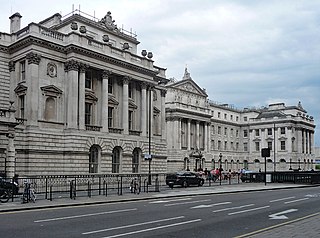
His or Her Majesty's Excise refers to 'inland' duties levied on articles at the time of their manufacture. Excise duty was first raised in England in 1643. Like HM Customs, the Excise was administered by a Board of Commissioners who were accountable to the Lords Commissioners of the Treasury. While 'HM Revenue of Excise' was a phrase used in early legislation to refer to this form of duty, the body tasked with its collection and general administration was usually known as the Excise Office.

An excise, or excise tax, is any duty on manufactured goods that is normally levied at the moment of manufacture for internal consumption rather than at sale. It is therefore a fee that must be paid in order to consume certain products. Excises are often associated with customs duties, which are levied on pre-existing goods when they cross a designated border in a specific direction; customs are levied on goods that become taxable items at the border, while excise is levied on goods that came into existence inland.
The Minister of Inland Revenue is the political office of Minister for the department of Inland Revenue which is responsible for the collection of taxes. "Minister of Inland Revenue" is a title held by politicians in different countries. As of 2017 the office remains in use in New Zealand, held by Stuart Nash; no historical information about the New Zealand office is provided on the government web site.
The biofuel sector in the United Kingdom, under the auspices of the government's Renewable Transport Fuel Obligation (RTFO), has been progressing towards enhanced sustainable energy solutions. Marking a significant stride in this direction was the government's endorsement and introduction of E10 biofuel in late 2021. This fuel blend, consisting of 90% regular unleaded gasoline and 10% ethanol, was introduced as part of an initiative to reduce greenhouse gas emissions (GHG) from transport fuels. The introduction of E10 led to a shift in the renewable fuel landscape in the UK, particularly influencing an increase in the utilization of non-waste feedstocks. In the year 2022, the biofuel sector, as per government reports, achieved a reduction in GHG emissions by 82% in comparison to traditional fossil fuels.
The Singapore Customs is a government agency under the Ministry of Finance of the Government of Singapore. Singapore Customs was reconstituted on 1 April 2003, after the Customs and Excise Department and the Trade Facilitation Division and Statistics Audit Unit of International Enterprise Singapore were merged. The border function's at the land, air and sea checkpoints were also simultaneously transferred to Immigration and Checkpoints Authority (ICA). Singapore Customs became the lead agency on trade facilitation and revenue enforcement matters. It is also responsible for the implementation of customs and trade enforcement measures including those related to Free Trade Agreements and strategic goods.

The Royal Malaysian Customs Department ; is a government department body under the Ministry of Finance. RMCD functions as the country's main indirect tax collector, facilitating trade and enforcing laws.
A number of vessels of the British revenue services, at times known as the Inland Revenue, HM Customs and Excise, HM Revenue and Customs, and most recently UK Border Agency, have been named Vigilant:[a]

HMC Vigilant is a Border Agency (customs) cutter of the United Kingdom. She was launched by Damen Shipyards in the Netherlands in 2003 and is one of four 42-metre (138 ft) cutters operated by the UK Border Force.

HMC Seeker is a Border Force (customs) cutter of the United Kingdom. She was launched by Damen Shipyards in the Netherlands in 2001 and is one of four 42-metre (138 ft) cutters formerly operated by HM Revenue and Customs, then from 2008 she was operated by the UK Border Agency and after its dissolution in 2013 operated by the Border Force.
The H.M. Customs and Excise Collection is a collection of British revenue stamps in proof or registration form for Table Water Duty, Medicine Tax, Playing Card Tax and other duties. It forms part of the British Library Philatelic Collections and was transferred to the Library by H.M. Customs & Excise in 2002.
